






 Portuguese
  Spanish
  5 min of reading
  0 comments


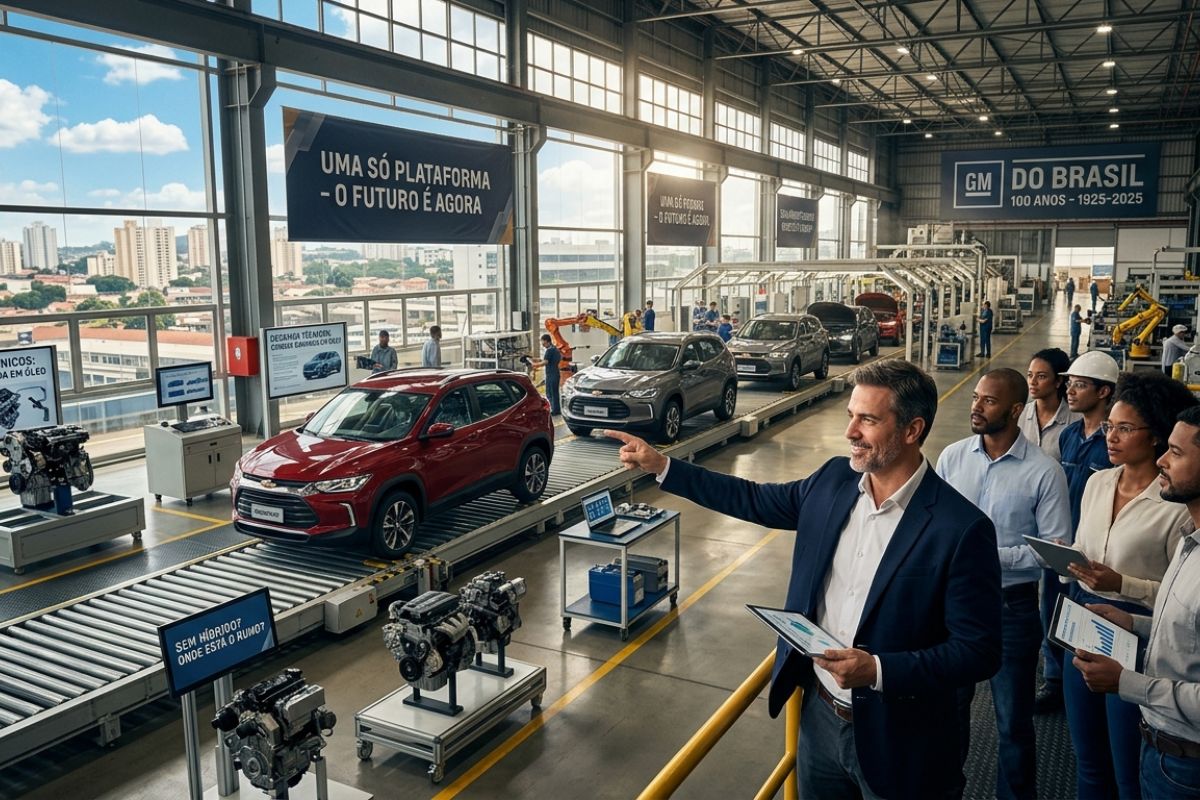
On its 100 years of presence in the country, GM tries to reorganize with new leadership, insists on the base of Onix, Tracker, and Montana, bets on the SUV Sonic, and still has not defined a clear path in electrification.
GM has completed 100 years in Brazil and, alongside the celebration, an uncomfortable picture emerges: a historic brand, with established factories and networks, but that gives the impression of lacking a clear direction. The change of president, with the departure of Santiago Tamoro and the arrival of Ziansk, reinforces that the mission now is to keep GM steady in a rapidly changing scenario.
The problem is that GM is experiencing a moment where old decisions come at a cost and new decisions have yet to arrive. The dependence on a single platform, the wear around the oil-soaked belt, and the lack of a hybrid in the Chevrolet lineup leave the company squeezed between declining combustion and electric that has not yet become the norm for everyone.
100 years in Brazil and the change in leadership
The centenary of GM in Brazil carries symbolic and industrial weight. At the same time, the change in local presidency exposes that the operation needs adjustments.
-
Two new 300cc models from QJ Motor are expected to arrive in Brazil as SBM to target the CB 300F and shake up the low-displacement market, with more power and liquid cooling than Honda.

-
Camaro may reappear in 2027, but not as you remember: Chevrolet prepares the return of the icon with four doors, manual transmission, and an extreme performance version to face the new era of sports cars.

-
Is the BYD Song Pro worth it? The Anderson Sincero channel says it doesn’t exceed R$ 140,000, and the price dropped by R$ 47,000, reinforcing the depreciation of the plug-in hybrid in the Fipe table.
-
Caoa Changan CS75 arrives for R$ 199,990 with 4.77 m in length, a trunk of up to 1,620 liters, 8-speed Aisin transmission, 180 hp, 37.2 inches in screens, and Zero Gravity seat with massage.


The mission of the new president is tough because it involves product, strategy and market perception, all at once.
In a country where consumers migrate based on price, usage, and maintenance costs, GM has little room for error. The feeling of a “lost company” often arises when decisions seem reactive rather than part of a consistent plan.
One platform for almost everything and the risk of getting stuck
Today, GM concentrates production and launches on a base that supports Onix, Tracker, and Montana. This brings efficiency but also creates fragility: if the platform is pressured by reputation, cost, or competition, the entire operation feels it.
The challenge is that, to gain momentum, GM needs to increase sales consistency without appearing to just be “repackaging” the same set, especially when the market demands deeper innovations.
The oil-soaked belt and the wear that doesn’t go away
The oil-soaked belt has become a recurring theme, and when a technical issue enters the popular imagination, it weighs beyond engineering.
For GM, the impact is not just mechanical: it is trust and cost of ownership, two points that directly influence the purchase decision.
This type of wear also affects the conversation within dealerships, as consumers arrive with doubts and fears. And when this happens, GM needs clear and consistent answers to prevent the issue from becoming permanent noise.
The SUV Sonic and the attempt to grow without changing the base
GM is launching an SUV called Sonic, described as a car aimed at the Volkswagen Terra. The idea is logical: to enter a market space with high appeal and try to improve volume and ticket.
However, there is a limit to how much GM can extract from the same platform and the same mechanics without giving the impression of repetition.
The bet may help sales, but it does not alone resolve the bigger question: what is the brand’s path in Brazil?
Without hybrid in the lineup and the transition that got stuck in the middle
The text points to a trend: for many people, the hybrid seems the “natural” choice as a transition, while pure electric is still seen as an adventure outside urban use. The problem is that GM, in the Chevrolet lineup, appears without a hybrid in the local portfolio.
There is also the idea attributed to global leadership that GM would go “straight to electric,” and then the perception that a hybrid would be necessary as a bridge.
The practical result, in Brazil, is a gap: combustion on one side, electrics on the other, and the middle of the road empty.
Electrics between the US and China and the puzzle of supply


GM combines different paths to compose the offer of electrics, with models coming from the United States and China.
There is also mention of a production arrangement in Ceará, at the former Troller factory, suggesting an attempt to reorganize the operation and leverage existing structure.
However, industrial strategy does not explain itself alone. For the public, what remains is simple: GM needs to make the portfolio more predictable and coherent, especially when electrification requires long-term planning.
The ghost of Ford and what GM needs to decide now
The comparison with Ford appears as a warning: a large brand, losing money, closing factories, and then living off imports.
GM has factories in different states and a relevant industrial presence, so the discussion is inevitable: what is the plan to avoid repeating this script?
In this context, GM also tries to sustain image and margin with innovations like the Cadillac line, but the text itself suggests that this does not resolve the core of the problem, especially due to scale and pricing positioning.
A compass for the new president
For the new president, the challenge is not just to “hold the operation.” It is to define priorities: platform, technical reputation, product mix, electrification, and clarity of communication. GM needs a compass that the market can see, not just isolated launches.
The centenary then becomes more than a celebration. For GM, it becomes a symbolic deadline to present a direction that makes sense for the Brazilian consumer, for the network, and for the industry itself.
Do you think GM should place a hybrid at the center of its strategy in Brazil or insist on jumping straight to electric?


Be the first to react!