





 Portuguese
  English
  Spanish
  5 min of reading
  0 comments


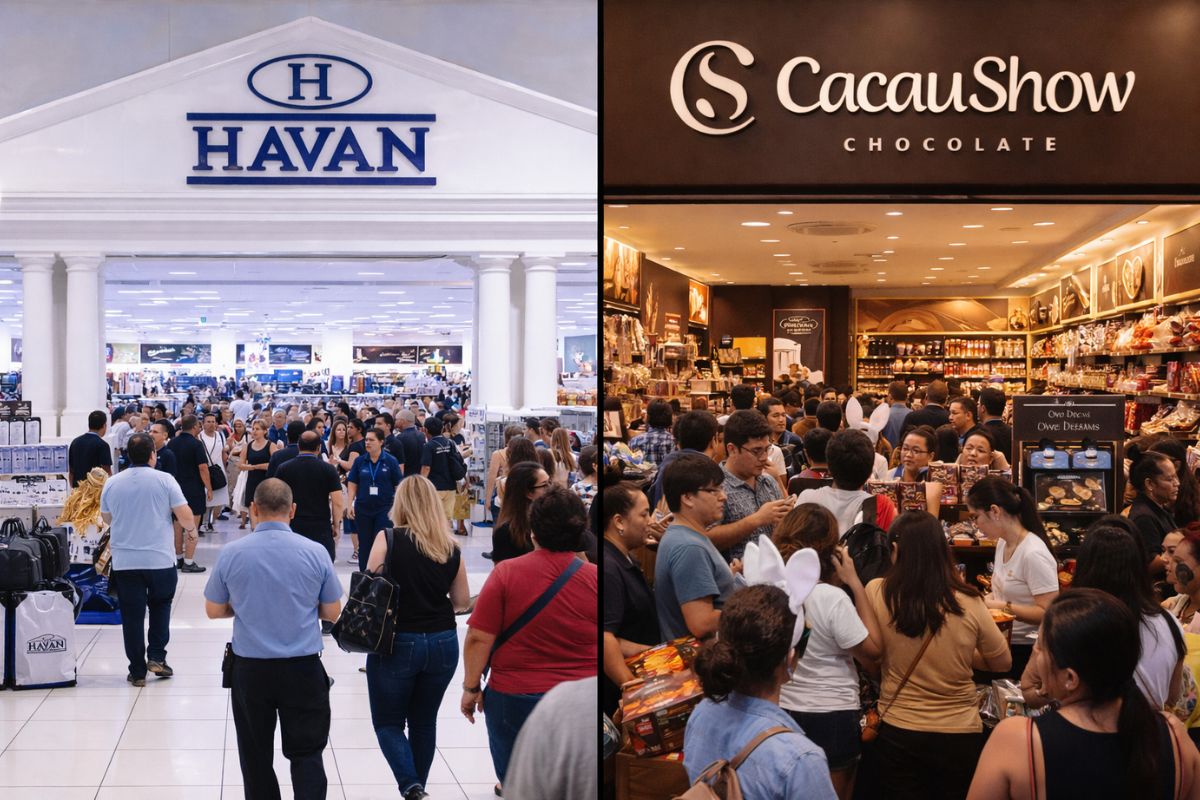
Cacau Show generated R$ 300 million in a single day on Easter 2026, six times more than Havan’s daily R$ 50 million, and totaled R$ 500 million in just two days, with R$ 300 million on Friday and R$ 200 million on Saturday, consolidating a historic record for the brand.
The recent numbers from two of the largest retail companies in Brazil reveal an impressive contrast in scale and business model. Cacau Show generated R$ 300 million in a single day, on the Friday before Easter 2026, consolidating a historic record for the company. To gauge what this number means, just compare it with Havan, which records daily revenue of about R$ 50 million throughout the year. In 24 hours, Cacau Show moved six times more than one of the largest retail chains in the country generates in a day.
The pace did not stop on Friday. On the following Saturday, Cacau Show added another R$ 200 million in sales, totaling approximately R$ 500 million in just two days of operation. Half a billion reais in 48 hours is a volume that few Brazilian companies can generate in an entire month. The comparison with Havan is not to diminish either one, but to illustrate how two completely different business models can produce results equally impressive in distinct contexts.
What explains Cacau Show’s record revenue on Easter 2026
Easter accounts for approximately 23% of Cacau Show’s annual revenue, which means the company concentrates almost a quarter of its entire income in just a few weeks of the calendar.
-
Weak dollar or strong real? The American currency plummets for the third day, approaching R$ 5 and surprising the market with global inflation and tensions in the Middle East that continue to create global uncertainty.

-
China’s investments in Brazil in factories, energy, oil, electric cars, and new industrial projects double to $4.2 billion, making the country the 3rd largest global destination for Chinese capital.

-
Lula announced that 160,000 students in debt with FIES will be included in the federal government’s renegotiation package and compared the cost of an inmate to that of a student by saying that Brazil invests in criminals when it does not invest in education.

-
Young people are leaving college in the United States and competing for jobs in construction with salaries of R$ 500,000 per year.

The performance of R$ 300 million in a single day reflects a recurring pattern in Brazilian consumption: the concentration of purchases in the final stretch of holiday dates. Even with higher prices and economic uncertainties, consumers tend to postpone their purchasing decisions until the last moment.
This behavior generates significant pressure on Cacau Show’s logistics and inventory, as any failure in the distribution chain in the days leading up to Easter results in direct revenue losses.
The company needs to scale production, transportation, and store staff to absorb a sales volume that in two days equals what many chains do in weeks. For Cacau Show, Easter is not just a holiday. It is the event that determines whether the fiscal year will be exceptional or just good.
The productive scale that placed Cacau Show at the top of the Easter market
Industry data reveals a dominance that goes beyond sales. According to industry information, more than half of the Easter eggs produced in Brazil in 2026 came from Cacau Show’s factories, reinforcing a market presence that no competitor can match in volume.
The brand does not compete only with other chocolatiers. It competes with supermarkets, bakeries, and convenience stores that also sell Easter eggs.
External factors also contributed to Cacau Show’s performance this Easter. The rise in cocoa prices, which increased the import costs of raw materials by up to 37%, proportionally made products from brands that rely on imported inputs more expensive.
National companies with integrated supply chains, like Cacau Show, managed to absorb part of this increase without fully passing it on to consumers, strengthening their competitiveness against foreign brands operating in Brazil.
How Havan maintains R$ 50 million per day and R$ 18 billion per year
On the other side of the comparison, Havan operates a completely different model. The department store chain maintains an estimated monthly revenue of R$ 1.5 billion and an annual revenue of about R$ 18 billion, with projections to reach R$ 20 billion in the next cycle.
Unlike Cacau Show, which depends on seasonal peaks, Havan distributes its sales throughout the year in a portfolio that ranges from appliances to clothing and decor.
The regularity of Havan’s revenue is what makes the comparison with Cacau Show so revealing. R$ 50 million per day, every day, requires a logistics, commercial, and marketing operation that functions with relentless consistency.
Havan does not have an Easter that concentrates 23% of its revenue. It has 365 days that need to yield evenly to sustain a billion-dollar annual revenue. These are opposing models that demonstrate equally valid paths to success in retail.
What the comparison between Cacau Show and Havan reveals about Brazilian retail
The difference between the two models exposes a striking characteristic of consumption in Brazil. Brazilian retail is driven by holiday dates that concentrate enormous volumes of purchases in short windows, and companies that dominate these periods achieve results that seem disproportionate to their usual size.
Cacau Show is a chocolate company that for two days of the year generates revenue like one of the largest retailers in the country.
Havan, on the other hand, demonstrates that it is possible to build billion-dollar revenue without relying on extreme seasonality. The continuous expansion of stores, diversification of categories, and presence in dozens of cities create a stable revenue base that does not fluctuate with the calendar.
For Brazilian retail as a whole, both cases show that there is no single formula for success: both concentrated explosions and distributed consistency can generate impressive numbers.
What the R$ 500 million from Cacau Show in two days means for the company
Half a billion reais in 48 hours is not just a headline number. For Cacau Show, these two days represent the result of months of planning for production, distribution, and temporary hiring that begins long before Easter arrives in the displays.
The company needs to manufacture millions of eggs, distribute them to its more than four thousand stores and kiosks across Brazil, and ensure that the stock is complete exactly on the days when consumers decide to buy.
The record of R$ 300 million in a single day positions Cacau Show at a daily revenue level that surpasses many companies listed on the stock exchange.
The question that remains for the next cycle is whether the brand will be able to maintain this pace in 2027, considering that cocoa prices remain pressured and that Brazilian consumers are sensitive to price increases. What is already certain is that Easter 2026 went down in history for the company as the best result in a single day of operation.
What impresses you more: Cacau Show generating R$ 300 million in a day or Havan maintaining R$ 50 million per day all year round? Which business model do you think is more sustainable in the long run? Share in the comments. Comparisons like this reveal how Brazilian retail operates in ways that most people never imagine.










Seja o primeiro a reagir!