





 Portuguese
  English
  Spanish
  4 min of reading
  0 comments


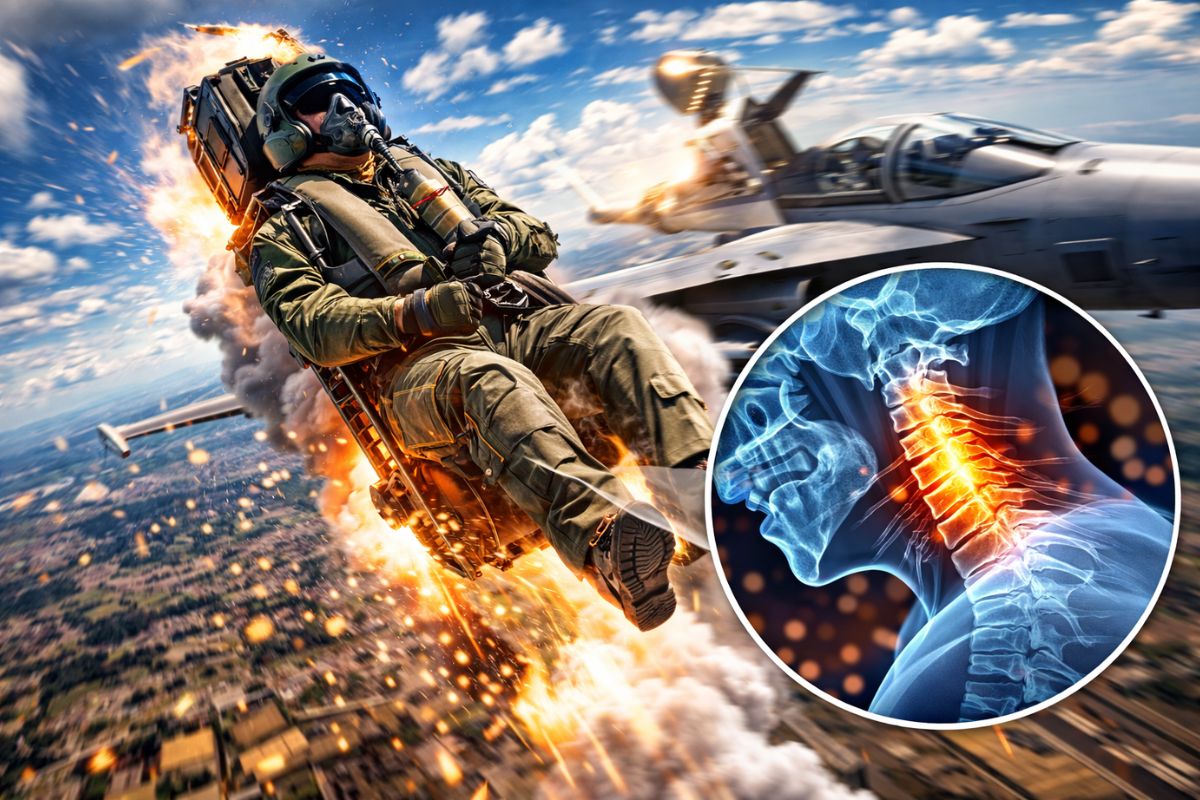
Medical leave is not punishment, it is protocol, because ejection compresses the spine, reduces G-force tolerance, and creates an unacceptable risk to fly combat again
Many people think that when a fighter pilot ejects, he is “punished” and therefore disappears from the cockpit. However, medical leave almost always has another origin: the body changes after ejection, even when the pilot saves his own life.
What seems like a quick jump is actually an extreme biomechanical event. Ejection is a last resort, and the decision to keep the pilot out of the fighter comes from a simple point: combat flight requires extremely rare physical tolerance, and any significant injury can lead to blackout, sudden pain, or limited movement under G-force.
Ejection is not failure and medical leave is not punishment

In military aviation, ejecting is not a sign of incompetence. It is the final action when the aircraft loses control, suffers structural failure, or there is an imminent risk of collision. The goal is clear: save a life trained for years.
-
The end of electrical waste? Meet the new AI that uses 100 times less energy, learns in minutes, and is still much more accurate than famous models.

-
How a “sweater” for buildings can cut energy bills by up to 23%: removable fabric panels capture solar heat, insulate facades, and promise to heat homes without construction or complicated installation.

-
A student from the Bahia semi-arid region discovers that the skin of the pine cone has cleaning power and creates a biodegradable detergent that can transform the waste from the largest producer of the fruit in Brazil into a sustainable product and generate income for the community.

-
An extratropical cyclone more intense than usual forms this Tuesday and is expected to hit the South of Brazil with winds of up to 125 km/h, rainfall of 100 mm, and a real risk of hail and destruction between Tuesday and Wednesday.

Therefore, medical leave is not seen as punishment for “losing an aircraft.” It is necessary because, after an ejection, the pilot may carry injuries that do not align with the reality of the fighter. The rule is pragmatic: if there is a real risk, the pilot does not return to the most demanding mission.
What happens to the body when the seat fires
The ejection system is a masterpiece of engineering, but brutal for the human body. In fractions of a second, the canopy is removed, and the seat is launched out.
The text describes a fact that helps understand the violence of the event: the pilot goes from zero to over 600 km/h vertically in less than 1 second.
In this interval, the body has no “adaptation time.” The spine receives extreme compression, the neck is pulled back, and discs and vertebrae suffer too much load. That is why medical leave appears as a logical consequence, not as an emotional decision.
Why the spine becomes the breaking point
The fighter requires the pilot to withstand severe G-forces in real maneuvers. The text explains that the body can feel 7, 8, even 9 times normal weight, with blood trying to “abandon” the brain and vision darkening.
After ejection, any injury to the spine changes the game. A compression or herniation can worsen under G-force, causing limited movement, sharp pain, and even loss of consciousness.
In combat, this is not a detail: it is operational risk. That is why medical leave tends to be the standard path when there is relevant clinical doubt.
Recorded injuries and the time problem

Among the injuries cited as frequent are compression fractures, herniated discs, cervical injuries, and vertebral damage.
The most dangerous point is that some do not hurt immediately. They may appear months or years later, just when the pilot is exposed again to high load.
This is where the logic that the text makes clear comes in: military aviation does not operate on guesswork. It operates with minimal risk tolerance.
If there is a chance of blackout, limitation, or sudden pain, medical leave appears to prevent the next mission from ending in tragedy.
Cited real example: the F5M of the FAB on October 22, 2024
The text mentions a concrete case to illustrate the difference between surviving and being fit to return to the fighter. On October 22, 2024, an F5M of the Brazilian Air Force crashed during a training flight near the Parnamirim airbase in the metropolitan area of Natal, Rio Grande do Norte.
The military managed to eject and was rescued by the rescue team, being taken to the hospital with a shoulder dislocation.
The report also mentions indications of a technical problem with the engine, with mention of fire before the crash, and that the aircraft fell in a wooded area, avoiding residential regions.
The case helps to see the central point: ejection saves lives, but can initiate a cycle of medical leave due to injury and future risk.
Why few return and what happens to the career

Returning to the fighter is described as extremely rare. Some manage to return, but they are exceptions. The standard is that the pilot remains valued and useful in other roles: instructor, planning, tactical analysis, or less physically demanding aircraft.
In other words, medical leave does not mean “end” of service, it means a change in profile. The pilot does not lose merit for surviving. He may lose the specific physical condition that the fighter requires.
The myth that short videos spread
The text points out that short videos oversimplify reality and turn medical protocol into punishment. This reading seems “sensational,” but ignores the basics: the human body has limits, and ejection pushes those limits to the extreme.
In the end, medical leave is the way to responsibly acknowledge these limits. No one should be judged for choosing to live when there is no other way out.
Did you think that medical leave was punishment, or did you already imagine that the main reason was physical and related to G-forces?








Seja o primeiro a reagir!