





 English
  Francês
  Alemão
  Italiano
  Japonês
  Norueguês
  Portuguese
  Spanish
  5 min of reading
  0 comments



Silkeborg City, Denmark, houses the largest solar heating plant in the world with 12,436 panels and covers 20% of local thermal demand
In February 2016, the municipal energy company of Silkeborg, Denmark, signed a contract with the manufacturer Arcon-Sunmark to build an urban-scale solar heating plant. Seven months later, the installation was completed. In December of that year, the city of 50,000 inhabitants began operating the largest solar heating plant in the world, based on thermal solar collectors connected to an urban heating network. The field of collectors occupies 156,694 square meters of agricultural land on the edge of the city and includes 12,436 flat solar panels, each with 12.6 square meters. The installation has a capacity of 110 thermal megawatts and delivers about 80,000 megawatt-hours per year to Silkeborg’s urban heating network, covering approximately 20% of the annual heat demand of 22,000 customers.
Urban solar heating in Denmark grows even with low solar irradiation
Denmark is located between 55° and 57° north latitude, a region characterized by low annual solar incidence, long winters, and short days for much of the year. Even so, the country has established itself as a global leader in district solar heating.
At the time of the inauguration of the Silkeborg plant, the country already had more than 100 large-scale installations connected to urban heating networks. This model became viable due to a combination of structural factors, including high taxation on fossil fuels and a highly developed thermal distribution network.
-
A study reveals the expansion of renewable energy procurement in Brazil and shows how companies are taking advantage of opportunities to reduce expenses, ensure energy efficiency, and strengthen strategic environmental commitments.

-
Mato Grosso do Sul excels in the sugar-energy sector: the state reaches a milestone of 22 operating mills and accelerates the production of clean energy in MS with a focus on sustainability.

-
National energy dilemma: Brazilians support clean energy but reject increases in tariff costs to finance the sustainable transition.

-
Research indicates that Brazilians support clean energy and wish to advance in the energy transition, but reject paying more on their electricity bill, showing a direct conflict between cost and sustainability.


Currently, about 65% of the Danish population receives heat through centralized urban heating systems, allowing large thermal solar plants to operate on a scale without the need for individual solutions in each residence.
How a large-scale solar heating plant connected to the urban network works
The system used in Silkeborg is based on flat solar collectors, a technology considered simple yet highly efficient on a large scale. Unlike concentrated solar plants, there are no mirrors or high temperatures.
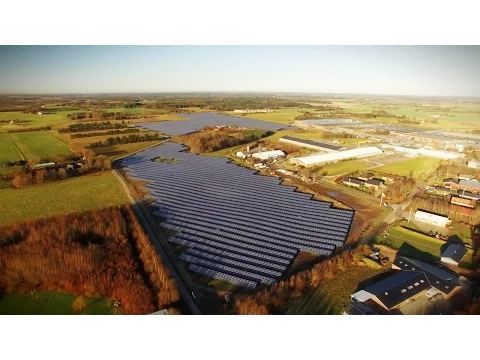

Each panel heats a thermal fluid that circulates through insulated pipes to a heat exchange center. At this point, the thermal energy is transferred to the water of the urban network, which is distributed through kilometers of underground pipes to homes and buildings.
The system operates in conjunction with a natural gas cogeneration plant, which complements production during periods of low solar radiation. Silkeborg utilizes short-term thermal storage, with daily accumulation tanks integrated into the network.
World record in solar heating was achieved with accelerated growth between 2013 and 2016
The advancement of solar heating in Denmark occurred at an accelerated pace throughout the 2010s. The size of the plants nearly doubled year after year during this period.
Previous projects like Marstal and Vojens established progressive records until Silkeborg surpassed all limits with its 156,694 square meters of collectors. This growth solidified the country as a global reference in the sector.
One of the most relevant aspects of the Silkeborg project was the speed of execution. The plant was built and integrated into the network in just seven months.
This performance was made possible thanks to the industrial standardization of the process. The panels were prefabricated, numbered, and installed in pre-prepared structures on site. Logistics operated continuously, with regular transport between factory and construction site.
The assembly followed a model closer to an industrial production line than to a conventional civil construction project.
Silkeborg solar plant reduces emissions by 15 thousand tons of CO₂ per year
In its first full year of operation, the solar plant contributed to a 46% reduction in CO₂ emissions associated with the city’s heat production.
The estimated annual savings is approximately 15,000 tons of CO₂, equivalent to removing thousands of vehicles from circulation. Over 25 years, the accumulated reduction could exceed 390,000 tons.
The city has set a goal to achieve carbon neutrality in heating by 2030, using a combination of solar energy, heat pumps, and other thermal technologies.
Danish solar heating model works with long-term financing and low cost
The economic model adopted in Denmark is based on municipal cooperatives or public energy companies, financed by long-term loans with state guarantees.
This structure allows for reduced interest rates, between 0% and 3% per year, making projects feasible with a 25-year horizon. The cost of heat produced in Silkeborg ranges from 30 to 50 euros per megawatt-hour, making the system competitive with natural gas.

The underground thermal distribution infrastructure is the central element that allows for projects like that of Silkeborg to exist.
These networks connect plants to entire neighborhoods through insulated pipes, eliminating the need for individual systems. In cities like Copenhagen, coverage reaches almost the entire population. Without this infrastructure, large-scale thermal solar generation would not have economic viability.
Denmark exports solar heating model while other countries struggle to replicate
After the success of Silkeborg, Danish companies expanded the model to other countries, including China, Austria, and South Korea.
Despite this, global adoption is still limited. The absence of urban heating networks and low taxation on fossil fuels in many countries makes replicating the model difficult.
The efficiency of the Danish model is directly related to the demand for heating. In warmer countries, the predominant need is for cooling, which completely alters the energy logic.
Additionally, the existing infrastructure in Denmark drastically reduces the cost of implementation, something that does not occur in countries without established thermal networks.
Silkeborg redefines scale of solar heating with field equivalent to dozens of football fields
The area occupied by the plant is equivalent to dozens of football fields and produces heat on a scale comparable to small conventional generation units, but without direct emissions.
During the summer, production exceeds immediate demand, being partially stored for later use. In winter, other sources complement the system.
After establishing the world record, even larger projects began to be planned, including initiatives with hundreds of thousands of square meters of collectors and seasonal storage systems.
These projects indicate that the Danish model can continue to evolve and scale up in the coming years.










Seja o primeiro a reagir!