





 Portuguese
  English
  Spanish
  5 min of reading
  0 comments


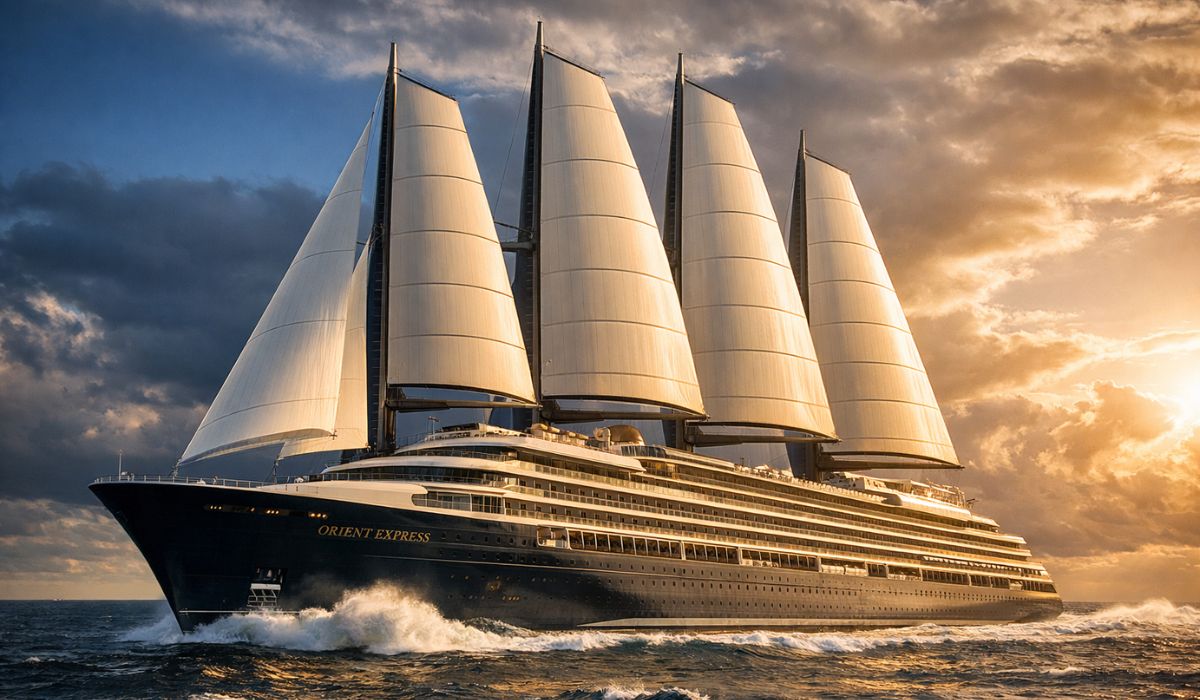
A ship of unusual dimensions, high-tech sails, and performance tests at sea put the power of the wind at the center of a current discussion about naval engineering, innovation, and new paths for large-scale navigation.
The Orient Express Corinthian, presented as the largest sailing yacht in the world, drew attention after recording, in propulsion tests, a mark described by the shipyard as unprecedented for a vessel of this size.
With 220 meters in length, equivalent to 721 feet, the ship was designed to combine luxury sailing with large-scale wind propulsion.
The design includes 54 suites and capacity for up to 110 guests, as well as a hybrid system that combines wind and engine power.
-
A Brazilian city is being invaded by the sea, buildings are leaning, and the solution could cost R$ 200 million with support from BNDES to prevent flooding, modernize drainage, and protect more than 200,000 residents within 5 years.

-
Lula’s government puts R$ 1 billion on the table to revitalize watersheds with 60 projects, including the São Francisco and Parnaíba rivers, sanitation, navigation, urban drainage, pollution control, and actions in strategic areas of Furnas.

-
Seen from space, a trio of black mesas formed hundreds of millions of years ago and remnants of the Paleozoic era created rare dunes in the heart of the Sahara and a strange sand-free zone that continues to intrigue scientists today, transforming the desert into an almost Martian landscape.

-
Mason teaches technique to make the “perfect mix”: simple method reduces cement waste and prevents structural problems in the construction.

In the most recent tests, the vessel reached 12 knots using only the sails, in winds of 20 knots.
In more common measurements outside the maritime sector, this corresponds to about 22 km/h under the exclusive force of the wind.
The maximum speed expected in commercial operation is approximately 17 knots, or just over 31 km/h.
According to the builder, the results obtained in the tests are unprecedented among sailing ships of this size.
Sail System of the Orient Express Corinthian
At the center of the project is the SolidSail system, developed by the French Chantiers de l’Atlantique to enhance the use of wind in large vessels.
Instead of conventional sails, the model adopts three carbon fiber masts approximately 69 meters tall.
Each of them supports approximately 1,500 square meters of sail area.
Combined, the three structures reach 4,500 square meters, equivalent to nearly 48,500 square feet.
The system was designed to operate with greater control and adaptation to navigation conditions.
The masts can rotate 360 degrees and tilt up to 70 degrees, allowing for adjustments in sail positioning according to wind direction.
There is also an operational function in this design.
The system allows for the reduction of mast height when necessary, enabling the ship to pass under bridges or in areas with height restrictions.
In its full configuration, the reported air draft is about 100 meters, or 328 feet.
The origin of this technology predates the Corinthian.
In 2009, Chantiers de l’Atlantique presented the Eoseas project, which already envisioned a large wind-powered cruise ship.
Since then, the concept has been adjusted to meet current demands for safety, automation, and commercial operation.
Scale Testing and Development of Naval Technology
Before application on a 220-meter ship, the system underwent an extended validation phase.
Between 2016 and 2019, the shipyard conducted tests with a reduced-scale demonstrator, equivalent to one-fifth the size planned for the final vessel.
The tests served to analyze aspects such as aerodynamics, sail control, and structural behavior.
Later, engineers installed a full-scale demonstrator in Saint-Nazaire, France.
The structure was used to evaluate rotation, tilt, automation, and the resistance of the system under conditions closer to those faced in operation.
This process preceded the integration of the system into the Corinthian.
Although the project is positioned in the luxury segment, it has also been followed by experts and the maritime sector for involving an attempt to increase the use of wind energy in large vessels.
In the case of the Corinthian, the proposal is not to completely replace conventional propulsion but to increase the contribution of wind in navigation.
When conditions are insufficient to maintain the planned performance, the vessel may resort to engines powered by liquefied natural gas (LNG).
This hybrid arrangement seeks to reduce exclusive dependence on weather conditions while preserving the regularity required for scheduled trips.
Luxury Ship with Reduced Operation
Another point that distinguishes the project is the relationship between dimensions and the number of passengers.
Despite its size being similar to that of large ships, the Corinthian was designed to accommodate a very limited group of guests.
There will be 54 suites distributed across seven decks, with an occupancy rate lower than that of conventional cruises.
According to Orient Express, the proposal is to offer an experience closer to that of a large yacht than that of a traditional cruise.
This positioning appears both in the internal configuration and in the reduced number of passengers relative to the size of the vessel.
The construction has progressed in stages considered decisive for the project’s timeline.
The ship floated for the first time in June 2025, after months of assembly.
In the following months, it received the three masts, an operation treated by the shipyard as essential for the completion of the sail system.
According to the schedule released by the company, the Orient Express Corinthian is expected to enter service in 2026.
Meanwhile, the Orient Express Olympian, sister ship of the same series, is scheduled for delivery in the spring of 2027 in the northern hemisphere.
Naval Engineering and Large-Scale Use of Wind
The interest surrounding the Corinthian is not limited to the premium cruise market.
The ship has also been observed as an example of applying contemporary technologies to an ancient principle of navigation.
Instead of repeating the model of small sailing boats, the project utilizes rigid structures, composite materials, and automated control systems.
In practice, the vessel tests how far wind-assisted propulsion can be incorporated into large-scale maritime operations without compromising the commercial demands of the sector.
This point helps explain why speed and maneuverability tests have gained prominence since the development phase.
At the same time, the project brings together elements that tend to spark interest outside the shipbuilding industry, such as the size of the ship, the configuration of the masts, and the attempt to adapt historical solutions to current engineering.
In this context, the Corinthian has become a frequent reference in discussions about innovation in maritime transport and complementary use of wind energy.






Seja o primeiro a reagir!