





 Portuguese
  English
  Spanish
  6 min of reading
  0 comments


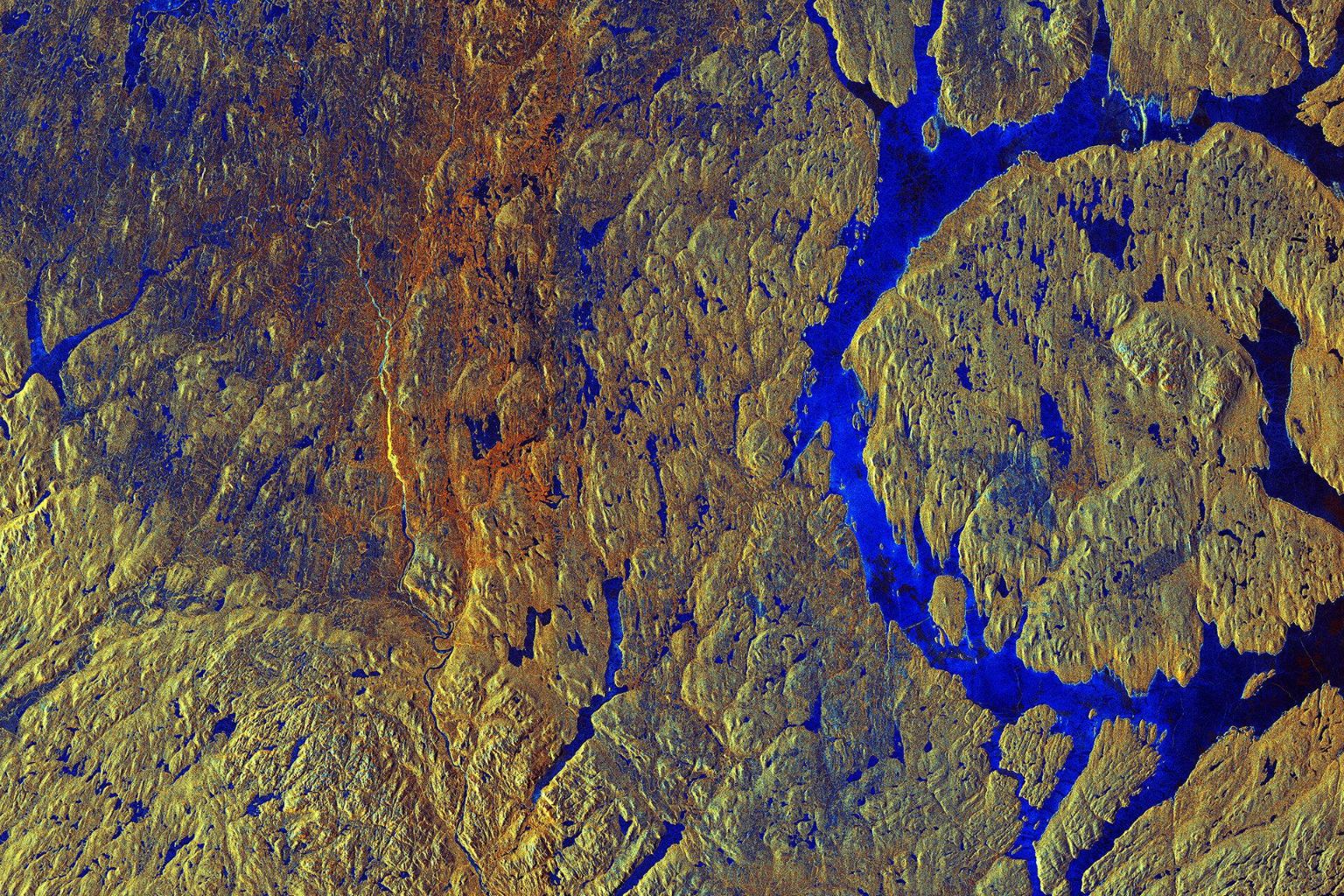
Manicouagan Crater in Canada exceeds 100 km in length and forms a 70 km ring visible from space after asteroid impact 215 million years ago.
In 2023, updated images released by the Earth Observatory of NASA once again highlighted one of the most impressive geological structures on Earth: the Manicouagan Crater, located in the province of Quebec, Canada. Formed about 215.5 million years ago during the Triassic period, this structure preserves the scar left by the impact of an asteroid estimated to be approximately 5 kilometers in diameter, an event that released enough energy to profoundly alter the Earth’s crust on a regional scale.
What sets Manicouagan apart from other impact structures is not only its origin but also the way it remains visible to this day. The original crater exceeds 100 kilometers in length, while the inner ring, currently filled with water, forms an almost perfect circle of about 70 kilometers in diameter, creating one of the most easily recognizable natural patterns on the planet when viewed from space. This combination of scale and symmetry has earned the formation the nickname “Eye of Quebec”, solidifying its importance both scientifically and visually.
Size of Manicouagan Crater exceeds 100 km and places the structure among the largest on Earth
The dimension of Manicouagan Crater is one of the main factors that place it among the most relevant impact structures ever identified on the Earth’s surface.
-
Scientists have found in China dinosaur embryos dating back 190 million years in various stages of development, and the discovery still preserves traces of extremely rare proteins in the bones, something that could change what is known about life before hatching.
-
The CEO of Honor in Spain says that smartphones will change with AI, foldables, and even robot phones; the component crisis is making cheap models more expensive in 2026 and shifting the focus to premium.

-
China’s artificial intelligence surpasses human commanders with 90% accuracy in military assault simulation tests.

-
The invisible system that keeps supermarkets cold in Brazil can account for up to 65% of the store’s energy; new pressure for efficiency targets freezers and refrigerated counters.

Unlike smaller craters, which may disappear over time due to erosion, Manicouagan has maintained much of its original shape thanks to the geological stability of the region and the scale of the event that created it.
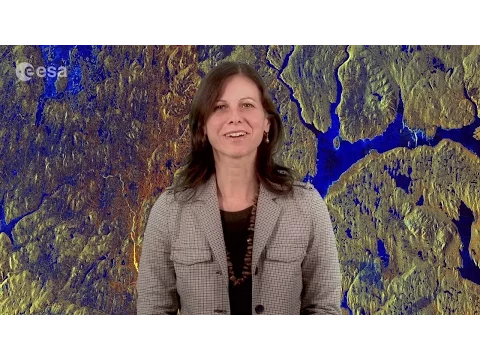

With more than 100 kilometers in original diameter, the structure covers an area that, in comparative terms, is equivalent to entire regions of large urban centers.
The inner ring of approximately 70 kilometers, now occupied by the reservoir, represents only a part of the complete structure, which includes less visible but equally important outer zones from a geological perspective.
This scale places the crater in a restricted group of high-energy impacts associated with rare events in the planet’s history. Structures of this magnitude are fundamental for studying the dynamics of cosmic collisions and their effects on the evolution of Earth.
Impact of the asteroid that formed Manicouagan released energy comparable to millions of bombs
The impact that gave rise to Manicouagan Crater was an event of extreme geological violence. An asteroid about 5 km in diameter struck the Earth’s surface at estimated speeds exceeding 20 km per second, releasing an amount of energy equivalent to millions of megatons of TNT.
This type of collision generates immediate effects that go far beyond the formation of a cavity in the ground. The energy released causes extreme compression of the rocks, followed by a process known as elastic rebound, in which the crust material partially returns after the impact, creating complex structures such as rings and central uplifts.
In the case of Manicouagan, this process resulted in the formation of a complex crater characterized by multiple structural levels and a highly defined circular pattern. The temperatures generated at the moment of impact were sufficient to melt rocks, while shock waves permanently altered the geological composition of the region.
Circular ring of Manicouagan Crater forms one of the most perfect patterns seen from space
One of the most impressive aspects of Manicouagan Crater is its geometry. The inner ring exhibits a level of symmetry rare in natural structures, especially on such a large scale. When viewed from space, the reservoir forms an almost continuous circle, with slight variations that reinforce its geological origin.

This symmetry is a direct result of the dynamics of the impact and subsequent erosion processes. Over millions of years, different layers of rock have eroded at distinct rates, highlighting the circular pattern that is now visible in satellite images.
The presence of water in the ring further amplifies this visual effect, creating a striking contrast with the surrounding terrain. This contrast is one of the factors that make the structure easily identifiable in orbital images, even at lower resolutions.
Manicouagan Reservoir transformed the crater into one of the most visible lakes on the planet
Although the origin of Manicouagan Crater is entirely natural, its current appearance has been significantly influenced by human intervention. In the 1960s, the construction of the Daniel-Johnson dam resulted in the formation of the Manicouagan Reservoir, one of the largest artificial reservoirs in Canada.
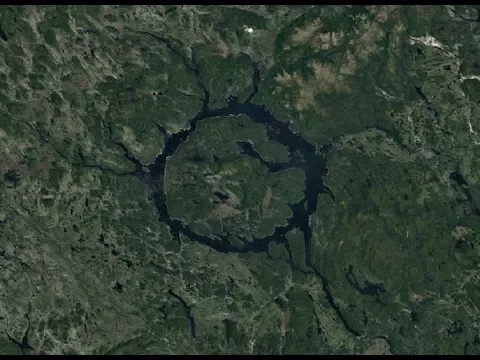
The flooding of the area around the inner ring further highlighted the circular shape of the structure, transforming the crater into a large lake visible from space. This process did not alter the geology of the crater but intensified its visual expression, making it even more recognizable.
Today, the reservoir serves both as a source of hydroelectric power and as an element that enhances the uniqueness of the formation in orbital images.
Manicouagan Crater is called the “Eye of Quebec” for its extreme circular shape
The nickname “Eye of Quebec” did not arise by chance. The combination of an almost perfect ring, color contrast, and gigantic scale creates an image that directly resembles a human eye when viewed from space.
This type of visual association is common in natural formations with a high degree of symmetry, but few examples reach the level of definition observed in Manicouagan. Over the decades, the structure has become one of the visual icons of planetary geology, frequently used in educational and scientific materials.
Moreover, the clarity of the pattern facilitates its identification by astronauts and remote sensing specialists, reinforcing its role as a visual reference in orbital studies.
Age of Manicouagan Crater connects impact to a critical period in Earth’s history
Dating of Manicouagan Crater points to about 215.5 million years, placing the impact at the end of the Triassic period. This period precedes one of the major mass extinctions in Earth’s history, although there is no definitive scientific consensus on a direct link between the impact and this global event.

Still, the temporal coincidence raises important hypotheses about the role of large-scale impacts in the dynamics of the planet. Events of this magnitude can influence climate, atmospheric composition, and ecosystems on a global scale, depending on factors such as location and energy released.
In the case of Manicouagan, studies indicate that the impact was significant but possibly not the only relevant event of that period.
Manicouagan structure helps scientists understand cosmic impacts on Earth
The importance of Manicouagan Crater goes beyond its appearance. It serves as a natural laboratory for the study of meteoric impacts and their effects on the Earth’s crust.
Researchers use the structure to analyze:
- deformations in rocks caused by extreme pressure
- evidence of melting and mineral recrystallization
- patterns of complex crater formation

These studies help to understand not only past events but also to predict possible consequences of future impacts. The preservation of the structure, combined with its scale, makes Manicouagan one of the most important references in this field of research.
Comment: Have you ever seen this “giant eye” of Earth recorded from space?
Manicouagan Crater shows how cosmic events can leave permanent marks on the surface of the planet. An impact that occurred over 200 million years ago is still visible today as one of the most impressive patterns on Earth when viewed from space.
Did you already know this formation or did you imagine that an impact of this size could still be seen so clearly today?







Seja o primeiro a reagir!