





 Portuguese
  English
  Spanish
  5 min of reading
  0 comments


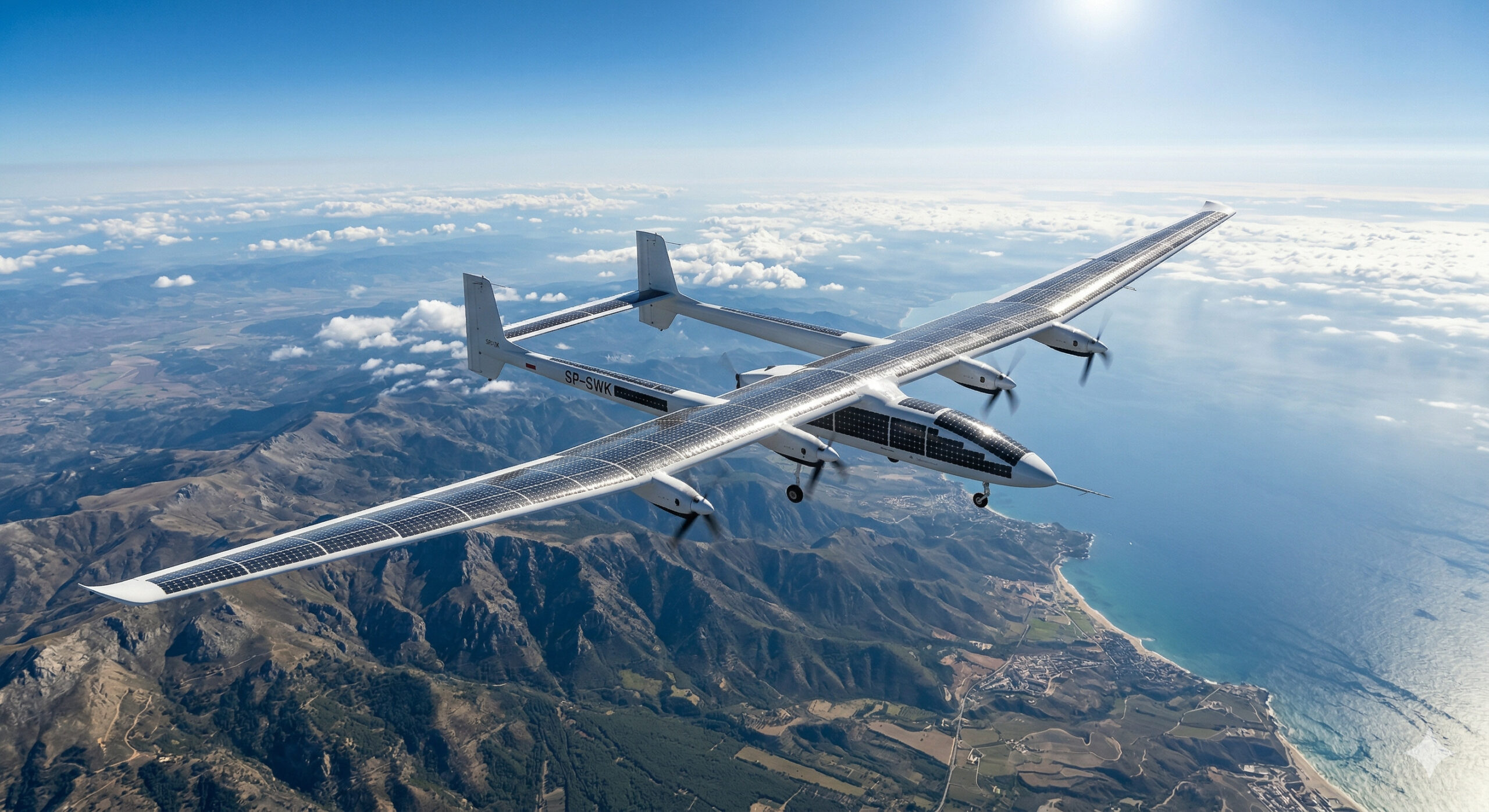
Solar drone Skydweller flies for days without landing, uses 17,248 panels, 200 km radar, and AI, and promises to stay in the air for 90 days without fuel
In 2025, according to reports from Live Science and tests conducted by the Naval Air Warfare Center Aircraft Division, the solar drone Skydweller Aero demonstrated the ability to fly autonomously for multiple days, using exclusively solar energy. The project, developed by Skydweller Aero, aims to achieve an unprecedented milestone in aviation: to remain in the air for up to 90 consecutive days without landing, without fuel, and without human intervention.
The proposal is not new. Previous programs by NASA, Boeing, and DARPA attempted to achieve the same goal but failed due to structural and aerodynamic limitations. The Skydweller emerges as the first attempt with real operational validation, combining lightweight engineering, artificial intelligence, and advanced flight control.
Skydweller Aero: solar drone born from Solar Impulse 2 and evolves to autonomous flight
The idea of building an airplane that flies forever using only sunlight is not new. NASA tried and failed. Its solar prototype HELIOS flew at over 27,000 meters in 2001 but broke apart in the air in 2007. Boeing and DARPA also tried and did not advance: the Solar Eagle program, with an investment of $89 million, was canceled in 2012.
-
Butantan Institute will produce pembrolizumab for the SUS and could change everything in cancer treatment by expanding access to innovative immunotherapy that strengthens the body and reduces high costs.

-
China wants to divert rivers through the sky using thousands of generators installed in the mountains of the Tibetan plateau to make it rain in dry regions, and neighboring countries like India and Nepal are already beginning to worry about the effects of this technology.

-
A highly powerful solar explosion is heading towards Earth and could jeopardize the historic launch of NASA’s Artemis II mission in April 2026.

-
Scientists are developing a self-repairing asphalt that can close microcracks on its own before they turn into potholes, a technology that could drastically increase the lifespan of roads and reduce billions in maintenance worldwide.


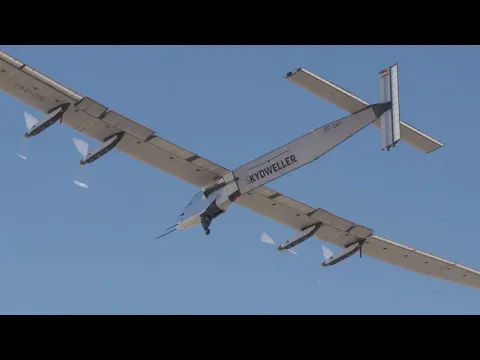

The Skydweller was not created from scratch. Its structural base derives from the Solar Impulse 2, an aircraft that in 2016 completed the first round-the-world flight powered solely by solar energy, piloted by Bertrand Piccard and André Borschberg.
Robert Miller, CEO of Skydweller Aero, identified potential in the platform and acquired the aircraft in 2019. The goal was to transform it into an autonomous drone capable of staying in the air for months.
The biggest challenge was not structural, but computational: developing software capable of controlling an ultralight aircraft in real conditions for long periods without human intervention.
Aeroelasticity: the problem that destroyed previous solar drones
The main technical obstacle for long-duration solar drones is aeroelasticity, a phenomenon involving the interaction between aerodynamic forces and flexible structures.
There is a critical altitude range between 1,500 and 10,000 meters where turbulence can cause dangerous flexing in the wings. If the deformation exceeds structural limits, a chain reaction occurs that can lead to the aircraft’s rupture.
It was exactly this phenomenon that destroyed NASA’s HELIOS. The Skydweller solved the problem not by reinforcing the structure, which would increase weight and reduce efficiency, but by using advanced flight control software.
The system adjusts control surfaces in real-time, neutralizing forces that could lead to structural failure, keeping the aircraft within safe limits.
Solar drone with a wingspan of 72 meters and 17,248 solar panels
The numbers for the Skydweller are extreme. The aircraft has a wingspan of 72 meters, larger than that of a Boeing 747, but with a maximum weight of only 2,549 kilograms, about 160 times lighter.
The structure is made of carbon fiber and houses 17,248 solar panels distributed over 270 square meters of wings, generating up to 100 kW of power.

The drone carries 635 kilograms of batteries for energy storage and can transport up to 363 kilograms of payload.
This combination allows continuous operation, day and night, without the need for fuel, creating a new paradigm of persistent flight.
200 km AESA radar with artificial intelligence enhances surveillance capability
The Skydweller is equipped with the AirMaster S radar, developed by Thales, an AESA technology in the X-band used in military aircraft.
The system has a range of up to 200 kilometers and the ability to track multiple targets simultaneously, both in the air and at sea.
The integration with artificial intelligence allows for automatic object classification, differentiating between civilian, military, and suspicious vessels. This capability transforms the drone into a strategic platform for persistent surveillance, with continuous operation for weeks or months.
Tests with the US Navy confirm autonomous flight of 73 continuous hours
In July 2025, the Skydweller completed autonomous flights of multiple days from Stennis Airport in the United States.
The longest mission lasted 73 continuous hours without fuel, without a pilot, and without human intervention. Previous tests included flights of up to 22.5 hours, some crossing storms in the Gulf of Mexico.
These tests were conducted in partnership with NAWCAD, the research arm of the US Navy.
The operational validation in a real environment represents a significant advancement towards the goal of 90 days of continuous flight.
Solar drone costs up to 10 times less than conventional military drones
Compared to military drones like the MQ-9 Reaper, the Skydweller has operational costs up to ten times lower.
The main difference lies in the absence of fuel, crew, and frequent maintenance. The system operates as a pseudo-satellite, offering continuous surveillance at a reduced cost. Operational savings are one of the main factors driving military and civilian interest in the project.
The Skydweller can operate continuously between 40 degrees north and south latitude, covering a large part of the world’s strategic areas.
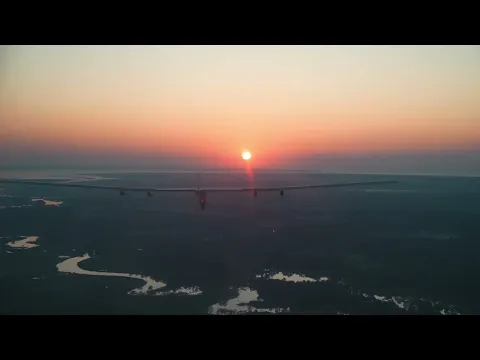
The flight altitude varies between 6,000 and 10,500 meters, reaching up to 13,600 meters under ideal conditions. This range allows operation in regions such as the Caribbean, Africa, the Middle East, and Southeast Asia, where sunlight incidence is sufficient for continuous flight.
Self-healing system allows continuous operation for months without maintenance
One of the differentiators of the Skydweller is the VMS system, which uses self-healing algorithms. The system detects software failures, isolates the problem, and automatically restarts processes, maintaining continuous operation.
This capability is essential for long-duration missions, where human intervention is not possible.
The applications of the Skydweller are broad and include maritime surveillance, combating drug trafficking, environmental monitoring, and communication coverage.
The drone can act as an airborne communication tower, providing connectivity in remote or disaster-affected areas. The operational versatility expands the system’s potential beyond military use.
Continuous flight goal of 90 days could redefine global aviation
The current goal of Skydweller Aero is to achieve continuous flights of seven to fifteen days with full operational payload, subsequently advancing to 90 days.
The company is already planning flights of up to a year in the future, depending on the evolution of predictive maintenance systems and batteries.
If achieved, this milestone will redefine the concept of persistent aircraft and could replace some of the functions currently performed by satellites.

The Skydweller does not fit into traditional categories. It is neither a conventional airplane, nor a satellite, nor a common drone. It is a continuous flight platform powered by solar energy, controlled by artificial intelligence, and capable of operating for months.
This new category represents a convergence of aviation, space, and artificial intelligence, creating a new model of persistent global surveillance.









Seja o primeiro a reagir!