





 Portuguese
  English
  Spanish
  5 min of reading
  0 comments


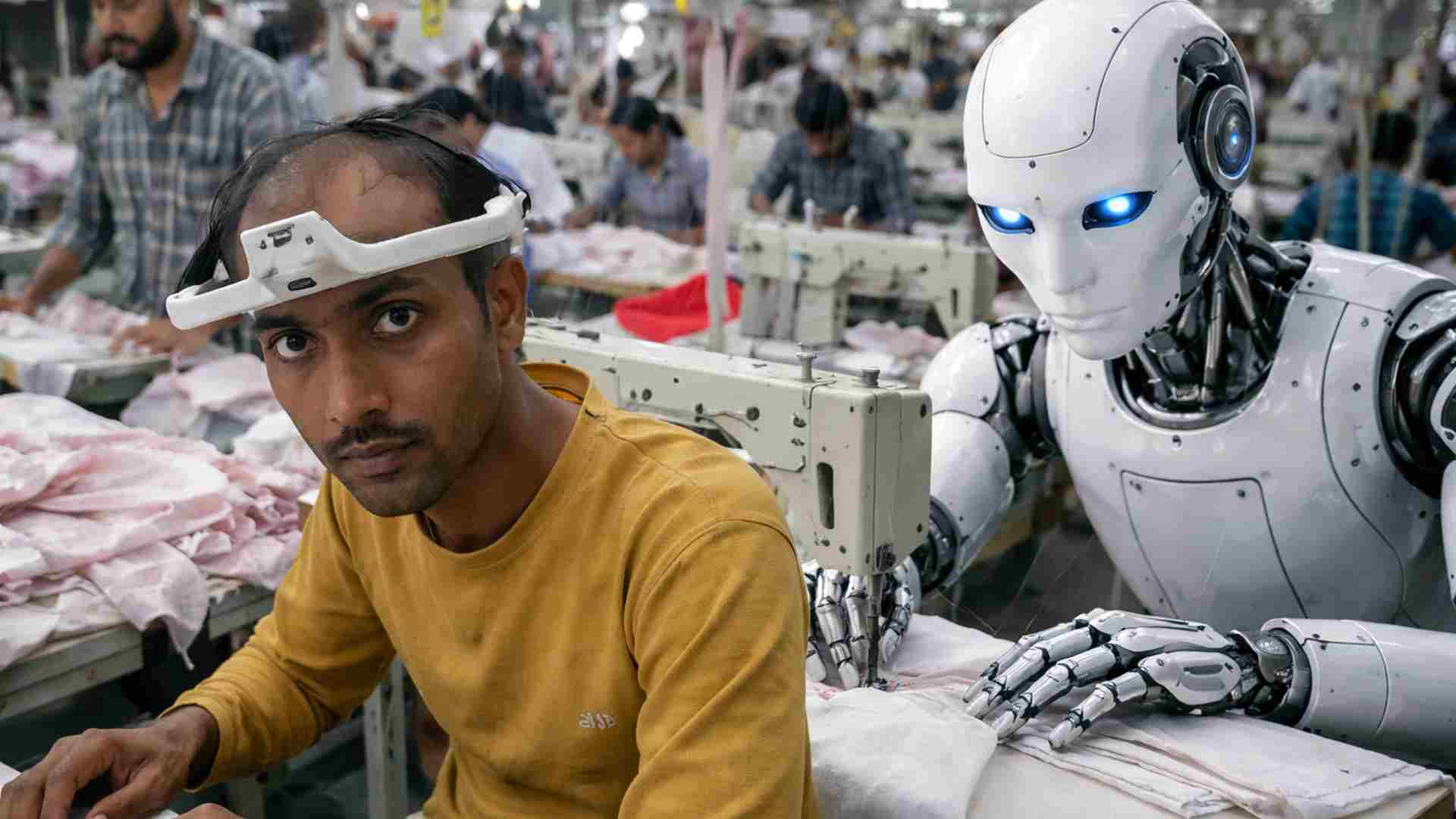
In factories, homes, and digital platforms, workers have started to record movements, correct responses, and perform tasks to train artificial intelligence systems, in a process that fuels the advancement of automation and amplifies the fear that technology will take over exactly the same functions currently performed by humans in the future.
Artificial intelligence no longer learns only from texts, images, and typed commands. In different countries, it is being trained with real movements of workers, household tasks recorded in the first person, and reviews made by experienced professionals.
The result is the formation of a new market: people who help AI systems and robots learn exactly what they themselves do in their daily lives.
The case of India that exposed the logic of the new automation
One of the most emblematic examples appeared in a report from the Los Angeles Times ands published in November 2025.
-
Archaeologists found in the desert an oasis 5,000 years old surrounded by giant walls, in a discovery that reveals a civilization much more complex, powerful, and organized than previously thought.

-
Giving your CPF at the supermarket has become routine, but in 2026 the rule will change: see how your data is used and when it is worth informing.

-
China has launched mysterious invasion barges into the sea with giant ramps that connect like Lego pieces and can form floating bridges of nearly 1 km to transport armored vehicles directly to the beach, in a kind of secret weapon for Taiwan.

-
Neither green in the fridge nor overripe forgotten in the fruit bowl: this is the correct way to store bananas.

The newspaper showed workers in Karur, in southern India, folding towels with cameras attached to their heads to record, in the first person, how hands and arms move during repetitive tasks. The goal was to generate data to teach robots to act in the physical world.
The practice goes beyond simply filming workers at their jobs. The recordings are used to create databases that allow robotic systems to learn detailed manual sequences, such as picking up, aligning, folding, separating, and repositioning objects.
This transforms human gestures into training material for the so-called “physical AI,” aimed at machines that need to interact with clothes, tools, doors, and other items in the real environment.
This case gained traction precisely because it exposed a contradiction: workers perform tasks while recording their own movements for technologies developed, in part, to reproduce that same work in the future. The report does not claim immediate replacement nor identifies an automatic cut in jobs at that moment, but it makes it clear that the process exists and is already being used to accelerate the learning of humanoid robots and mechanical arms.
When the home also becomes a data laboratory
The same logic appeared in the United States on another front. In March 2026, the Los Angeles Times reported that hundreds of people in Los Angeles began using cameras on their heads and hands to record household tasks such as washing dishes, making coffee, watering plants, and cleaning the house.
The purpose was to help AI systems understand how humans move within everyday environments.
In this model, work is no longer just industrial and begins to include simple everyday actions, transformed into training for domestic robots and autonomous systems. The article describes this service as a new type of on-demand economy occupation, where people are paid to perform common tasks while machines observe, record patterns, and build operational capacity from that.
The significance of this movement is broad. Automation no longer depends solely on engineers and closed laboratories and is now fueled by a network of dispersed workers, paid to provide images, routines, and motor coordination to databases. What once seemed like science fiction is now gaining scale through small fragmented jobs.
China accelerates the race for humanoid robots
In China, the expansion of this process has taken on industrial dimensions. In May 2025, Reuters showed how startups like AgiBot began investing in training centers for humanoid robots, with strong state support and accelerated growth in public purchases related to the area. The report describes the advancement of humanoid robotics as part of a broader strategy to transform manufacturing.
The most striking data from the Reuters survey was the leap in state purchases of humanoid robots and related technologies: from 4.7 million yuan in 2023 to 214 million yuan in 2024. This shows that the creation of machines capable of learning physical tasks is not limited to isolated experiments but has already entered the radar of industrial policies and heavy investments.
In this scenario, training with human data gains even more weight. For robots to fold clothes, handle objects, or execute production steps, they need concrete, repeated, and very well-organized demonstrations. It is precisely here that human work returns to the center of the equation: not only as productive labor but as a source of data for the next generation of automation.
It’s not just workers: specialists also train AI
The phenomenon does not only affect manual tasks. A report from the Guardian published in April 2026 showed that experienced professionals, many of them over 50 years old, have started working by reviewing, labeling, and evaluating responses from AI models. Doctors, technology professionals, and other specialists help systems improve performance in complex areas by correcting errors and refining responses.
The same report clearly states that the goal of this training is to elevate the models until they can perform a job as well as a human, which means that in the future, they may replace some of these professionals.
Still, many accept this type of service out of immediate need for income, flexibility, or difficulty in re-entering the traditional job market.
Another investigation by the Guardian, also from April 2026, revealed a darker side of this chain. Workers from the Outlier platform, linked to Scale AI, reported tasks such as data collection on social media, use of copyrighted materials, and labeling disturbing content. Many said they believed they were training their own replacements.
The case that went viral in 2026 and has not yet been proven
It was in this context that, in April 2026, a video attributed to sewing workers in India using head-mounted cameras to record hand movements while working went viral on social media. Posts on Instagram, Facebook, and Reddit began presenting the scene as proof that those workers were “training AI to replace them.”
However, the specific viral video from 2026 has not yet had its authenticity publicly confirmed with conclusive identification of date, company, and exact context. Therefore, it cannot be treated as definitive proof, only as content compatible with a real dynamic already proven in other reports.
The heart of the matter
The most sensitive point of this transformation is simple: for machines to learn to act like humans, they still need to observe humans very closely. This applies to those folding towels in a factory, washing dishes at home, or correcting responses from advanced models. In all these cases, people are transferring to automated systems the movements, criteria, and decisions that sustain their own work.
Total replacement is not proven in each individual case, and the viral video from 2026 continues without conclusive verification. What is already proven is something else: workers, in various sectors, are already helping to train artificial intelligences to perform human tasks with increasing precision.







Seja o primeiro a reagir!