





 Portuguese
  English
  Spanish
  5 min of reading
  0 comments


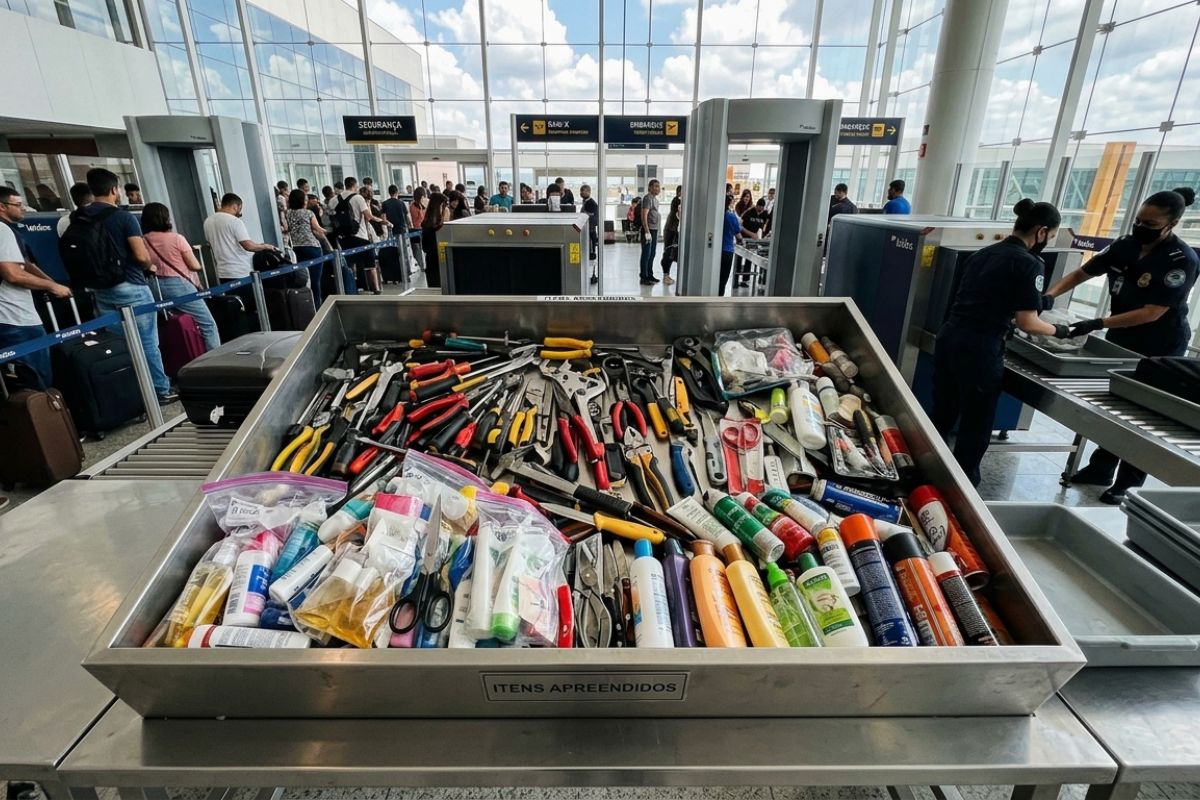
In the airport X-ray, the carry-on bag is the first to be stopped, and checked baggage is usually the safest way for liquids over 100 ml and sharp objects before everything goes to discard.
In the airport X-ray, thousands of objects end up discarded every day, and not just “dangerous things.” Many people lose expensive perfume, work tools, sealed drinks, brand new deodorant, and even travel souvenirs because the item is not allowed in the carry-on, and most of the time, there’s no discussion: it goes to discard.
The logic is simple: what seems harmless can be stopped, and the final decision is always up to the security team. To avoid losses at the airport X-ray, it’s worth understanding which items are most often flagged and what to do when in doubt, especially before entering the inspection line.
Why so many things are retained in the airport X-ray
Security is strict to keep the flight safe. Therefore, all baggage heading to the boarding area goes through X-ray, metal detectors, and, if necessary, additional inspection. If the agent identifies something suspicious, they may ask to open the baggage, conduct a manual inspection, and retain the item. In some cases, there is also random inspection, and you may have to open everything again.
-
60 meters above the ground, the Eiffel Tower once again offers a crossing over the void on a suspended walkway that has already attracted more than 24,000 people and transforms the visit into an experience of tension and an open view over Paris.

-
Little-known fruit from the Cerrado draws the attention of scientists for containing antioxidants, fibers, and provitamin A, according to scientific research; meet the mama-cadela.

-
It seems to have come out of a science fiction movie: a Brazilian city houses a crater over 150 meters deep, equivalent to a 45-story building, which shaped the city’s growth; meet Pedreira Lageado in São Paulo.

-
McDonald’s bets on collectors and includes Toyota cars in the Happy Meal with exclusive miniatures and a surprise that hints at the brand’s future supercar, turning it into a rare collectible item.
The most important point is this: the security at the airport decides whether something goes through or not, so “borderline” items vary according to local assessment and procedures.
Tools are the champions of seizure

Many people think liquids lead the list, but data consulted with some airport administrations indicate that tools are by far the champions of seizure at the airport X-ray. According to this data, they represent more than a third of everything that is retained and discarded.
Among the most common are screwdrivers, wrenches, pliers, hammers, and similar items. The problem is that many people put these in their carry-on without realizing that they cannot go in the cabin, especially on the return trip when they bring purchases and “fit” the item into the bag.
If you need to transport tools, the solution is straightforward: put them in checked baggage, because in the carry-on, the chance of losing them is high.
Liquids over 100 ml become quick losses

In second place in the ranking are liquids, especially containers over 100 ml on international flights. The rule is well-known, but many people confuse it with limits for domestic flights or simply forget.
On international flights, liquids must meet two requirements: containers of up to 100 ml and everything in a transparent bag with a maximum capacity of 1 liter. This includes perfume, shampoo, creams, toothpaste, gel, spray, and similar items. And there’s one detail that catches many people at the airport X-ray: it doesn’t matter if the bottle is half empty, what counts is the size of the container. A 200 ml bottle with a little left inside tends to be discarded.
Even items that seem solid can fall under this rule. A classic example is dulce de leche: because it is pasty, it must respect the limit. The difference between losing and saving, in these cases, can simply be going back to the counter and checking the carry-on bag, if that option is still available.
On the other hand, empty containers, like water bottles, can be taken without issue. Many people pass through the X-ray with them empty and fill them up later at the water fountain.
Cutting and piercing blades come under scrutiny

In third place are cutting or piercing objects: knives, cutlery, box cutters, pocket knives, daggers, scissors, scalpels, and blades in general. According to security rules, they cannot go in the cabin even when they seem harmless.
Some items still cause confusion in practice. Knitting or crochet needles are not allowed. Small, blunt scissors and pocket knives with blades up to 6 cm may be allowed in certain situations, but there is a real risk at the airport X-ray: if the agent believes it poses a danger, it won’t be allowed.
The safest recommendation is simple: if it has a blade or point, check it.
Flammable and dangerous items surprise many people

The fourth position often catches travelers off guard: flammable or dangerous products. This includes everyday items that, when transported by air, are treated as risks.
Some cited examples include refills or lighter fuel, fireworks, culinary torches or torch lighters, flammable liquids or gases, paints, solvents, bleach, and corrosive substances. And there is one case with even stricter restrictions: charcoal for hookah, which is extremely prohibited even in checked baggage.
The reason is straightforward: any material that can catch fire or react chemically poses a risk, so in many cases, it simply cannot be taken on board.
Weapons, defense, and sports equipment also fall under scrutiny

There is a group that rarely goes unnoticed at the airport X-ray: weapons and defense items, as well as sports equipment that can be interpreted as a threat.
This includes firearms, stun guns, pepper spray, weapon replicas, toy guns, martial arts equipment, and also items like walking sticks, bats, paddles, and similar items. Weapons can be transported, but with specific procedures and strict rules, it’s not something to just “put in the bag and board.”
An item that often causes headaches is the walking stick: in some airports it’s allowed, in others it’s not. When there’s a chance of interpretation, the practical rule is: when in doubt, check it.
“Bizarre” items also appear from time to time

There is also a sixth, less common group that appears in security at times: stones, slingshots, umbrellas with points, and other items that don’t easily fit into the previous categories.
This type of object reinforces the logic of the airport X-ray: sometimes the problem is not what you think is “dangerous,” but rather what can be interpreted as a risk during that screening.
How to avoid losses at the airport X-ray
To avoid leaving anything behind, three simple precautions help a lot:
Check the list of prohibited items from the airline before leaving home, as this avoids surprises in line.
Check ANAC rules and use consultation tools when in doubt, as there are items with specific restrictions.
If the item is controversial, uncommon, or difficult to explain, check it. This reduces the risk of losing something valuable, sentimental, or work-related, and also avoids delays due to discussions during inspection.
And now I want to know: have you ever lost an item at the airport X-ray, or do you know someone who had something retained and discarded?







Seja o primeiro a reagir!