






 Portuguese


The 13-ton bridge uses tracks, geometry, and counterweights to maintain pedestrian crossing at Cody Dock and free the entrance for boats in an old dock in London.
Why would the floor of a bridge be pointing down? At Cody Dock in the British capital, this unusual position is part of the functionality of a 13-ton bridge designed to accommodate both pedestrians and vessels in the same space.
When a boat needs to enter the dock, the steel structure rolls on tracks and turns upside down. This movement removes the deck used by pedestrians from the path, allowing the channel to be free without requiring a conventional drawbridge.
The Institution of Structural Engineers, a British professional body dedicated to structural engineering, noted that the bridge can be operated via a manual crank winch, despite its significant weight.
-
Fehmarnbelt tunnel vessel lifts an extra 1,600 metric tons ahead of a deeper Baltic Sea installation

-
Construction of Steel and Glass Observation Deck on Mountain in Brazil May Finally Move Forward: Million-Dollar Project to Feature 76,000 m² Park with Views of Cascata Paraíso

-
Autonomous Painting Robot Covers Up to 2,700 Square Feet Per Hour, Applies Paint and Compound Independently, and Uses AI to Navigate Around Beams and Installations on Job Sites

-
Chinese Factories Transform Production: From Quarantine Boxes to Homes in 25 Days, Exporting $4.3 Billion Annually


The entire bridge rolls on tracks until the floor is facing down
Instead of raising just a portion of the deck, as happens with many moveable bridges, the Cody Dock structure rotates almost as a single piece. The tracks installed on the sides guide this movement.

During the opening, the bridge moves along the curved path defined by the design. The decking used for crossing follows the movement until it is inverted, with the surface facing down.
This solution makes the bridge itself part of the mechanism. There is no separate deck being lifted by large towers, tall cables, or visible hydraulic arms.
When boat passage ends, the process is reversed. The bridge returns to its normal position, and the deck is once again available for pedestrians.
Counterweights Allow Control of a Structure Weighing Approximately 13 Tons
The weight of the bridge does not disappear during opening. What changes is how this mass is distributed, allowing one person to control the movement with much less effort.
The designers added counterweights to elevate the center of gravity to the central point of the frame. In simple terms, the center of gravity is the region where the weight of the structure is balanced.
When this point is in the calculated position, the bridge encounters less resistance to roll. The crank operates a manual winch that guides the structure along the tracks in a controlled manner.
The apparent ease depends on precise calculations. An error in weight distribution could make the operation difficult, unstable, or impossible. Therefore, geometry, balance, and manufacturing needed to function as parts of the same system.
The Solution Maintains Pedestrian Path Without Closing the Dock Entrance
The bridge spans an abandoned dock that needed to be reopened for vessels. At the same time, the area required a passage for pedestrians between the two banks.
A fixed structure would block boats. Meanwhile, a conventional opening could require larger equipment and significantly alter the landscape. The chosen solution reconciled both needs with a compact and movable bridge.
The Gasworks Dock Partnership is identified as the project's client and also participated in the main execution alongside Cake Industries. The organization is connected to the revitalization of Cody Dock and the repurposing of the former industrial site.
Thus, the bridge serves not only as a crossing. It also ensures that the dock's entrance remains operational, preserving the relationship between the space, the canal, and the vessels.
Project Combined Structural Engineering, Architecture, and Specialized Manufacturing
Price & Myers developed the structural design, responsible for the calculations, stability, and behavior of the bridge during movement. Architect Thomas Randall Page worked on the form and the integration of the structure with Cody Dock.
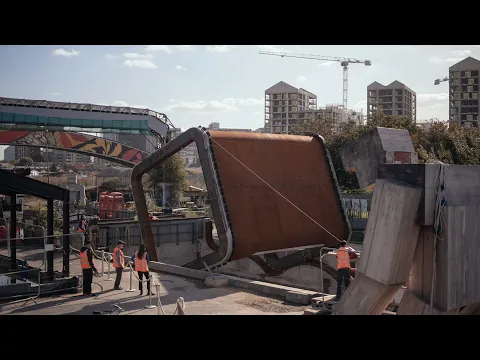

The main execution was handled by Gasworks Dock Partnership and Cake Industries. The manufacturing required care because each part needed to maintain the necessary geometry for the bridge to roll without losing balance.
The Institution of Structural Engineers, a British professional body dedicated to structural engineering, emphasized that the movement appears simple, but the development and manufacturing presented complex and unusual challenges.
The team needed to understand not only the steel structure but also the mechanics, geometry, architecture, and the manufacturing process. This integration explains why the operation depends on the whole system, rather than a single special piece.
Cody Dock Bridge Received Structural Recognition in 2023
The bridge was recognized as a winner in the 2023 Structural Awards, an accolade aimed at structural engineering projects. The recognition highlighted the bold design and the ability to transform a practical need into a striking structure.
The evaluation highlighted the use of advanced mathematics to create a stable form. When closed, the bridge presents a discreet appearance. However, during the opening, the complete rotation transforms the operation into a visual spectacle.
The project was also presented as a contemporary piece of industrial architecture and a functional sculpture. This definition helps explain the union of utility, movement, and visual presence.
A Crank Demonstrates How Balance Can Replace Raw Strength
The Cody Dock bridge demonstrates that moving a heavy structure does not always require massive machines. When the weight is correctly distributed and the path of movement is controlled, one person can operate approximately 13 tons with a crank.
The result maintains the pedestrian crossing, allows boats to enter, and restores a practical function to an old dock in London. More than just turning upside down, the bridge illustrates how precise calculations can transform weight into controlled movement.
Would you dare to rotate a 13-ton bridge using only a crank? Share this story and tell what surprised you most about how the structure works.


