





 Portuguese
  English
  Spanish
  5 min of reading
  0 comments


Latest Observations With The Most Advanced Space Telescope In The World Increase Accuracy Of The Trajectory Of Asteroid 2024 YR4 And Elevate Risk Of Lunar Impact, While Earth Remains Out Of Danger
An asteroid the size of a building, known as 2024 YR4, has just had its chances of collision with the Moon updated to 4.3%, according to NASA. The revision was made after a last observation captured by the James Webb Space Telescope in May 2025, before the object became impossible to detect by terrestrial or space-based optical instruments.
The analysis of the new data was conducted by specialists from the Center for Near-Earth Object Studies at the Jet Propulsion Laboratory (JPL) in California. The updated forecast increased the accuracy of the asteroid’s location by nearly 20% and slightly elevated the risk of lunar impact, while maintaining zero risk of collision with Earth.
A New Alert From Deep Space
The asteroid 2024 YR4 was discovered in December 2024, raising initial concerns due to its orbit crossing the Earth’s trajectory. With a diameter of between 53 and 67 meters, it is large enough to devastate an entire city in the event of an impact, earning the nickname “city-killer” or “city destroyer“.
-
In Kenya, engineer Nzambi Matee created “bricks 2.0” using packaging plastic: a mixture with sand, heated and pressed; they are 5 times more resistant, already have official licensing, and are being used in streets and construction projects.

-
More than 20,000 positions could be opened, and thousands of technicians are starting to be trained in Brazil, as the expansion of data centers creates an urgent race for professionals to keep the internet, cloud, and artificial intelligence running 24 hours a day.

-
China approves the 15th Five-Year Plan 2026-2030 to become a global power: prioritizes brain implants, 6G with AI, humanoid robots, flying cars, quantum technology, and nuclear fusion, while strengthening defense and the economy.

-
Goodbye iron: new technology from Xiaomi promises to revolutionize the way we iron clothes with 500 kPa steam, continuous flow of 120 g/min, heating in 65 seconds, and six smart modes for different fabrics.


The initial analyses suggested a risk of collision with Earth, estimated at 3.1% in February. However, subsequent observations, including those from the James Webb, completely ruled out this possibility for the foreseeable future.
Despite this, the risk of impact on the Moon has been increasing. Observations made with the Webb’s infrared camera in May 2025 allowed scientists to refine the asteroid’s orbit with unprecedented precision.
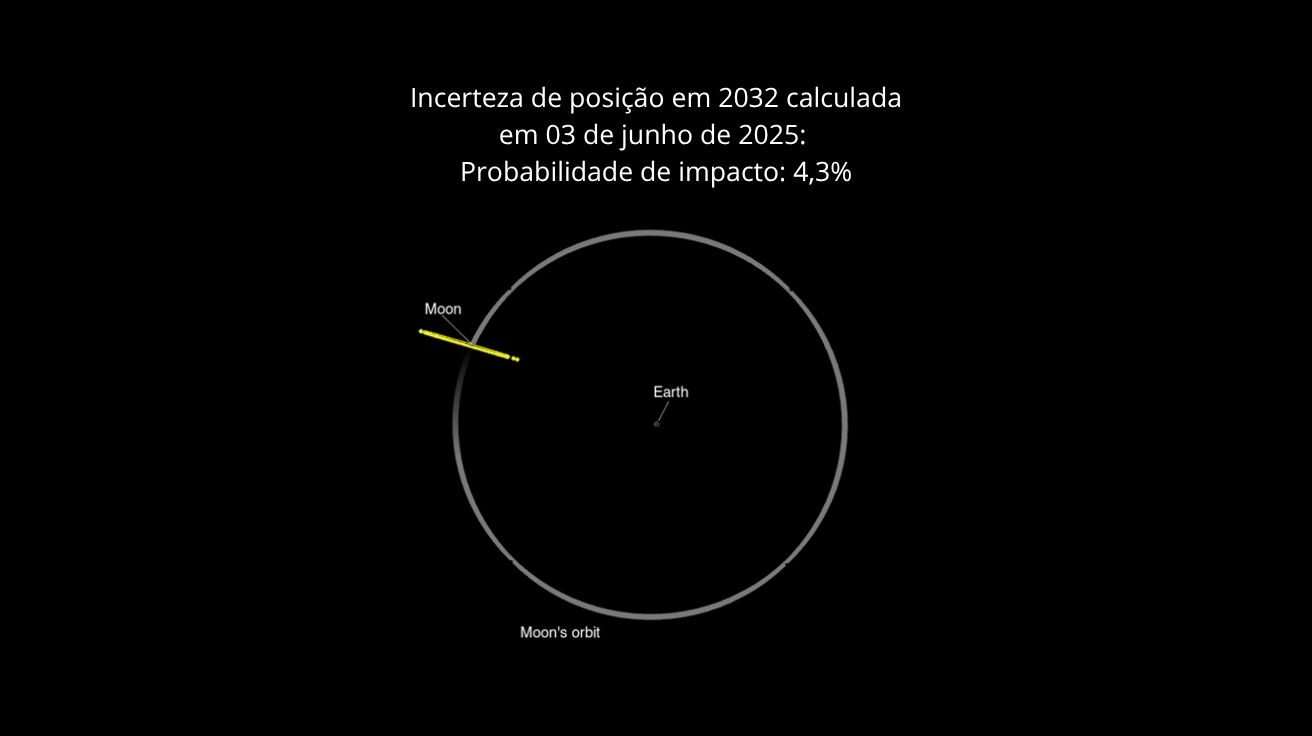
Based on this new calculation, the risk of lunar collision on December 22, 2032 rose from 3.8% to 4.3%. Although still a small probability, it is considered significant in the astronomical context.
The space agency emphasizes that, even in the event of an impact, the event would not alter the orbit of the Moon, but would cause the formation of a new visible crater.
The Trajectory Of 2024 YR4 And The Role Of James Webb
The James Webb Space Telescope, considered the most powerful ever launched by humanity, played a key role in this risk update. Operating outside of Earth’s atmosphere, it captured data with unprecedented resolution of the position and speed of the asteroid.
This information was analyzed by an international team led by Dr. Andy Rivkin from the Johns Hopkins University Applied Physics Laboratory. Scientists used the May 2025 data to project the asteroid’s position on December 22, 2032 with much greater confidence.
From the observations, the uncertainty range about the position of 2024 YR4 drastically decreased, which led to the slight elevation of the probability of collision with the Moon. The study also revealed that the asteroid is currently out of reach of telescopes and will only be observable again in 2028, when its path brings it back to the vicinity of Earth.
One of the most symbolic images released shows yellow dots representing the possible locations of the asteroid in 2032, with the lunar orbital radius marked. Between April and June 2025, the “path” of dots narrows, showcasing the gain in precision.
NASA emphasized that this type of refinement is common and expected as more data is collected. The process helps improve planetary defense protocols and tests the capabilities of global monitoring systems.
The Risk To Earth Is Ruled Out
At the beginning of the analyses, there was a real concern about a potential impact from the asteroid 2024 YR4 with Earth. The initial models suggested that the object would dangerously cross the orbit of our planet.
This possibility has been completely ruled out after multiple observations with ground-based telescopes and the James Webb. The accuracy of the new calculations reduced the chance of collision with Earth to 0% in 2032 and the following years.
According to specialists from JPL, the current main threat is only statistical and directed towards the Moon. Nonetheless, the risks are considered low, and NASA classified the situation as no significant impact expected for any terrestrial or space structure.
If the lunar impact occurs, it would be a unique scientific opportunity to study the effects in real-time, test monitoring alerts, and obtain valuable data on celestial collision dynamics.
There are no expectations of changes in the lunar rotation or translation, nor is there a risk of debris being ejected towards Earth.
What Would Happen If The Impact Occurred
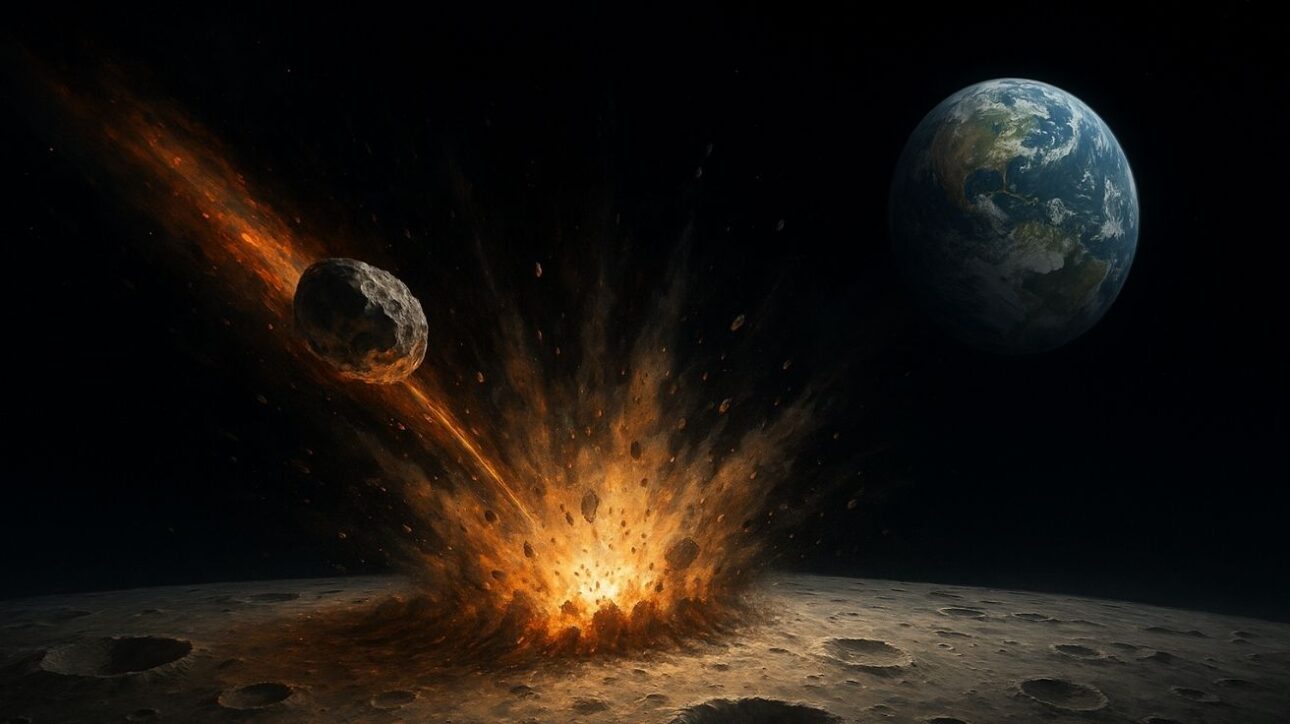
If the collision with the Moon does indeed happen on December 22, 2032, astronomers state that the event would be visible by space probes and could leave a notable-sized crater.
The impact of a body with more than 60 meters in diameter, traveling at tens of thousands of km/h, would release energy equivalent to 500 Hiroshima bombs. Still, due to the absence of an atmosphere on the Moon, there would be no shock wave like on Earth.
For scientists, this type of event is valuable because it allows for the calibration of instruments, impact simulation testing, and evaluation of future planetary defense strategies.
NASA and other agencies, such as the ESA (European Space Agency), are closely monitoring the situation. The impact on the Moon would not jeopardize lunar missions but could alter landing points in future projects, such as Artemis.
Moreover, the episode would be extensively monitored by radios, satellites, and ground stations, serving as a global alert exercise.
The last significant asteroid collision with the Moon recorded by humans occurred in March 2013, resulting in a crater of about 20 meters in diameter.
When Will We See 2024 YR4 Again
The asteroid 2024 YR4 is now at a point in its trajectory that makes it invisible to conventional observation systems. The next visibility window will occur only in 2028, when it returns to the inner solar system.
On that occasion, scientists expect to carry out new observations with Webb and other high-resolution telescopes, as well as possibly include the object in tracking programs such as DART and NEO Surveyor.
This new opportunity will allow for confirmation or further adjustment of its trajectory and review the probability of lunar impact.
The expectation is that technology by then will have evolved to allow for even more precise measurements, potentially even predicting the exact impact zone, should the risk remain.
Finally, NASA emphasizes that the case of 2024 YR4 serves as a warning about the importance of continuous surveillance of near-Earth objects, and as a fundamental exercise in protecting humanity against future cosmic risks.









-

-

2 pessoas reagiram a isso.