





 Portuguese
  English
  Spanish
  4 min of reading
  0 comments


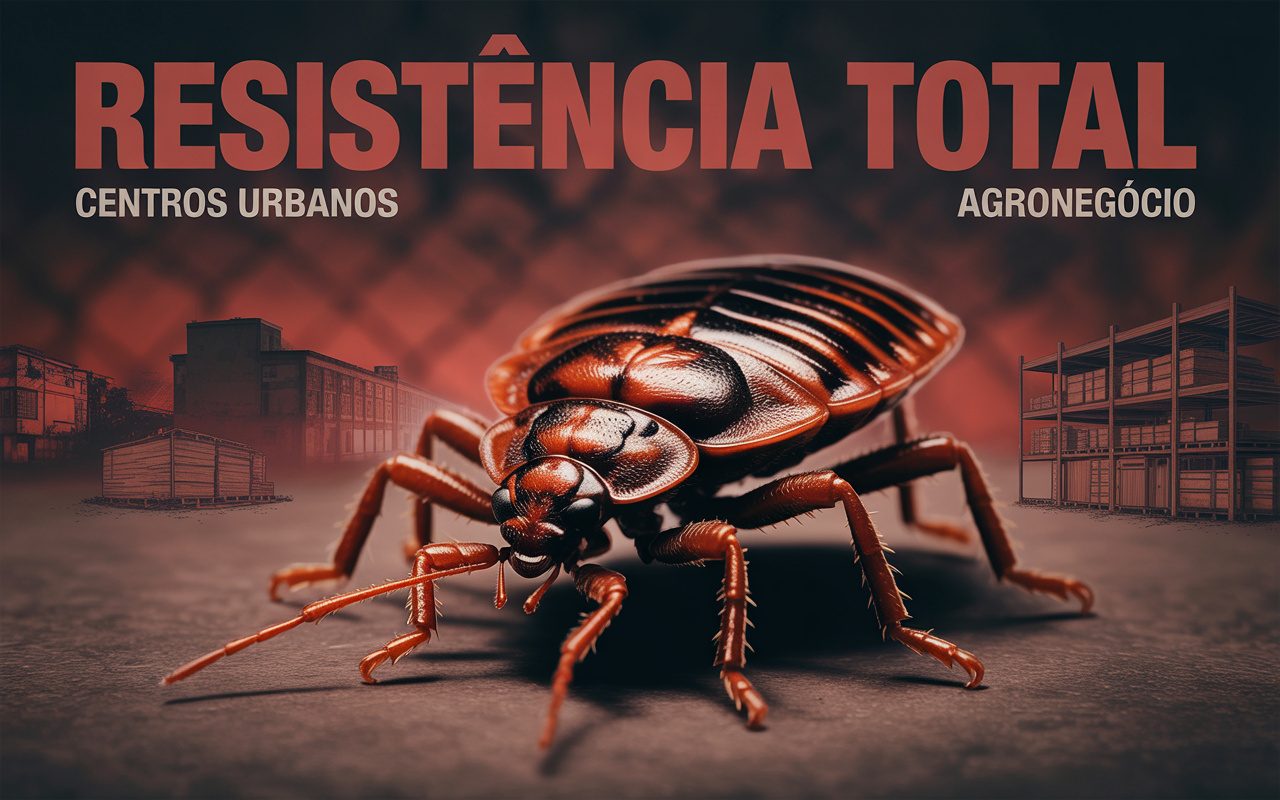
Bed Bugs Evolve Nearly Total Resistance to Insecticides, Resurge in Cities and Begin to Concern Accommodations, Logistics, and Agriculture Structures
For much of the 20th century, bed bugs seemed to be a conquered pest. The intensive use of insecticides after World War II virtually eliminated these insects from hotels, residences, and collective accommodations in large urban centers. For decades, the problem was treated as residual. However, the current reality is opposite: bed bugs have returned with strength, exhibiting levels of resistance that challenge modern control methods and raise alerts that go beyond the urban environment — including structures linked to agriculture.
The bed bug, Cimex lectularius, never completely disappeared. Small populations survived in isolated pockets, and with the advancement of urbanization, increased international travel, and intensified circulation of people and goods, it found an ideal environment to spread once again. The difference in this new phase lies not only in the geographic expansion but in the biological transformation of the insect. Current populations no longer respond to the insecticides that sustained control strategies for decades.


This phenomenon has also caught the attention of productive sectors dealing with temporary accommodations, cargo transport, storage, and intense employee flow — a common reality in agricultural chains, seasonal harvests, and logistical operations in the agro sector.
-
The sugar-energy sector advances with agricultural technology, but agricultural productivity still raises concerns.

-
The eggshell that almost everyone throws away is made up of about 95% calcium carbonate and can help enrich the soil when crushed, slowly releasing nutrients and being reused in home gardens and vegetable patches.

-
This farm in the United States does not use sunlight, does not use soil, and produces 500 times more food per square meter than traditional agriculture: the secret lies in 42,000 LEDs, hydroponics, and a system that recycles even the heat from the lamps.

-
The water that almost everyone throws away after cooking potatoes carries nutrients released during the preparation and can be reused to help in the development of plants when used correctly at the base of gardens and pots, at no additional cost and without changing the routine.


Extreme Resistance to Insecticides and Failure of Traditional Methods
Research conducted in different countries shows that modern populations of bed bugs have developed multiple resistance to entire classes of insecticides, especially to pyrethroids, which for a long time were the basis of chemical control in urban and rural environments. In laboratory tests, individuals survive doses tens or even hundreds of times higher than those that were lethal in the past.
This pattern is not localized. It repeats across different continents, indicating that resistance did not arise in isolation but as a global response to continuous chemical pressure. For sectors linked to agriculture, this means that products traditionally used in accommodations, dormitories for rural workers, administrative areas, and support structures no longer provide the expected protection.
The risk lies not in the crops themselves, but in the operational surroundings of agriculture: collective accommodations, adapted warehouses, transport trucks, containers, rest areas, and temporary structures set up during harvest periods.
How Human Environments Accelerate Insect Adaptation
Bed bugs have a short life cycle and efficient reproduction, characteristics that favor rapid evolution. In environments where the same type of insecticide is repeatedly applied, extreme selective pressure is created.

Only individuals with mutations capable of resisting survive and reproduce. In just a few generations, the entire population carries genes that neutralize or circumvent the effect of the poison.
Genetic studies have identified changes in genes linked to detoxification of chemical compounds and modifications in the nervous system, reducing the effectiveness of insecticides. Additionally, there is evidence of behavioral changes: greater ability to avoid treated surfaces, use of increasingly smaller hiding places, and adaptation to complex structures — something common in both urban areas and improvised rural facilities.
In practice, the insect not only resists. It actively adapts to environments created by humans, including those linked to agricultural production.
Sanitary, Economic, and Operational Impacts on Agriculture
Although bed bugs are not recognized as direct disease vectors, their sanitary impact is relevant. Frequent bites can cause intense allergic reactions, secondary infections, and sleep disturbances.
In accommodations for rural workers, these effects translate into decreased productivity, absenteeism, increased medical costs, and labor disputes.

Infestations also generate indirect losses. The need for recurrent pest control, replacement of mattresses, bedding, and furniture, as well as the temporary shutdown of facilities, represents a growing operational cost.
In chains that depend on seasonal labor and high turnover, such as harvesting, primary processing, and agricultural logistics, the problem scales rapidly.
A Biological Warning with Lessons for Pest Control in Agriculture
For science, the return of bed bugs is a clear example of accelerated evolution induced by human action. The insect has become a real model for understanding how chemical pressures shape genomes, behaviors, and survival patterns.

The learning extends beyond the urban environment and directly addresses challenges faced in agriculture, such as resistance of agricultural pests, herbicide-tolerant weeds, and resistant pathogens.
The case illustrates the limits of control based solely on chemical products. Just as occurs in crops, repetitive and poorly strategic use accelerates the selection of the most resistant organisms.
The End of the “Product Solves Everything” Logic
The extreme resistance of bed bugs is forcing a paradigm shift. Integrated strategies are gaining traction, combining thermal control, physical barriers, constant monitoring, environmental management, and smart product rotation.
The lesson is clear and valid for all agriculture: production systems that ignore the biology of pests end up creating adversaries that are increasingly difficult to control.
The resurgence of bed bugs shows that urbanization and human production systems not only transform landscapes but also transform species. By surviving, adapting, and returning with full force, this insect sends a direct message to agriculture: biosafety begins outside the crop, in the structures that support production. What seemed like a problem of the past has become a biological alert of the present.










-

-

-

-

12 pessoas reagiram a isso.