





 Portuguese
  English
  Spanish
  6 min of reading
  3 comments


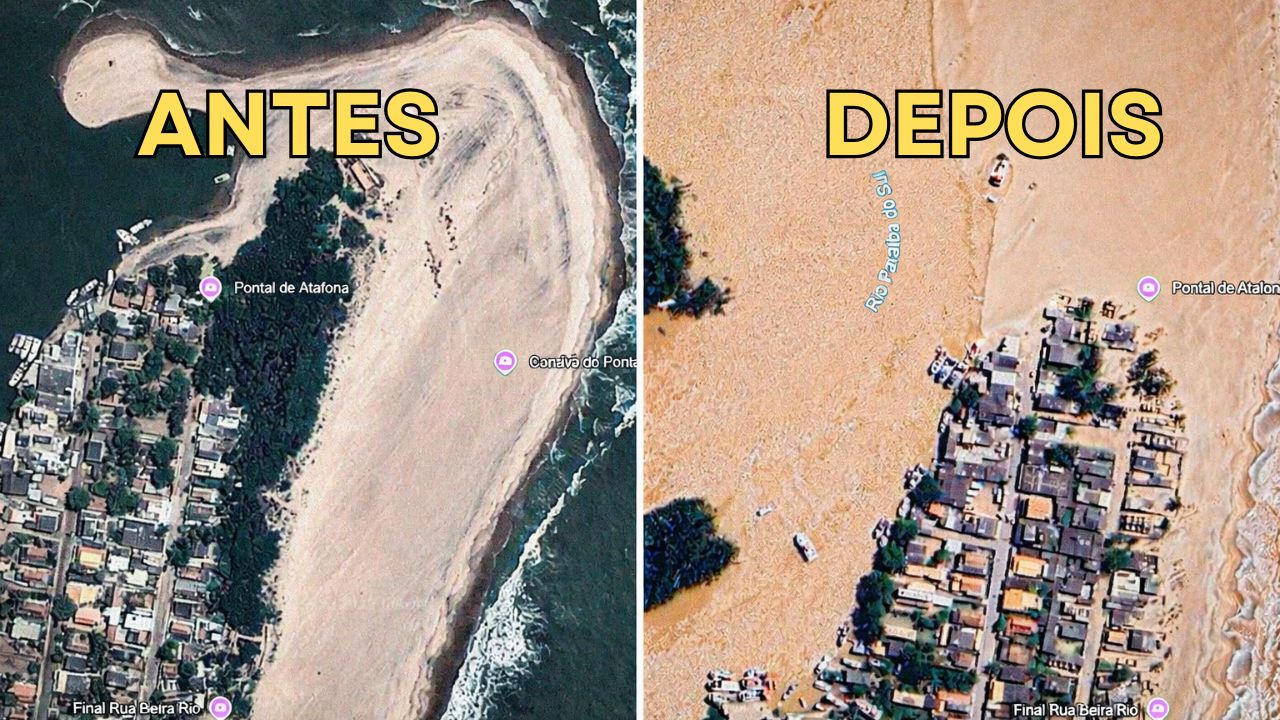


In Atafona, In Northern Fluminense, Brazilian City Sees The Sea Engulf Streets At An Accelerated Pace, While Fishermen Resist, Houses Disappear, And Experts Point Out Why Destruction May Advance Even More In The Coming Years.
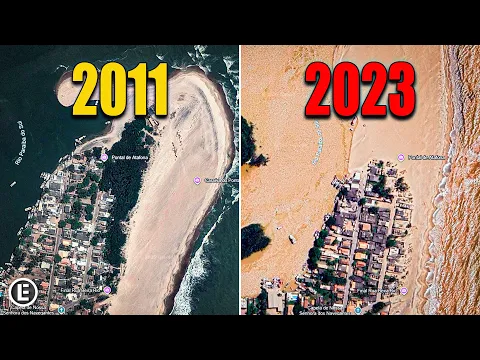
Atafona, in the municipality of São João da Barra, has become a stark portrait of how the coast can change before our eyes. In comparisons between 2011 and 2023, the Brazilian city sees the sea engulfing streets and advancing upon properties, leaving abandoned houses and, in some cases, blocked off by the Civil Defense.
Where Is Atafona And Why Is The Ground So Fragile
Atafona is located in the north of the state of Rio de Janeiro, in São João da Barra, at the mouth of the Paraíba do Sul River, where river and sea meet and form a delta. This area is a sedimentary plain, built over thousands of years by the accumulation of sand and other sediments.
This means one essential thing: it is a naturally unstable place, where the line between land and sea changes over time. When the Brazilian city sees the sea engulfing streets, it is not just a one-off change; it is a process that finds a vulnerable territory.
-
Man never set foot on the Moon? 5 scientific proofs confirm that humanity has been there and definitively dismantle conspiracy theories.

-
The Brazilian Army will adopt humanoid robots to test the concept of future combat, says a website, surprising everyone, but later revealing that it was all just an allusion to April Fool’s Day.

-
There is a city in China right next to Hong Kong where people speak Portuguese, the streets have names in Portuguese, and the architecture looks like it came straight out of a historic city in Brazil.
-
Rare frog thought to be extinct after only appearing in fossils reappears, becoming a ‘living relic’ of evolution and gaining a real path to spread after combating introduced predators.


From Fishing Community To Resort And Then The Visible Loss Of The Shoreline

The occupation of Atafona began in 1622 as a fishing community. Artisanal fishing sustains the local economy and shapes the way of life, with families divided between going to sea and preparing and selling the fish.
From the 1950s onwards, the district transforms with the arrival of summer visitors and becomes one of the best-known resorts in Northern Fluminense, with clubs, bars, restaurants, and busy streets. It is also during this phase that erosion stops being a back-and-forth of sand and starts to become an increasingly visible problem.
With urbanization right at the seaside, the sea begins to advance faster. Houses, streets, and businesses disappear, especially in areas like Pontal de Atafona. By the mid-2000s, more than 200 buildings had already been destroyed.
In some sections, the advance reaches 7 to 8 meters per year. Part of the sand removed from Atafona is carried by currents to Grussaí, which grows in proportion to Atafona’s diminishing area. This serves as a reminder that the coast functions as a system, and not as an isolated point.
Why Erosion Accelerates And Why It May Get Worse
The phrase the Brazilian city sees the sea engulfing streets is not explained by a single factor. The process involves natural and human causes.
On the natural side, there are the force of the waves, the prevailing northeast winds, and historical cycles of erosion that existed prior to the occupation of the shoreline. On the human side, there are the constructions of houses and streets very close to the sea and the more than 900 dams scattered throughout the Paraíba do Sul River basin.
These dams reduce flow and decrease the amount of sediments that the river carries to the coast. In practice, the beach loses part of the natural replenishment that would help sustain the sand strip.
There is also the factor of sea level. Between 1990 and 2020, the sea level in the region rose by 13 centimeters, and there is a projection of an additional rise of up to 21 centimeters by 2050.
In a fragile territory, this advance tends to worsen the situation, reinforcing why the Brazilian city sees the sea engulfing streets may cease to be an exception and become the rule.
The Impact Is Not Just Material: It Changes Work, Belonging, And Memory
The families of fishermen are among the most affected. Many lose their homes and workplaces, yet they remain because the sea is also their identity and sustenance.
At the same time, there are parallel issues: floods from the Paraíba do Sul River invade nearby streets and houses, the lack of drainage worsens damages, and strong winds displace dunes that encroach on homes.
Fishing is also suffering. With the sea advancing, fishing spots are pushed farther offshore, making the activity more difficult and costly. In a survey mentioned in the base, 15% of respondents cited the reduction of fishing as one of the most harmful consequences for the local economy.
In the real estate sector, many houses lose value, disappear, or are blocked due to structural insecurity. One resident, Sônia Ferreira, who has already lost two homes, summarizes the turnaround with a phrase that captures the shock: “I didn’t have a sea view when the house was built”.
And there is a silent layer. When a house is taken by the sea, it is not just bricks and concrete. It also carries pieces of the history of an entire community. That’s why older residents have started telling younger people about streets and references that no longer exist.
Daily Resistance And Why The Public Response Still Seems Insufficient
Even when the Brazilian city sees the sea engulfing streets, Atafona also sees people improvising to avoid losing what remains. On days of strong northeast winds, residents build barriers with boards, sandbags, and debris to try to hold back the advance of the sea and the movement of dunes.
Life inside the house also changes: furniture and appliances are raised to face recurring flooding. Meanwhile, the Civil Defense blocks off weakened structures, marking a risky daily routine.
On a collective level, there is mobilization for public policies, but the grassroots perception indicates an absence of effective action from the government to curb erosion.
Another relevant piece of data is that 100% of respondents had never heard of Integrated Coastal Management, an approach recommended to integrate community, academia, and government. Without coordination, the Brazilian city sees the sea engulfing streets and, at the same time, sees solutions becoming fragmented.
What Can Curb The Advance And The Risk Of Solving One Section And Worsening Another
Technical solutions exist, but they require criteria: artificial beach nourishment, groins, and works to dissipate wave energy can alleviate critical sections if they come with a study of sediment dynamics, continuous monitoring, and periodic maintenance.
Without planning and community participation, the intervention may only push the problem to another area and even worsen erosion.
While large projects remain on paper, adaptation continues in practice. Fishermen adjust their schedules, choose days with calmer seas, and change landing points as the beach shrinks. It’s operational survival, with increased risk and cost.
The grassroots also cites Brazilian examples that help illustrate the dilemma. In Balneário Camboriú, beach nourishment recovers sand strips and boosts tourism, but costs hundreds of millions and requires constant maintenance.
In Ceará, groins stabilize sections, but alter dynamics and cause sediment accumulation in neighboring areas. In the coast of São Paulo, replanting restinga vegetation shows that smaller and less costly actions can aid in fixing the sand.
For Atafona, any decision must consider not just technical effectiveness but also cultural identity and the community’s ability to adapt. In the end, what is at stake is not just geography: it is the survival of a way of life.
And now a quick question: in your opinion, when the Brazilian city sees the sea engulfing streets as in Atafona, should the priority be to invest in containment works or plan for an organized retreat of constructions away from the shoreline?



Planejar um recuo organizado das construções para longe da orla, tipo o mesmo cuidado que o governo tem em não construir as margens das Rodovias, deveria ser aplicado com relação ao mar. Isto é, usar o mesmo princípio e com mais rigor, após análise e estudos geológicos e científicos.
Contenção e planejamento urbano
Retirar os moradores mais rápido e dando condição digna possível.