





 Portuguese
  English
  Spanish
  6 min of reading
  20 comments


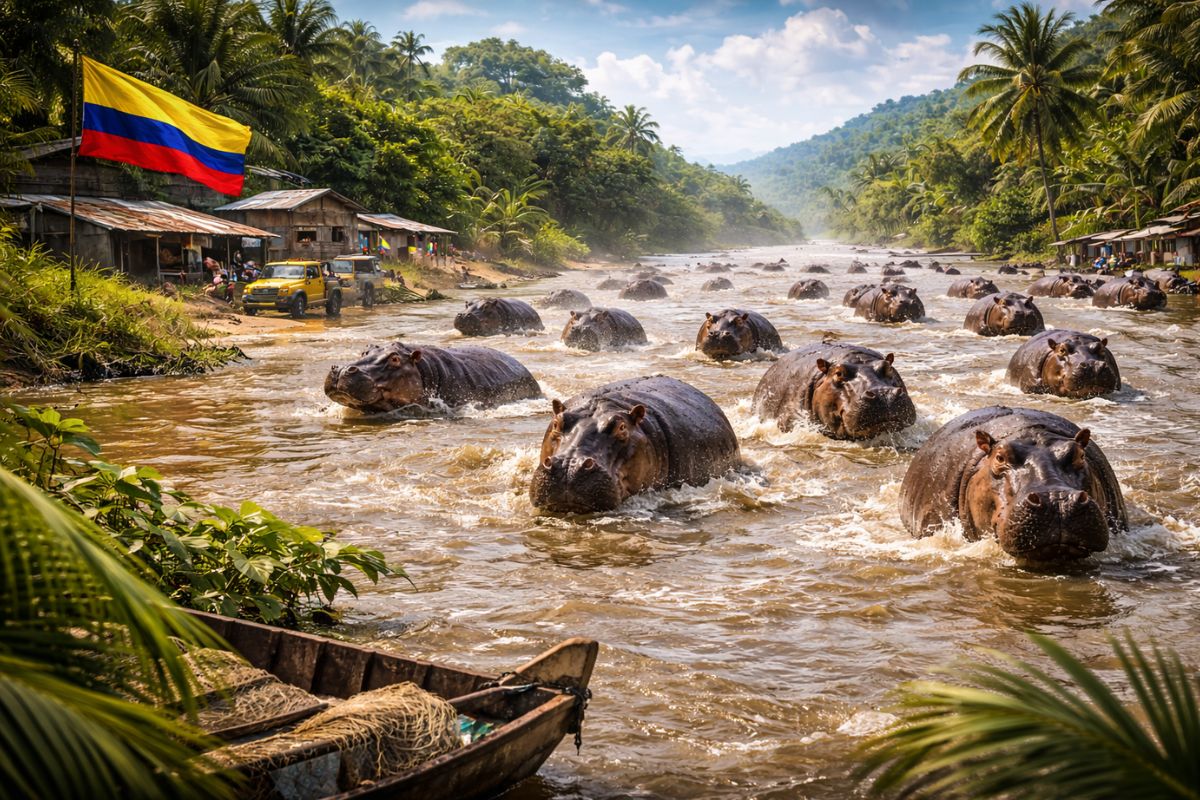


Thirty Years After The Death Of Pablo Escobar, The Invasion Of Hippos Is Spreading Through The Magdalena River, Having Already Traveled 300 Km From The Former Drug Trafficker’s Farm, Scaring Residents And Could Reach 1,400 Animals In Just Over Ten Years.
Colombia is currently experiencing an invasion of hippos that is anything but exotic or harmless. Descendants of just four animals illegally brought to Pablo Escobar’s private zoo in the 1980s, they have multiplied to form the largest herd of hippos living freely in the wild outside Africa, occupying lakes, roads, and stretches of one of the country’s most important rivers. The sight of a fisherman with six scars on his arm, destroyed cars from collisions, and families afraid to leave their homes shows that the problem has stopped being a curiosity and has turned into a public safety issue.
At the same time, this same invasion of hippos has become a tourist attraction, leading to a theme park, souvenirs, and jobs in the area of the former Anápolis Farm. After the property was abandoned and confiscated by the state, many animals were sent to zoos inside and outside Colombia, but the hippos remained, adapted to the climate, escaped the confines of the farm, and today present the country with a difficult dilemma: to cull, sterilize, relocate, or coexist with a charismatic, dangerous, and rapidly expanding invasive species.
How The Hippo Invasion Began On Pablo Escobar’s Farm
It all began when Pablo Escobar decided to set up a private zoo at the Anápolis Farm, about 180 km from Medellín.
-
HONOR X80i arrives with a massive 7,000 mAh battery, a 120 Hz AMOLED display with a brightness of 6,500 nits, and the new Dimensity 6500 Elite chip, promising up to 22 hours of video playback and impressive performance in casual gaming.

-
Xiaomi TV Stick HD 2 is announced with Google TV and dual-band Wi-Fi, offering 38% superior performance, HDR10+, Dolby Atmos, a quad-core chip, Mali-G31 GPU, 1 GB RAM, and support for 1080p at 60 Hz.

-
Brazil joins the select group of countries by producing a supersonic fighter that reaches 2,400 km/h with advanced electronic warfare technology, US$ 4 billion in investments, 36 units planned, 350 trained engineers, and unprecedented national production by 2032.

-
At the bottom of the sea, scientists have found a true underwater cathedral measuring 62 meters at the base, 31 meters at the top, and 1,347 square meters of giant coral in the Maug Islands, estimated to be 2,050 years old.

A millionaire, violent, and eccentric, he illegally imported hundreds of animals, including four hippos, one male and three females. At that time, no one imagined that this small group would become synonymous with hippo invasion decades later.
After Escobar’s death in 1993, the Anápolis Farm became the target of a legal dispute between the family and the Colombian government, was left abandoned for a long time, and ended up being confiscated by the state.
Most of the animals were transferred to other zoos in the country and even abroad, but the hippos were left behind.
According to biologist Davi Lopes from Cornare, capturing a hippo is expensive, risky, and logistically complicated, which weighed on the decision. Many thought that, left there, they would die out over time.
What happened was the opposite. The four hippos from Pablo Escobar survived, had offspring, grandchildren, and great-grandchildren, forming an expanding population that took advantage of abundant water, easy food, and the absence of natural predators.
In just a few years, what was a remnant of the private zoo turned into a runaway herd of more than 120 hippos, spread across the Colombian landscape.
From Private Zoo To The Largest Herd Of Hippos Outside Africa

Over time, the animals escaped the confines of the Anápolis Farm and reached the Magdalena River, one of the most important rivers in Colombia.
Today, hippos can be seen about 300 km away from the former farm, occupying stretches of rivers, lakes, and areas close to rural communities. This expansion is the most visible face of the hippo invasion in the country.
Natives of the African continent, hippos can weigh over 3 tons and, in Colombia, are more than 10,000 km away from their original habitat. Nevertheless, they have shown a great capacity for adaptation, found favorable conditions, and multiplied almost without control.
The result is that today the region hosts the largest herd of the species living freely in the wild outside Africa, something that was never planned by the state, scientists, or local communities.
Studies indicate that if nothing is done, the number of animals could jump from just over 120 to more than 1,400 hippos in just over a decade, consolidating a hippo invasion on a national scale.
The larger the population, the more difficult and expensive any control plan becomes, and the greater the risks to the environment and people.
When The Hippo Invasion Becomes A Case Of Safety And Environmental Health
The massive presence of hippos brings direct consequences for the region’s ecosystem. By constantly entering and exiting the water, they alter the chemical composition of lakes and rivers, which can affect fishing and water quality.
The intense movement also drives away other important species, such as manatees and capybaras, changing the natural balance of environments.
However, the problem is not solely ecological. Hippos are extremely aggressive animals, especially when they feel threatened or are protecting their young. The 33-year-old Colombian fisherman displaying six scars on his left arm is a symbol of this risk.
He was attacked while fishing at the edge of a lake for getting too close to a female with her calf, and admits that he now feels afraid to return to the spot where he was injured.
On the roads, the danger is also real. On a stretch of the Medellín–Bogotá highway, one hippo was hit by a car, died on the spot, and fortunately, the driver was uninjured.
In areas like the district of Puerto Triunfo, residents capture on video herds of hippos crossing dirt roads at night, or an animal passing under fences, very close to homes and businesses.
Although there are no recorded deaths caused by hippos in Colombia, in Africa, they are among the animals that kill the most humans, heightening the alert that the worst may happen if the hippo invasion continues to advance.
Hippos Between Fear, Tourism, And The Imaginary Of Pablo Escobar
Despite the risks, many residents view hippos with affection and as an opportunity. Tourists travel to the region to see up close the animals linked to the story of Pablo Escobar, generating jobs in hotels, snack bars, souvenir shops, and the theme park created at the former Anápolis Farm.
It is common to find miniatures, keychains, and decorative products featuring the image of the “rich ones,” as the animals are called.
In some areas, hippos have already become part of the everyday landscape. There are warning signs, but visitors often ignore the danger, enchanted by the scene of hippos roaming near lagoons, hotel entrances, and trails of a theme park.
For many merchants, the animals are the main attraction, and the idea of losing this source of income creates resistance to stricter control measures.
This mix of fear and fascination further complicates the management of the hippo invasion. When experts suggested culling part of the population to contain the invasive species, public opinion reacted strongly.
Residents and animal welfare advocates protested against the culling, arguing that hippos generate jobs and attract visitors, and that the solution should be found without exterminating all the animals.
How Colombia Is Trying To Control The Hippo Invasion Without Killing Them

Faced with social pressure and the rapid growth of the herd, environmental agencies have had to seek alternatives to culling, betting on more complex, slow, and expensive techniques.
One of the strategies is to perform sterilization and chemical castration surgeries, trying to reduce the fertility of hippos and slow the hippo invasion over time.
However, each procedure requires capturing the animal, sedating it, and operating safely, which represents a significant logistical challenge.
Another front is the transfer of some hippos to other countries. Zoos in India, Mexico, and Ecuador have already expressed interest in receiving some animals.
The plan is to lure the hippos with food into large steel containers, which would be closed and flown abroad.
The initial idea is to transfer more than 70 individuals in the coming months, alleviating the pressure on the Magdalena River and neighboring communities.
Not everyone agrees with a broad removal. There are residents who accept that a part of the hippos be taken away, but do not want to see all the animals go, either out of attachment or fear of losing tourist traffic.
In the midst of this, the hippo invasion continues to advance, and time is running against the authorities: the larger the population grows, the more expensive and challenging any form of control becomes.
Ultimately, Colombia needs to decide what future it wants for Pablo Escobar’s hippos and the Magdalena River, balancing safety, local economy, and environmental protection.
And you, in the same situation as the Colombians, would you accept partial culling to control the hippo invasion or only support sterilization and transfer to other countries?







As autoridades responsáveis precisam e devem criar soluções para o problema, castração seria a melhor forma de previnir a fauna e os empregos.
Abre uma temporada de caça, com regras por ex. O Governo emite X autorizações de caçar e vende aos caçadores. Vai movimentar o turismo….
Sem ser especialista no assunto,não vejo alternativa.O abate de parte desses animais é mais que necessária.Em mais ou menos,teremos vítimas fatais.Infelizmente.