





 Portuguese
  English
  Spanish
  6 min of reading
  0 comments


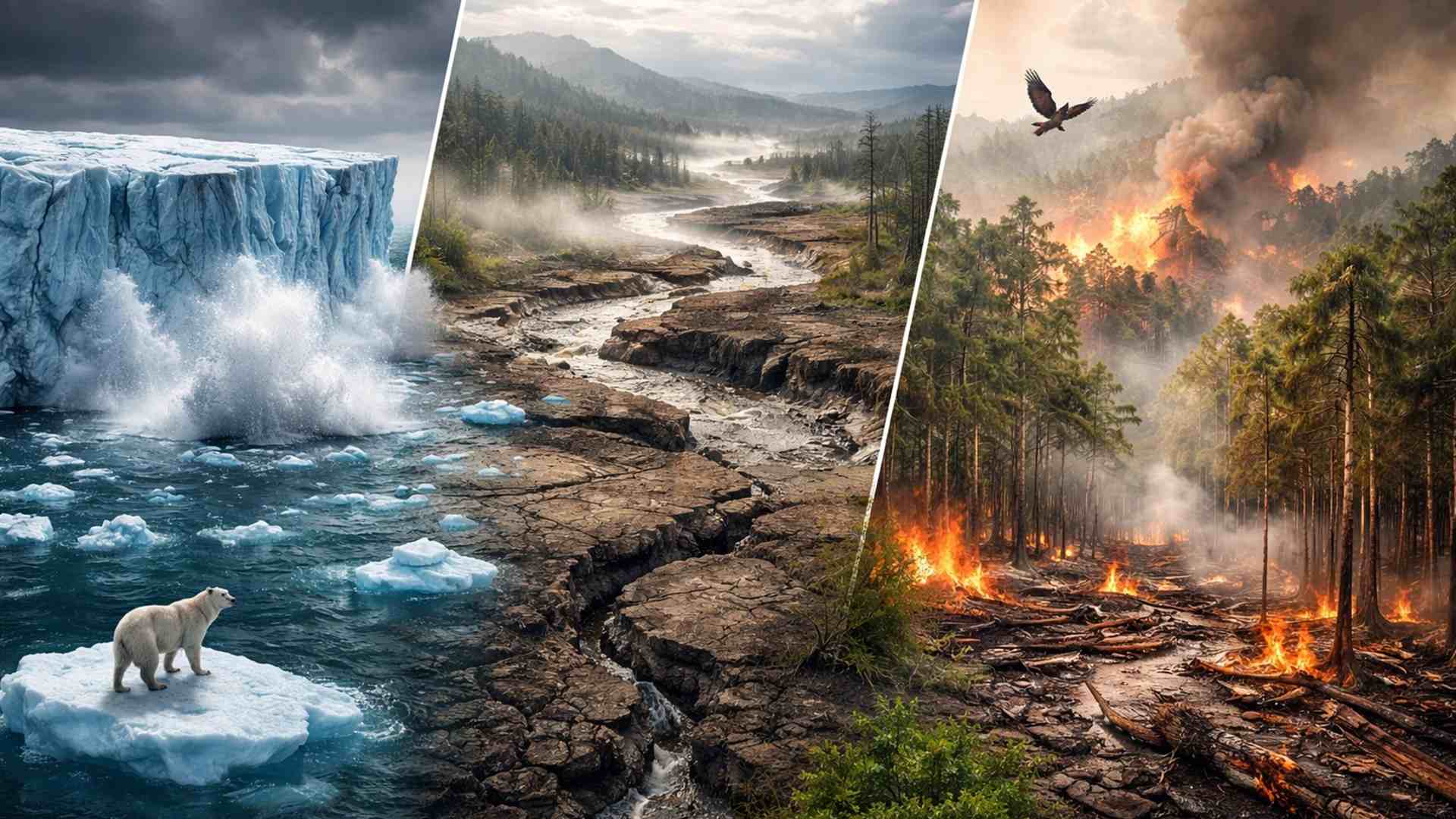
Recent Scientific Studies Indicate That Global Warming Is Pushing Interconnected Earth Systems To Cross Climatic Tipping Points, With Risks Of Irreversible Collapse Of Polar Ice Sheets, Rapid Melting Of Arctic Permafrost, Ocean Circulation Instability, And Functional Loss Of The Amazon Rainforest
Global warming caused by human emissions of greenhouse gases is pushing essential Earth systems toward tipping points capable of generating lasting and cascading changes, according to warnings from climate scientists, with potential impacts on polar ice, forests, and ocean circulation.
Researchers describe tipping points as critical thresholds in environmental systems, beyond which persistent transformations occur. Once crossed, these limits trigger feedback cycles that drive the system to a new state, often considered irreversible on human timescales.
Diverse potential tipping points have already been identified by climate scientists. Among the main ones are the collapse of polar ice sheets, melting of carbon-rich permafrost, and large-scale die-off of tropical forests. The ongoing advance of global warming raises the likelihood of crossing these thresholds.
-
HONOR X80i arrives with a massive 7,000 mAh battery, a 120 Hz AMOLED display with a brightness of 6,500 nits, and the new Dimensity 6500 Elite chip, promising up to 22 hours of video playback and impressive performance in casual gaming.

-
Xiaomi TV Stick HD 2 is announced with Google TV and dual-band Wi-Fi, offering 38% superior performance, HDR10+, Dolby Atmos, a quad-core chip, Mali-G31 GPU, 1 GB RAM, and support for 1080p at 60 Hz.

-
Brazil joins the select group of countries by producing a supersonic fighter that reaches 2,400 km/h with advanced electronic warfare technology, US$ 4 billion in investments, 36 units planned, 350 trained engineers, and unprecedented national production by 2032.

-
At the bottom of the sea, scientists have found a true underwater cathedral measuring 62 meters at the base, 31 meters at the top, and 1,347 square meters of giant coral in the Maug Islands, estimated to be 2,050 years old.


As the Earth’s systems are interconnected, the activation of one tipping point can trigger others in sequence. Researchers indicate that this dynamic creates a domino effect, in which changes in one system amplify instabilities in others, exacerbating global warming and its associated impacts.
In a report on the state of the climate in 2025, published on October 29 in the journal BioScience, scientists stated that crossing one tipping point could initiate cascades of new crossings. According to the document, most of these interactions tend to be destabilizing for the global climate system.
In the worst-case scenario described in the report, these cascades could push Earth’s climate onto a trajectory of extreme warming. Such a trajectory would result in a fundamentally different planet, with severe consequences for natural systems and humanity, the authors warn.
Feedback Loops And Greenhouse Gases
Current global warming is primarily driven by human activities that release large volumes of greenhouse gases into the atmosphere. Carbon dioxide and methane absorb radiation emitted by the Earth, retaining heat and raising global average temperatures.
The main source of these emissions is the burning of fossil fuels, such as coal, oil, and natural gas, used in energy generation. There are also natural processes that emit and absorb greenhouse gases, partially balancing the climate system.
The increase in temperatures can activate, intensify, or disrupt these natural processes. When this occurs, the rate of warming tends to accelerate, reinforcing feedback cycles that further amplify climate change.
The tipping points are driven precisely by these cycles. Elevated emissions lead to warming, which causes additional gas release, generating more warming. This mechanism creates a self-sustaining process that is difficult to interrupt after a certain threshold.
An example cited by scientists involves the oceans. As the waters warm, their ability to absorb carbon dioxide decreases, as gases dissolve less in warm liquids. Consequently, more CO₂ remains in the atmosphere, intensifying global warming.
Melting Of Arctic Permafrost
Among the most discussed tipping point scenarios is the melting of permafrost in the Arctic. This permanently frozen soil stores enormous amounts of carbon accumulated over thousands of years in the form of frozen organic matter.
With rising global temperatures, permafrost is beginning to thaw. This process releases carbon into the atmosphere, amplifying the greenhouse effect and promoting further warming, which accelerates melting in a continuous feedback cycle.
A 2024 study published in the journal PNAS indicated that permafrost plays a decisive role in water flow in Arctic regions. The melting of the soil may foster the formation and expansion of rivers, contributing to the additional release of carbon emissions.
Climate changes are particularly intense in the Arctic. Temperatures in the region are increasing about four times faster than the global average, a phenomenon known as Arctic amplification, which intensifies the risks associated with melting.
This accelerated warming is linked to the melting of sea ice. Ice reflects more sunlight than exposed water or soil. When the ice disappears, the surface absorbs more solar energy, further raising local temperatures.
Collapse Of Polar Ice Sheets

The loss of ice in the polar ice sheets of Greenland and West Antarctica has intensified since the 1990s, accompanying rising global temperatures. This trend directly contributes to sea level rise.
The increase in sea level represents a significant threat to coastal communities worldwide. Research suggests that these ice sheets may be approaching, or may have already crossed, tipping points that would lead to progressive collapse into the ocean.
Scientists do not yet know exactly how much additional warming is needed to push these ice sheets beyond their critical limits. In many cases, the tipping point only becomes evident after it has already been crossed.
Researchers warn that current human efforts to contain global warming may be insufficient to prevent the collapse of polar ice sheets. The uncertainty increases the risk of late responses and irreversible impacts.
In 2015, world leaders signed the Paris Agreement, pledging to limit global warming to less than 1.5 degrees Celsius, preferably, and well below 2 degrees Celsius. These limits aimed to reduce extreme climate risks.
A 2025 study published in the journal Communications Earth & Environment suggested that even a warming of 1.5 degrees Celsius could be excessive for the stability of polar ice sheets. The assessment indicates narrower safety margins than previously anticipated.
The United Nations recently announced that the world is not on track to meet the 1.5-degree Celsius goal. This deviation increases the likelihood of crossings of tipping points associated with polar ice.
The accelerated melting of Greenland could also affect other systems, such as the Atlantic Meridional Overturning Circulation. This current transports warm water to the North Atlantic and influences regional climate patterns.
If this circulation weakens or collapses, parts of the Northern Hemisphere could experience sharp drops in temperature. This effect illustrates how a single tipping point can generate contradictory and wide-ranging climate impacts.
Amazon Rainforest At Risk
The Amazon rainforest is often referred to as the “lungs of the planet,” but scientists consider this description inaccurate. Although it absorbs carbon dioxide through photosynthesis, the ocean has always been a larger carbon sink.
Research indicates that the Amazon’s capacity to absorb carbon is deteriorating. A 2021 study published in the journal Nature showed that the forest has begun to emit more carbon than it absorbs, reversing its historical role.
This reversal is primarily attributed to human activities, such as deforestation and controlled burning for agricultural and industrial expansion. The fires release carbon and are intensified by warmer and drier conditions.
Climate warming makes the forest more vulnerable to fire, while the fires reinforce the warming, creating a destructive feedback loop. This process compromises the long-term resilience of the Amazon ecosystem.
Some scientists warn that the combination of climate change and deforestation could push the Amazon to a tipping point. In this scenario, the forest could transform into a dry savanna over the course of about a century.
Not all researchers agree with this assessment, highlighting uncertainties about the exact limits of the system. Nonetheless, the growing risk worries scientists due to the global climate implications of forest loss.
Emission Reduction As A Response
The consequences of global warming and tipping points are complex, but the main cause is straightforward. The increase in temperatures results from the continuous release of carbon dioxide and other greenhouse gases into the atmosphere.
The degree of observed warming is directly related to the accumulated volume of emissions. Therefore, reducing emissions is pointed out as the most effective means of limiting warming and decreasing the risk of crossing critical tipping points.
Experts emphasize that delays in action increase risks and costs. Each additional year of elevated emissions reduces the leeway to avoid severe and potentially irreversible impacts on the climate system.
According to William Ripple, professor emeritus of ecology at Oregon State University and coauthor of the State of the Climate 2025 report, it is still possible to limit the damage if humanity acts as if faced with a real emergency, acknowledging the climate urgency.
This article was prepared based on reports and scientific analyses published by the journal BioScience, by PNAS, and by Nature, by Communications Earth & Environment.






-

-

2 pessoas reagiram a isso.