





 Portuguese
  English
  Spanish
  3 min of reading
  0 comments


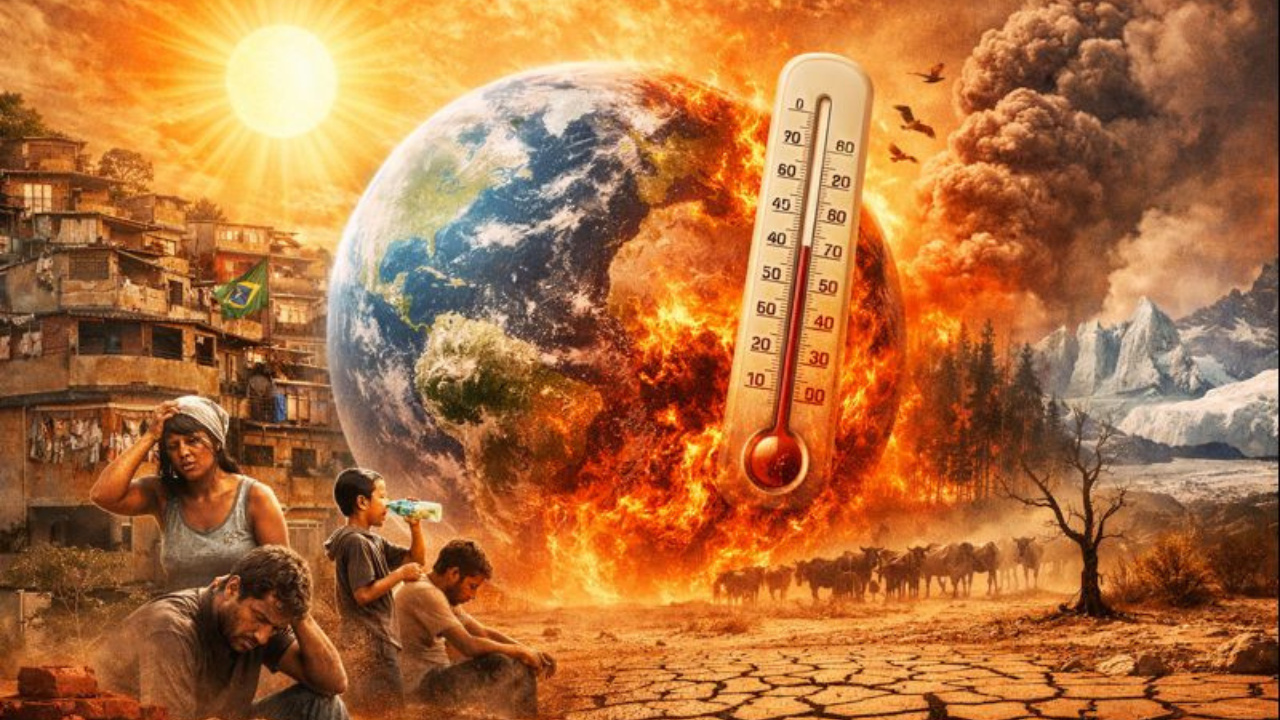
Extreme Heat Could Affect 3.79 Billion People By 2050 As Global Warming And Climate Change Advance.
The advance of extreme heat, driven by global warming, could put almost half of the world’s population at risk by 2050, according to a study by the University of Oxford published in the journal Nature Sustainability.
The research estimates that 3.79 billion people will be exposed to severe temperatures if the global average exceeds 2 °C above pre-industrial levels, a scenario that is increasingly likely.
The phenomenon will have a global reach, affecting tropical countries and cold regions and will require urgent responses for climate adaptation to avoid unprecedented social, economic, and structural impacts.
-
6 sources of free fertilizer that you are throwing away every day and can transform your garden without spending anything.

-
With a water crisis on the radar, Sabesp invests in reclaimed water for data centers and transforms sewage treatment into a solution that saves millions of liters and protects public supply.

-
Foresea achieves 100% offshore waste reuse in 2025, eliminates landfill disposal, and consolidates sustainable strategy with 1,500 tons recycled.

-
With earth, bamboo, straw, and lime mortar, a specialist builds a house for just over $460 and draws attention for its cost being much lower than traditional construction.


Climate Impact By 2050 Expected To Be Five Times Higher Than In 2010
The study reveals that the climate impact by 2050 will be dramatically higher than observed in recent decades.
Compared to 2010, the number of people exposed to extreme heat could be up to five times greater if global warming reaches 2 °C.
This growth is not limited to historically hot regions.
While tropical countries concentrate much of the vulnerable population, traditionally cold areas will also face abrupt changes in thermal patterns, increasing the risks associated with climate change.
Brazil Will Be Among The Countries Most Affected By Extreme Heat
Among the countries most affected by extreme heat are Brazil, Central African Republic, Nigeria, South Sudan, and Laos.
In these regions, the combination of high temperatures, population growth, and structural limitations increases social vulnerability.
In the case of Brazil, global warming is expected to intensify heatwaves, pressure health systems, reduce economic productivity, and exacerbate regional inequalities, especially in densely populated urban areas and regions already sensitive to climate.
Cold Countries Will Also Feel Severe Effects Of Climate Change
On the other hand, the study shows that cold climate nations are not immune to the climate impact by 2050.
Compared to the period from 2006 to 2016, when the global average temperature rose by 1 °C, a warming of 2 °C could double or even triple the number of extreme heat days.
The researchers note increases of 100% in Austria and Canada, 150% in the United Kingdom, Sweden, and Finland, 200% in Norway, and up to 230% in Ireland.
This leap highlights how climate change affects even regions considered resilient.
Unprepared Infrastructure Increases Extreme Heat Risks
One of the main warnings from the study relates to infrastructure. In cold countries, buildings, electrical networks, and urban systems were designed to retain heat, not to dissipate it.
Thus, even moderate increases in temperature can generate disproportionate impacts.
“Our study shows that most of the changes in demand for heating and cooling occur before we reach the limit of 1.5 °C, which will require the implementation of significant adaptation measures as soon as possible,” highlights Jesus Lizana, a professor of engineering sciences at Oxford.
Climate Adaptation And The Construction Sector At The Center Of The Solution
Moreover, Lizana emphasizes that achieving net zero emissions by 2050 necessarily involves transforming the construction sector.
According to him, it will be necessary to decarbonize buildings while simultaneously investing in more efficient and resilient climate adaptation.
This adaptation includes better thermal insulation, passive cooling, smart urban planning, and energy systems capable of supporting demand spikes caused by extreme heat.
Extreme Heat Affects Health, Education, And Migration
In a statement, Radhika Khosla, leader of the Oxford Martin Programme Future of Cooling, reinforces that the warning goes beyond environmental issues.
“Exceeding the 1.5 °C warming limit will have unprecedented impacts on everything from education and health to migration and agriculture,” she states.
According to her, sustainable development with net zero emissions is the only proven way to curb rising temperatures.
Why Action Now Is Essential In Light Of The Climate Impact By 2050
Therefore, the study makes it clear that the effects of extreme heat are not a distant problem.
They are already underway and are expected to intensify rapidly, requiring immediate political, economic, and social decisions.
Meanwhile, experts emphasize that limiting global warming and accelerating climate adaptation strategies are indispensable actions to reduce human and economic losses in the face of the inevitable advance of climate change.
See more at: By 2050, Almost Half Of The Population Will Live Under Extreme Heat









-

Uma pessoa reagiu a isso.