





 Portuguese
  English
  Spanish
  4 min of reading
  0 comments


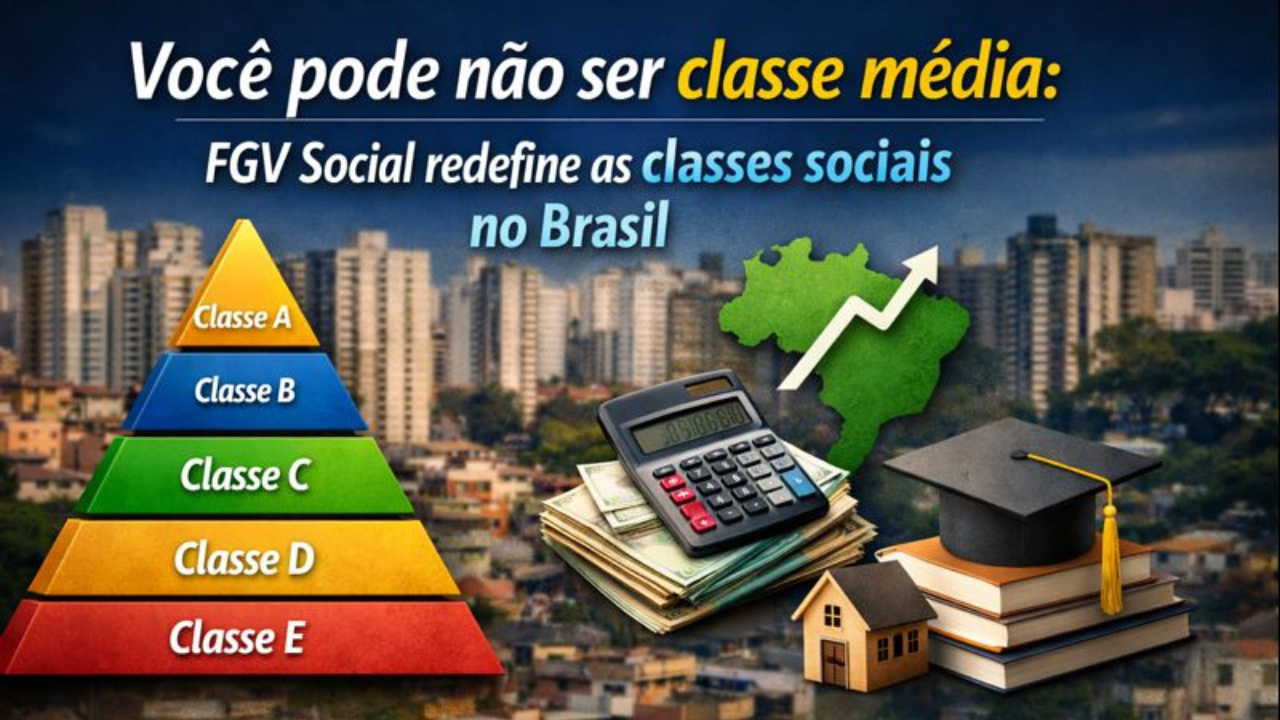
New Study on Social Classes and Per Capita Income Changes the Portrait of the Middle Class and Economic Mobility in Brazil.
Many Brazilians believe they belong to the middle class, but this perception may be outdated.
A new study by FGV Social revealed significant changes in the way of classifying social classes in Brazil. The survey, released in 2024, was conducted by economist Marcelo Neri and uses per capita income as the central criterion.
The proposal seeks to more accurately reflect the current economic reality of the country and explain why millions of families have shifted social class in recent years.
-
Lula responds directly to Trump and says that Pix is from Brazil and will not change under pressure from anyone, after a report from the United States pointed out the Brazilian payment system as an American trade barrier.

-
Amazon has just announced a new fee on all deliveries, and your online purchases will become more expensive starting April 17, including for those buying from the United States here in Brazil.

-
He sold his share for R$ 4 thousand, saw the company become a giant worth R$ 19 trillion, and missed the opportunity of a lifetime.

-
Elon Musk’s Starship megafrocket puts $8 billion at risk, raises alarms in the market, and could affect technology, mining, and space internet startups in the coming years.


Right from the start, the study answers the main questions: what has changed, who analyzed it, when the data was consolidated, where the methodology is applied, how the classes are defined, and why per capita income became the starting point.
The answer lies in the transformation of the profile of Brazilian families and the direct impact of this on economic mobility.
How the Study Redefines Social Classes in Brazil
The research “Evolution of Brazilian Economic Classes: 1976 to 2024” updates the way of viewing social classes by considering total household income adjusted for the number of residents and corrected by official inflation, the IPCA.
This adjustment is fundamental.
In recent decades, the average size of families has consistently decreased.
Therefore, looking only at total household income has begun to generate distortions, especially when comparing different historical periods.
Thus, FGV Social adopted a model that brings the statistical concept closer to the reality experienced by Brazilian families.
How Much You Need to Earn to Be in Each Social Class
Based on average values from 2023, the study establishes clear income ranges for defining each social group.
These numbers include salaries, pensions, social benefits, rents, and other sources of income.
Class A: above R$ 14,191, Class B: between R$ 10,885 and R$ 14,191, Class C (middle class): between R$ 2,525 and R$ 10,885, Class D: between R$ 1,580 and R$ 2,525, and Class E: up to R$ 1,580.
Although these values serve as a statistical reference, they do not consider accumulated wealth or regional differences in the cost of living, such as those between large capitals and interior cities.
Middle Class Dominates the Country in 2024
The most relevant data from the survey is the consolidation of the middle class as the largest social group in Brazil.
By 2024, Class C became home to 60.9% of the population, becoming dominant in the national socioeconomic portrait.
When combined with Classes A, B, and C—referred to as the “expanded middle class”—the percentage reaches 78.1% of the population, the highest level since the start of the historical series in 1976.
This movement indicates a structural change in social classes, primarily driven by the labor market and increased access to education.
Economic Mobility Gains Strength in Recent Years
Another highlight of the study is the advancement of economic mobility. Between 2022 and 2024, approximately 17.4 million Brazilians migrated to Classes A, B, or C.
At the same time, Classes D and E, which represent the base of the social pyramid, receded to 21.8% of the population, the lowest level ever recorded.
This indicates that despite economic challenges, more families have managed to increase their income.
This movement does not occur uniformly but shows a positive trend in the medium term.
Education Remains a Watershed
The research reinforces that the level of education continues to be the main factor of differentiation among social classes.
Households led by individuals with a complete higher education have a much higher probability of belonging to Classes A and B.
Meanwhile, families with lower levels of education remain more vulnerable to economic fluctuations, even when there is a temporary increase in income.
Therefore, education remains the most relevant structural element for sustainable social ascension.
Why Per Capita Income Is the Fairest Criterion
FGV Social highlights that per capita income provides a more accurate reading of economic well-being.
A household with five residents and a total income of R$ 3,000 faces a very different reality than someone living alone with the same amount.
By dividing the income by the number of people, it is possible to better compare living conditions, consumption patterns, and access to opportunities over time.
Still, the study emphasizes that income is not the only factor.
Social position also depends on access to public services, financial security, and future prospects.
A New Portrait of Brazilian Social Classes
In summary, the survey shows that Brazil in 2024 is predominantly made up of the middle class, with significant advancements in economic mobility and a reduction in the poorest base.
At the same time, it highlights that individual perception does not always align with real data.
Understanding these changes helps qualify public debate, guide social policies, and adjust expectations about the true place of each family in the structure of social classes in Brazil.
See more at: You Think You’re Middle Class? You Might Be Wrong: New Study Redefines Socioeconomic Classes in Brazil








-

-

-

3 pessoas reagiram a isso.