





 Portuguese
  English
  Spanish
  5 min of reading
  0 comments


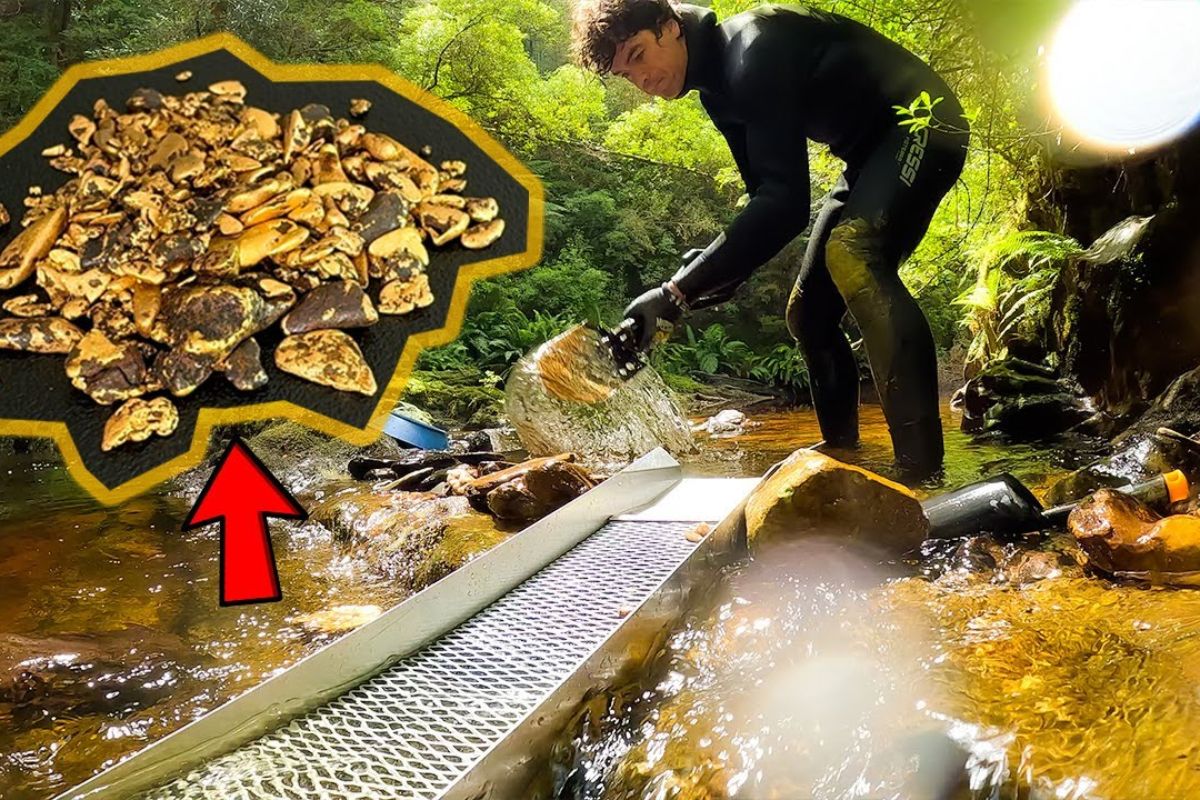
On The Wild West Coast, A Prospector Returns To The Tasmanian River To Test Why Alluvial Gold Concentrates In Invisible Fissures. Among Black Sands, Compacted Clay And Waterfalls, He Records Nugget Weights, Compares Days Of 12.69 G And 10.41 G, And Suggests Up To US$ 1,000 In A Few Hours
In the Tasmanian river, a prospector camped on the west coast reports that gold does not “appear by luck,” but through repeated patterns. The focus is on fissures submerged in the bedrock, where the current deposits heavy materials, and on black sands that serve as a sign of concentration. The declared goal is to surpass the previous mark of over 22 grams.
The scene draws attention because the promised value does not come from sophisticated machinery, but from environmental reading, patience, and recording. Still, the same scenario that favors nuggets also comes with a price: cold water, irregular beds, low visibility, and quick decisions near rapids and waterfalls. It is a type of search that requires caution, local rules, and environmental responsibility.
A Repetitive Prospecting In The Tasmanian River

The account begins with a simple routine: moving down the Tasmanian river to reach stretches that, under normal conditions, remain hidden by the flow and the tangle of logs.
-
Goodbye iron: new technology from Xiaomi promises to revolutionize the way we iron clothes with 500 kPa steam, continuous flow of 120 g/min, heating in 65 seconds, and six smart modes for different fabrics.

-
Rio Pardo, the most mysterious city in Rio Grande do Sul: untouched Pampas castle, the missing treasure of the Devil Boy, bride’s saint, invisible tunnels, and a 200-year curse today.

-
China retires the J-7 fighter after years of military protection and can now transform military items into drones, following more than 60 years of operation of the J-7, derived from the MiG-21, with thousands of units produced and strategic use in the PLAAF and PLANAF.

-
Volunteers are sought to live in the mountains for a month: a study pays people to stay at 2,500 meters, with 24-hour monitoring of sleep, metabolism, and blood pressure.

The bet is that alluvial gold continues to follow the same “grain” of the bed, even when access changes, and that daily repetition depends more on where one looks than on how much one carries.
The central point is that the environment acts as a natural sifting process. Where the water speed increases, the lighter sediment is swept away; where the energy drops, the heavy materials remain.
It is in this alternation between acceleration and calm that nuggets end up settling, and the narrative insists that reading the forms of the channel is worth more than any promise of ease.
Why Fissures Become Traps For Gold

The technical explanation revolves around the exposed bedrock. Fissures, cracks, and natural steps create microzones of turbulence and “dropout,” reducing local energy and allowing gold, magnetite, and dense fragments to settle.
When the water rises again, the bed is reworked, but the deep fissures continue to serve as shelters.
Throughout the day, the prospector describes the same logic in different scenarios: behind obstacles, at the base of waterfalls, and in small cavities that only appear with the right light.
The recurring detail is the contrast between the smooth surface and the rough interior of the fissures, where grains and nuggets find friction to avoid returning to the main current.
Black Sands As A Thermometer For What Is Hidden

The presence of black sands appears as a “thermometer” of concentration because they tend to accompany the heavier minerals that resist transport.
In the record, the dark material dominates the bottom of the pan and capture mat, suggesting that the system is retaining heavies at the highest part of the flow.
At the same time, black sands are not an automatic synonym for wealth. They indicate that the river is sorting by density, but the valuable fraction still depends on where the current loses strength and how much material has been recently reworked.
The implicit message is that the shine of gold comes after the “black”, when the natural sifting has already done part of the job.
Current, Clay And The “Glue” Effect In The Bed
A recurring element is the compacted clay. In low-energy environments, clay forms layers that trap fine particles and also larger fragments, creating a temporary “sealing.”
When the material is disaggregated, part of the gold appears mixed with heavy sand grains, requiring attention to what remains at the bottom.
The current, in turn, is treated as a tool. When well-directed, it removes light gravel and exposes what was trapped, but when it is too strong, it can also wash away part of the concentrate.
The technical point is not to romanticize the effort, but to understand how water reorganizes the bed and why certain zones repeat results in the Tasmanian river.
Nuggets, Weights And What The Number Really Means
The day’s record alternates between moments of frustration and quick findings. At one stage, “nice pieces” appear after about half an hour of processing; at another, a fissure behind a waterfall delivers thicker nuggets, including a piece described as “egg” with an estimated weight close to 1 gram.
The total reported for two days reaches 23.13 g, with 12.69 g on the first day and 10.41 g on the second.
Turning this into money is less straightforward than it seems, even when talking about values above US$ 1,000 in a few hours. Weight, purity, shape, and ease of commercialization alter the equation, and the narrative itself suggests that “value” is a possible ceiling, not a guarantee.
What the numbers clearly show is the consistency of method, not a certainty of return for any attempt.
Safety, Legality And Impact In The Tasmanian River
The aesthetics of the find often hide the real risk: slippery bed, strong current, submerged objects, and the possibility of getting stuck in narrow fissures. In such accounts, a common mistake is to confuse persistence with invulnerability.
In the field, safety is the primary variable, especially when the work nears rapids and waterfalls.
There is also the legal and environmental layer. Even when it comes to alluvial gold and small nuggets, extraction and intervention in waterways can be regulated, and remote areas often have specific rules to minimize siltation and harm to the habitat.
The case of the Tasmanian river reinforces a simple idea: reading the environment cannot ignore the environment.
In the end, what stands out is not the promise of wealth, but how a Tasmanian river repeats signals: black sands before the shine, fissures as shelters, and nuggets emerging where the energy of the water drops. If there is a “secret,” it lies more in reading the bed than in the strength of the arm.
What was the strangest clue you ever saw in a river, black sands, iron stones, a “perfect” fissure, or none of that? And, if you had to bet, what weighs more in finding gold responsibly: daily persistence, knowledge of the terrain, or sheer luck?








-

-

3 pessoas reagiram a isso.