





 Portuguese
  English
  Spanish
  8 min of reading
  0 comments


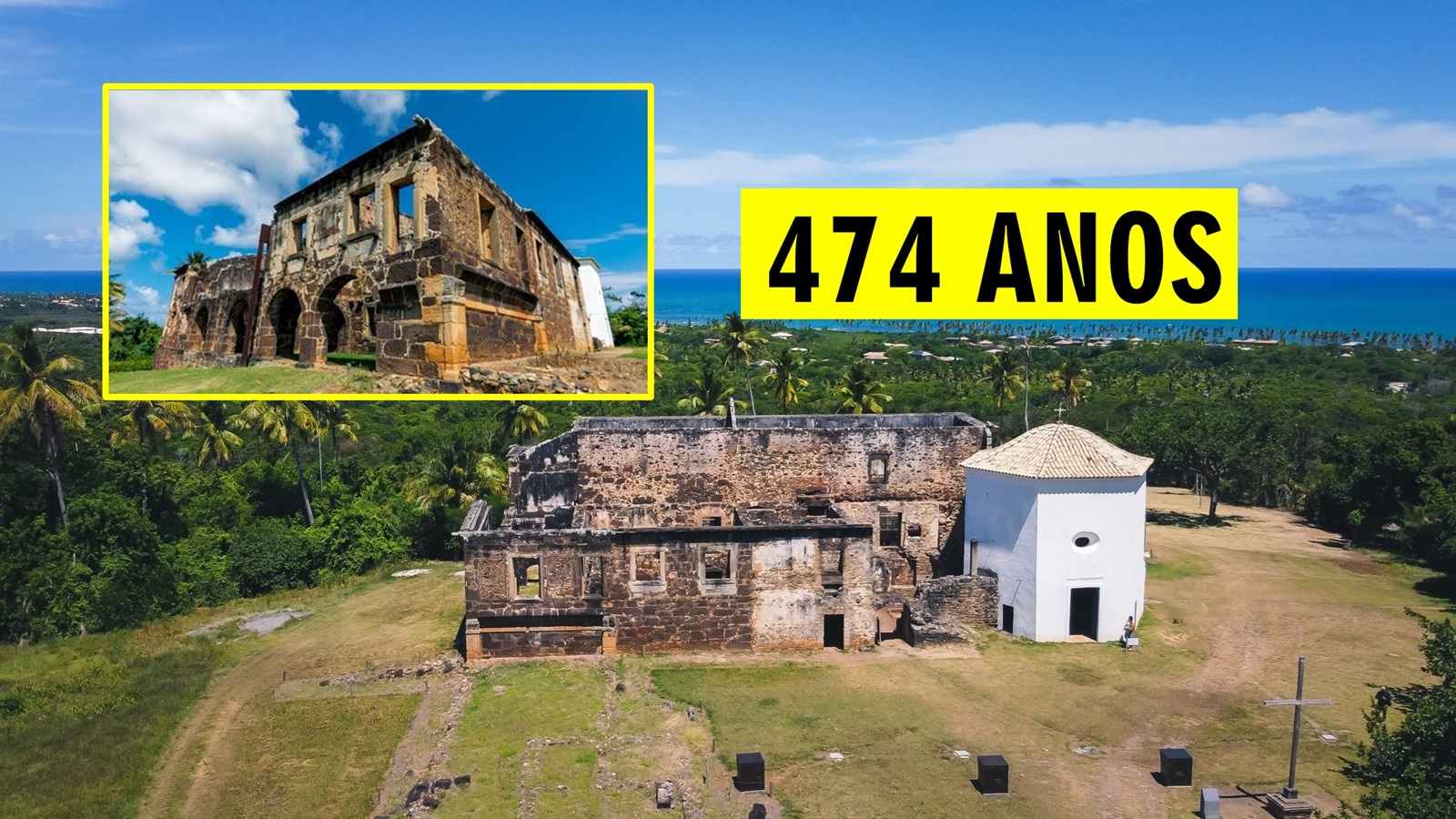
Perched on top of a hill at Praia do Forte, the Casa da Torre de Garcia d’Ávila is one of the most impressive legacies of colonial Brazil. With 474 years, it was the first construction with medieval features in the Americas, combining fortress, residence, and chapel. From its stone walls, the d’Ávila family commanded the coast and the hinterlands of Bahia for almost three centuries.
Few places in colonial Brazil gathered as much wealth, power, and history as the Casa da Torre de Garcia d’Ávila, an imposing fortress built in the 16th century atop a hill at what is now Praia do Forte, Bahia.
Built from stone and lime, resembling a European castle with a stunning view of the Atlantic, it housed one of the most powerful families of the colonial period for nearly 300 years.
A symbol of the Portuguese advance into the interior, it was the center of a domain that covered areas equivalent to several states in the Northeast.
-
The village where two rivers run side by side without mixing in Santarém and Alter do Chão reveals some of the most beautiful freshwater beaches on the planet.

-
Brazil’s nuclear submarine with a speed 5 times greater than normal advances after nearly 50 years and R$ 40 billion spent.

-
A Brazilian island charges R$ 0.50 to receive visitors and prohibits any new residents.
-
Why was the Great Wall of China built? The truth that many are unaware of!


Today, in ruins, it remains one of the most important landmarks of colonization and Luso-Brazilian architecture.
Foundation and Construction of the Castle
The story begins in 1549, when Tomé de Sousa arrived in Bahia to found Salvador, accompanied by a young Portuguese nobleman named Garcia d’Ávila.
Appointed storekeeper and manager of the new city, d’Ávila soon distinguished himself for his loyalty and administrative skills.
In 1552, he received a land grant of two leagues and some heads of cattle brought from Cape Verde, initiating cattle ranching in the region.
Land grant was a form of land concession used by Portugal during the colonial period.
A few years later, the nobleman decided to erect a stronghouse on his lands to protect the territory and serve as a residence.
The construction, which began around 1551, is considered the first major civil Portuguese building in Brazil.
The complex included a residence, watchtower, and chapel, initially known as Torre Singela de São Pedro.
Its stone and lime structure, the battlements, and its strategic seaside location gave it the appearance of a medieval fortification, a rare style on the American continent.
The work took decades to complete. Only around 1624, under the command of Francisco Dias d’Ávila, the founder’s grandson, did Casa da Torre take the shape that would make it famous.
The thick walls, bastions, and wide ocean view made it a militarily strategic point and, at the same time, a symbol of the family’s prosperity.
Atop the hill, the fortress dominated the landscape and controlled both the coast and the nearby hinterlands.
The Garcia d’Ávila Dynasty and the Land Grant System
The fortune of the d’Ávila family began with the land. Thanks to the land grants given by the Crown, the family built a true rural empire stretching from Bahia to Piauí.
In 1563, Garcia d’Ávila received a new land grant — six leagues of coastline by fourteen leagues deep — becoming one of the largest landowners in the colony.
When he died in 1609 at the age of 90, he left behind a vast fortune that would pass to his grandson Francisco Dias d’Ávila, the first heir of Casa da Torre.
Francisco further expanded the family domain. In 1624, King Philip IV authorized him to “open up the hinterlands,” or in other words, to conquer and colonize lands in the interior.
This permission, along with the family’s economic power and military strength, led to the creation of an almost feudal dynasty.
The Garcia d’Ávila family controlled farms, cattle routes, settlements, and even indigenous villages, expanding their holdings for centuries.
At its peak, the territory administered from Casa da Torre reached over 260 leagues along the São Francisco River, according to records from 1711 by chronicler André João Antonil.
This area was equivalent to two modern states in the Northeast. Thus, the Casa da Torre became a symbol of a model of autonomous rural power, sustained by land grants, indigenous slavery, and extensive cattle ranching — the so-called “d’Ávila feudal estate.”
A Decisive Economic and Military Center
Casa da Torre was not just a residence but the heart of an economic and military empire.
Its main source of wealth was <strong)cattle ranching, an activity introduced by Garcia d’Ávila and responsible for supplying farms and settlements with meat, leather, and draft animals.
The family created the first cattle routes in Brazil, connecting the coast to the hinterlands and later to the mining areas of Minas Gerais. The famous “Caminho da Bahia” originated from their farms.
The economic power also sustained a defense structure. Casa da Torre, situated in an elevated position, served as a coastal observation post.
Through signals of smoke and torches, the sentinels alerted Salvador about the approach of enemy ships.
This network of communication was essential in defenses against French privateers in the 16th century and against the Dutch invasion in the 17th century.
Francisco Dias d’Ávila actively participated in the expulsion of the Dutch from Bahia in 1625 and provided men and resources for new campaigns until 1640.
The castle housed a small private army, formed by cowhands and allied Indians. These groups, besides defending the region, were used in expeditions to conquer and capture indigenous people in the interior — a common practice at the time of territorial expansion.
Over three centuries, Casa da Torre functioned as barracks, farm, fortress, and administrative center.
No other private property in colonial Brazil exerted such territorial power. Therefore, scholars like Pedro Calmon and Moniz Bandeira referred to it as “the seat of the first private empire of Brazil“.
Architecture: Between the Castle and the Sugar Mill
Casa da Torre impresses to this day with its hybrid architecture, a blend of European fortress and tropical manor house.
Built with local limestone and shell lime, it had walls up to two meters thick and narrow windows suitable for defense.
The layout followed the model of Portuguese medieval stronghouses, with a watchtower, inner courtyard, and residential dependencies arranged around.
Integrated into the complex, the Chapel of Our Lady of Conception was built in the 16th century and expanded in the 17th.
Its hexagonal shape and stone doors reflect influences of the Manueline style, and part of the original structure is still preserved. It was the religious center of the property, where the family held baptisms and private masses.
During the 17th and 18th centuries, the complex was expanded, incorporating residential wings and service courtyards.
Although resembling a castle, the site also functioned as a subsistence sugar mill, with storage facilities, slave quarters, and pens. This combination of manor house, fortress, and farm is what makes the building a unique example in Latin America.
In the 19th century, with the family’s loss of prestige, maintenance ceased. Parts of the roof collapsed, and the interior was looted. Today, only walls, arches, and foundations remain, which, even in ruins, still reveal the grandeur of the original construction.
Notable Figures of the Lineage
The history of Casa da Torre intertwines with that of its owners. Among the main figures are:
- Garcia d’Ávila (1528–1609): the founder, considered the first major landowner in Brazil. He arrived in Bahia in the entourage of Tomé de Sousa and introduced cattle ranching to the country.
- Francisco Dias d’Ávila (c.1575–1641): the founder’s grandson and first heir. He was a warrior, explorer, and administrator, responsible for consolidating the family’s power and expanding their lands into the hinterlands.
- Garcia d’Ávila II (1609–1658): continued the policy of alliances and expanded the domains, facing Jesuit missionaries and competitors like Casa da Ponte, from the Guedes de Brito family.
- Luís Pires de Carvalho e Albuquerque (Viscount of the Torre de Garcia d’Ávila, 1789–1847): a direct descendant who supported the Independence of Bahia in 1823 and received a nobility title in the Empire. Under his administration, the power of the d’Ávila family was already declining.
There is also a legendary figure associated with the lineage: Diogo Álvares Correia, the Caramuru, a Portuguese castaway who lived among the Tupinambás and married Paraguaçu. Part of the genealogy of the Garcia d’Ávila family traces back to him, uniting indigenous and European blood in the family’s origin.
Decline and Abandonment
The decline began in the early 19th century. Political and economic changes after Independence weakened the old manorial houses.
In 1835, the law that abolished the heirs ended hereditary ownership of the domains, fragmenting the properties.
Additionally, the crisis of the sugarcane crop reduced revenues and led to the progressive abandonment of the castle.
By around 1850, Casa da Torre was in ruins. Parts of the structure were dismantled for repurposing the stones, and the site was slowly consumed by vegetation.
Although it served as a base for liberating troops during the independence wars in Bahia, it never returned to being inhabited.
During the 20th century, the ruins became a point of curiosity and study. In 1938, the then National Institute of Historical and Artistic Heritage (SPHAN, now IPHAN) officially registered the complex, recognizing its historical and architectural value. It was one of the first Brazilian monuments in ruins to receive federal protection.
In the 1970s and 1980s, teams from IPHAN and the Federal University of Bahia conducted archaeological excavations and consolidation works, preventing collapses.
The chapel was restored and preserves original elements such as the altar and the baptismal font. The castle was maintained as a consolidated ruin, without artificial reconstructions, respecting its authenticity.
Casa da Torre Today
Currently, Casa da Torre is part of the Garcia d’Ávila Historical Park, maintained by the Garcia D’Ávila Foundation in partnership with IPHAN.
The space houses an interactive museum that recreates, with projections and models, the history of the castle and the family. There are also exhibitions on archaeology, slavery, cattle ranching, and the land grant system.
The ruins are surrounded by coconut groves and offer a panoramic view of the sea. The scenery combines colonial past and modern tourism, attracting visitors from around the world.
Concerts, fairs, and cultural events utilize the space, which today symbolizes both the legacy of colonial power and the resistance of Brazilian historical memory.
Even in ruins, Casa da Torre continues to inspire. It is a monument to the formation of Brazil, to the contradictions of the colonial period, and to the persistence of Luso-Brazilian culture. It embodies both splendor and ruin, luxury and solitude — marks of a time when the coast and the hinterland were governed from a single stone tower, built under the Bahian sun nearly five centuries ago.
This article was based on information from the National Institute of Historical and Artistic Heritage (IPHAN), the Garcia D’Ávila Foundation, classic works such as “History of Casa da Torre” (Pedro Calmon, 1958) and “The Feudal Estate – Casa da Torre de Garcia d’Ávila” (Luiz Alberto Moniz Bandeira, 2000), as well as historical records available in public and university collections.
If any reader identifies inaccuracies, omissions, or wishes to contribute with new historical references, please leave a comment. Any contribution is welcome to keep the content accurate, updated, and faithful to the memory of Casa da Torre.








-

-

-

-

-

-

364 pessoas reagiram a isso.