





 Portuguese
  English
  Spanish
  5 min of reading
  4 comments


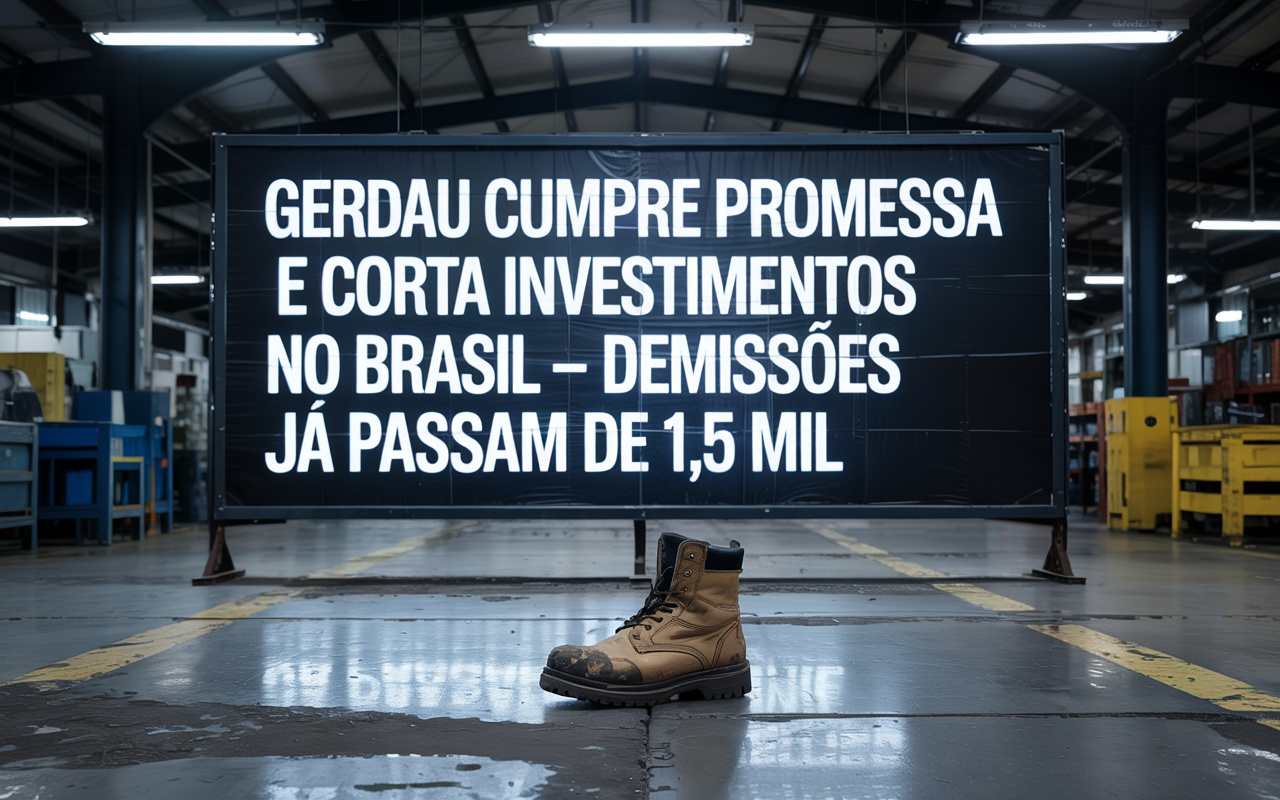


Gerdau Keeps Its Promise and Cuts Investments in Brazil After Imported Steel Invasion. Layoffs Already Reach 1,500 and CEO Gustavo Werneck Calls for Government Action to Save the Industry.
Gerdau, the largest steel producer in Brazil, officially confirmed what it had been signaling for months: it will cut investments in the country and rethink its production capacity in light of the increasing “invasion” of imported steel, especially from China. The announcement, made by CEO Gustavo Werneck this Friday (1st), exposed the severity of the crisis in the national steel sector. “Our situation is very serious. The federal government has not deeply understood what is happening,” the executive stated during the disclosure of the second-quarter results.
With the presence of foreign steel reaching 23.4% of the Brazilian market in the first half of the year, the company’s patience with the lack of trade defense measures has reached its limit. The decision already has immediate repercussions: 1,500 workers have been laid off in the first six months of 2025, and further cuts are expected by the end of the year.
Gerdau Cuts Investments and Seeks “Rebalancing” in Brazil
The company is currently undergoing an investment cycle of R$ 6 billion, two-thirds of which is directed toward Brazil.
-
He sold his share for R$ 4 thousand, saw the company become a giant worth R$ 19 trillion, and missed the opportunity of a lifetime.

-
Elon Musk’s Starship megafrocket puts $8 billion at risk, raises alarms in the market, and could affect technology, mining, and space internet startups in the coming years.

-
Airfare prices may rise with increasing fuel costs, and the government is considering urgent measures to avoid a direct impact on the wallets of Brazilians.
-
Chocolate prices soar nearly 15% and become a luxury item for Easter 2026, with increases surpassing inflation and changes in Brazilian consumption habits.


Although Werneck assured that the previously announced investments will be maintained, the company confirms that the amount of future investments will be reduced — with the size of the cuts to be detailed between August and September and officially revealed in October.
According to the CEO, the company does not wish for imported steel to be blocked, but demands “a balance that allows national production to compete on equal terms.” Without this, Werneck warns that the sector is likely to contract further, with reduced production, closure of lines, and factory shutdowns.
Imported Steel in Brazil: From 9% to 23% in Five Years
The numbers from the Brazilian Institute of Steel show the rising share of foreign steel in the national market: in 2020, the penetration was 9.3%. In 2022, it jumped to 13.6%; in 2023, to 18.5% — a level maintained in 2024. But only in the first six months of 2025 was there a jump of almost 5 percentage points, reaching the current 23.4%.
A large portion of this volume comes from China, which pressures local steelmakers and could lead to a loss of R$ 7 billion in taxes for public coffers, according to estimates from Gerdau itself.
Layoffs at Gerdau Exceed 1,500 — and More Cuts Are on the Horizon
The impact of unfair competition is already directly affecting the workforce. Gerdau confirmed layoffs of 1,500 workers in the first half of the year, mostly at the Pindamonhangaba (SP) unit. Werneck warns that without a government response, further layoffs are inevitable.


The company also signals that it may halt production lines, such as the special steel plant in Mogi das Cruzes (SP), transferring production to other units. “There comes a point where the volume is so low that it no longer makes sense to continue producing. It’s better to stop the plant and dilute the cost,” says the CEO.
Gustavo Werneck CEO: Direct Criticism of the Federal Government
Werneck’s tone was harsh in criticizing the absence of stricter measures by the government. According to him, Gerdau expected progress in the executive management committee (Gecex) of the Foreign Trade Chamber (Camex), held on July 24, but no relevant changes were adopted.
“As soon as the federal government implements trade defense measures, we can immediately reopen these plants and continue producing,” he said, making it clear that the scenario can still be reversed — but it depends on an official reaction.
U.S. Eases Financial Pressure, but Brazil Remains Stressed
Despite the crisis in Brazil, Gerdau’s numbers are not entirely negative. The Ebitda (earnings before interest, taxes, depreciation, and amortization) in the second quarter was R$ 2.56 billion, with 61% coming from operations in the United States.
The company benefited from increased production in U.S. territory, which partially offset the downturn in Brazil. Nevertheless, adjusted net income fell 8.6% compared to the same period in 2024, closing at R$ 864 million.
Steel Crisis and U.S. Tariff: An Even More Complex Scenario
While facing competition from Chinese steel in Brazil, Gerdau is also closely monitoring the impact of the 50% tariff announced by President Donald Trump on Brazilian products.
Although the machinery sector — which uses domestic steel to export to the U.S. — was not included among the exempt items, Werneck admits that the “side effect” of this policy cannot yet be measured. “Our concern is that many of our customers in Brazil buy our steel, transform it into machines and equipment, and export it to the United States. We still cannot measure that effect,” he stated.
Evaluation and Future of Gerdau
Despite the crisis, Gerdau remains the largest steel producer in the country, valued at R$ 31.9 billion on the B3. However, shares have accumulated a 8.2% decline in 2025, reflecting market uncertainty regarding the future of the company and the steel sector in Brazil.
Gerdau’s decision to cut investments in Brazil serves as a warning for the entire steel sector. Without trade defense measures, the national industry loses ground to imported steel, with repercussions in layoffs, factory shutdowns, and declining revenues.
CEO Gustavo Werneck makes it clear that there is still a chance for reversal: if the government acts to balance the competition, Gerdau promises to resume production lines and investments. But until then, the scene will remain tense — and the “steel crisis” could deepen in the coming months.







É só ganhar menos, o mercado interno é explorador,a China entrega o aço aqui livre de impostos e transporte, aí é questão de capacidade de concorrência, aí ou se atualiza, sei lá tem coisas erradas
O aço exportado pelas empresas brasileiras chegam muito mais barato no destino do que o preço que pagamos pelo mesmo produto internamente. Nunca valorizaram o mercado interno com preços decentes, e quando o aço externo entra aí reclamam. Vão à pqp, seus ****.
Gerdau sempre esteve na linha de frente da oposição aos governos Lula. Sempre defendendo o liberalismo e sendo contra a presença do estado na economia. Agora que a economia liberal os está engolindo, não pensa duas vezes em lançar seus colaboradores no abismo e usar isso para chantagear o governo de Lula. Hipocrisia e oportunismo.