





 Portuguese
  English
  Spanish
  11 min of reading
  16 comments


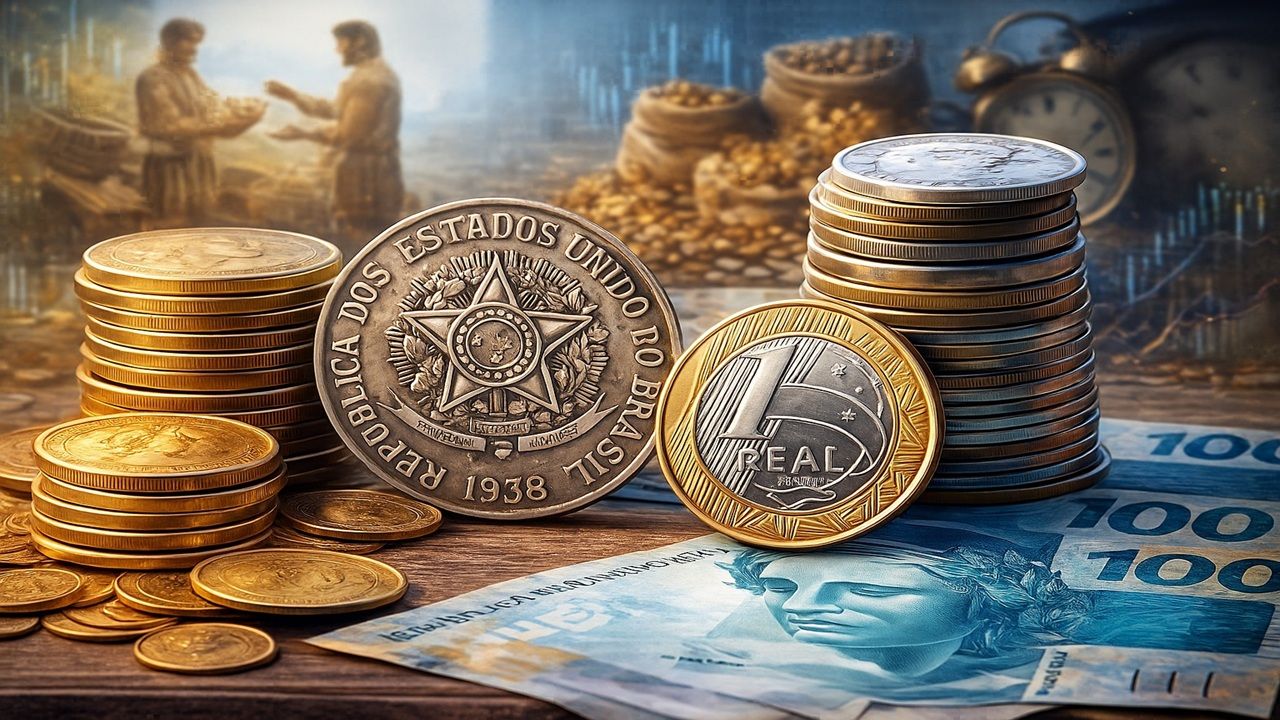


The History of Coins in Brazil Shows How the Country Moved from Direct Barter and Commodity Money to Metal Coins, Banknotes, Structured Bills, and Institutions That Shaped Its Economy Over the Centuries
The history of coins in Brazil begins before the existence of any locally minted currency. At the beginning of colonization, there was no structured monetary system, and exchanges occurred through barter, with goods serving as a reference for value.
Products such as brazilwood, shells, cotton, tobacco, and sugar played an essential role, functioning as barter items in different regions.
Shells of the zimbo type, in particular, were widely used in transactions along the coast, showing how the absence of an official currency was compensated by items socially accepted as equivalents of value.
-
The Brazilian colonial city that stopped in time and shares territory with a rocket launch base.

-
79-year-old woman challenges limits, visits 193 countries in the world after 56 years of planning and reveals the behind-the-scenes of a global journey that few have managed to accomplish.

-
These are the drivers who may stop paying tolls on highways in a project that promises to reduce costs for those who live from transportation in Brazil.

-
(Video): Italian pilot lands plane on moving train at 120 km/h and achieves unprecedented feat in aviation, even with a narrow runway and without direct visual contact.


This system, despite meeting the basic needs of communities, was limited because it depended on mutual acceptance between the parties and did not allow for broader or more structured transactions.

As colonization progressed, commercial needs grew, and pressures arose for more standardized forms of exchange.
The colonial economy developed with agricultural and extractive cycles, and the lack of coins hindered larger-scale commercial operations.
Barter, although functional in local contexts, proved inadequate for a growing society, especially in light of the need to integrate economic activities from different regions and to deal with transactions involving long distances.
The Arrival of Metal Coins in the Colonial Territory
The introduction of the first metal coins occurred with the expansion of Portuguese influence. The coins brought from Europe, mainly those made of silver and copper, began to circulate among colonists, merchants, and authorities.
However, given the nature of colonial trade and Brazil’s strategic position in the Atlantic, Spanish coins also became common.
After 1580, when the crowns of Portugal and Spain were unified under the same monarch, the presence of Spanish-origin coins significantly increased, creating a heterogeneous monetary circulation composed of pieces that reflected broad economic interests and an indirect monetary integration with the rest of Europe.
Even with this variety of coins, the available quantity was insufficient, and many regions continued to depend on commodity money.
This lack of sufficient monetary circulation made it difficult to organize internal trade and expand the economy.
The lack of coins also increased the colony’s vulnerability in the face of external crises, as the flow of metals depended on the decisions of the metropolis and trade routes, which were not always stable.

The Dutch Minting: The First Monetary Step Within Brazilian Territory
The history of coins in Brazil took an important step during the Dutch domination of the Northeast, from 1630 to 1654.
The Dutch, responsible for administering the region independently of the Portuguese crown, faced the need to pay troops, suppliers, and colonists.
To solve the problem, they began to mint their own coins within the occupied territory. The florin and soldo emerged, which held not only economic value but also symbolic value.
A noteworthy detail of these coins was the presence of the word “Brazil” inscribed on the reverse, something that some historians consider the first monetary expression directly linked to Brazilian territorial identity.
Although created in the context of invasion, these coins represented an administrative and economic milestone because they broke away from exclusive dependence on European minting and proved that local monetary production was viable, even if restricted to the occupied region and the Dutch period.
The Creation of the First Mint in Brazil
The recognition of the need for stable monetary production within the colony led to the foundation, in 1694, of the first Mint of Brazil, located in Bahia.
The objective was to standardize the circulation of coins, reduce metal scarcity, and strengthen the colonial economy. The institution became central to the production of metal coins, reinforcing the operational autonomy of the colony in relation to Portugal.
Over the years, the Mint changed locations several times, motivated by logistical, administrative, and strategic issues.
It was first transferred to Rio de Janeiro, then to Pernambuco, and again to Rio. Each change reflected adjustments in colonial administration and demonstrated the importance of the agency as a central piece in the Brazilian economy.
With the functioning of the Mint, the colony began to mint its own coins more regularly, strengthening the monetary system and expanding the circulation of metal money.
The Gold Cycle and the Expansion of Metal Minting
The 18th century brought a decisive turning point in the history of coins in Brazil. With the beginning of the gold cycle in the regions of Minas Gerais, Goiás, and Mato Grosso, Brazil became the world’s largest gold producer for a certain period.
This scenario drastically changed the economic dynamics of the colony, generating an abundance of precious metal and boosting both internal trade and the geopolitical importance of Brazilian territory to the Portuguese crown.
In this context of golden wealth, monetary production gained strength. The Mint began to mint high-value gold coins, including the famous doubloons.
The 20,000 réis doubloon, which weighed 53.78 grams, is remembered as one of the largest gold coins ever issued in the world, highlighting Brazil’s economic weight during that period.
The variety of coins included values such as 400, 1,000, 2,000, 4,000, 10,000, and 20,000 réis, allowing transactions of various sizes and reflecting local prosperity.
However, the intense circulation of gold also brought problems.
The abundance of metal encouraged smuggling and production diversion. To circumvent these risks and ensure that the crown received its share, a rigid inspection structure over gold was created.
Refineries and the Fifth Tax
To control mining, the Portuguese crown established refineries, where all extracted gold had to be delivered. There, the metal was melted down, standardized, and transformed into officially marked bars.
Each bar received a seal and a certificate of ownership, guaranteeing its authenticity and regularity. This process allowed the crown to collect the “fifth,” a 20% tax on all gold produced. Only after this collection could the remaining gold circulate legally.
The refineries sought to curb smuggling and ensure the flow of wealth to Portugal. However, they also generated tensions between miners and authorities, as many viewed the tax as excessively burdensome.
Still, the system defined how gold circulated and profoundly influenced the monetary history of the colonial period. With the decline of mining at the end of the 18th century, the role of the refineries diminished, but their impact on monetary control remained as a historical reference.
The Scarcity of Metals and the Approach of Paper Money
With the decline in gold production, a period of precious metal scarcity began. The decrease in gold directly affected the amount of available metal coins, creating difficulties for internal trade and hindering large-scale transactions.
The lack of coins made the monetary system less agile and increased the need for alternatives.
In this context, the idea of paper money began to gain traction. The replacement of metal currency with banknotes was already a reality in other parts of the world, and Brazil began to experiment with mechanisms that could meet the demands of a more complex economy.
The adoption of paper money, however, would only materialize with the arrival of the Portuguese court in Brazil.
The Creation of the Bank of Brazil and the First Banknotes

In 1808, with the arrival of D. João VI and the Portuguese court in Rio de Janeiro, several administrative changes were implemented to strengthen Brazil’s economic structure.
Among them, the creation of the Bank of Brazil stands out. The institution was initially founded for multiple purposes, including commercial banking and issuing authority.
Two years later, in 1810, the first banknotes issued by the Bank of Brazil appeared. These notes functioned as predecessors to modern banknotes and marked the effective introduction of paper money in Brazilian territory.
Although they still coexisted with metal coins, the notes facilitated high-value transactions and allowed greater fluidity in the economy, reducing dependence on metal.
The banknotes were fundamental in organizing the monetary system and adapting Brazil to the demands of a broader economy. The practicality of paper, lighter and simpler to transport, allowed for its progressive expansion. Over time, paper money became a central element of the country’s financial life.
The Consolidation of Paper Money in the 19th Century
Throughout the 19th century, the circulation of paper money gained strength. The expansion of banknote usage occurred gradually as internal trade expanded and new demands arose.
Paper money became more common in urban areas, especially among merchants and financial institutions.
Printing techniques were improved, increasing security against counterfeiting and allowing for greater sophistication in banknote design.
Despite advancements, the country still coexisted with a combination of metal coins and paper notes. This coexistence varied according to the availability of metals and the specific needs of each region.
The system was not fully centralized, and occasional monetary crises affected public confidence. Nonetheless, Brazil’s monetary structure was moving towards greater consolidation.
Transformations of the Republic and Monetary Modernization
With the Proclamation of the Republic, Brazil faced new monetary changes. Imperial symbols were replaced by republican representations, and the banknotes began to reflect the values of the new political regime. This visual alteration represented a historical rupture and reinforced the identity of the Republic.
However, economic instabilities marked the beginning of the regime, with shifts in confidence and crises linked to the issuance of paper money.
Even so, the state sought to improve the system, modernizing production and adopting new controlling practices.
The Mint kept pace with these changes, implementing technical improvements and introducing more efficient security mechanisms.
The Transition from Réis to Multiple Currencies in the 20th Century
Until 1942, the monetary unit used in Brazil was the “réis” – a legacy of the colonial and imperial period. On November 1, 1942, by decree, the country switched to the currency called Cruzeiro (Cr$), defining 1 cruzeiro as equivalent to 1,000 réis.
This change inaugurated the modern era of the national currency and marked the end of the long tradition of the réis — generating a new monetary standard more adapted to the contemporary economy.
Cruzeiro, Novo Cruzeiro, and the First Monetary Reforms
On February 13, 1967, in a context of economic instability and rising inflation, the government instituted the Novo Cruzeiro (NCr$), as part of an effort to readjust the monetary system. In this transition, each Novo Cruzeiro was equivalent to 1,000 old cruzeiros.
The name “Cruzeiro” referred to the constellation of the Southern Cross — a symbol of national identity. After a period of adaptation, in 1970, the currency returned to simply being called Cruzeiro (Cr$), maintaining the value equivalence of the Novo Cruzeiro.
Even with these adjustments, inflation persisted, and the monetary system continued to feel pressure. The Cruzeiro coexisted with increasingly larger values of banknotes and coins, and the national currency showed signs of wear from continuous inflation.
From Reforms to Economic Wounds: Cruzado, Novo Cruzado, and New Exchanges
In 1986, in the face of the accelerated devaluation of the Cruzeiro, the government adopted the Cruzado (Cz$), with a conversion of 1 Cruzado = 1,000 Cruzeiros. The measure sought to curb inflation and simplify prices, but the inflationary pace imposed new challenges.
In 1989, the country adopted the Novo Cruzado (NCz$), equivalent to 1,000 Cruzados for 1 Novo Cruzado, in a new attempt at monetary restructuring. This rapid succession of currencies demonstrated the fragility of the economy and the necessity for drastic measures to try to maintain purchasing power and monetary stability.
However, none of these changes managed to completely curb economic problems, and the currency continued to suffer from inflation, devaluation, and loss of confidence.
Return of the Cruzeiro and the Final Phase Before the Real
In 1990, the government reintroduced the name Cruzeiro (Cr$) for the national currency, as part of a new monetary reform. This was the third phase of the currency with this name (1942–1967; 1970–1986; 1990–1993).
Despite adjustments, inflation remained high and the country faced severe instability. The real value of the currency was eroded, and exchange rates and prices varied rapidly. It was then indicated that a deeper reform was needed, one that would bring a stable, reliable currency with preserved purchasing power.
The Adoption of the Cruzeiro Real and the Creation of the Real
On August 1, 1993, the Cruzeiro Real (CR$) was established as another transition stage in the Brazilian monetary system, with 1 Cruzeiro Real being equivalent to 1,000 Cruzeiros from the previous phase.
Less than a year later, on July 1, 1994, the Real (R$) came into effect, the currency that remains to this day. The conversion was fixed at 2,750 Cruzeiro Reais for 1 Real.
The creation of the Real was part of a broader economic stabilization plan, aimed at controlling inflation and implementing structural reforms — transforming the monetary trajectory of the country.
Since then, the Real has been the official currency, subdivided into cents, issued by the competent authority, and recognized internationally as the Brazilian monetary unit.
Why So Many Currency Changes: Inflation, Devaluation, and the Search for Stability
The succession of currencies and monetary reforms is part of the complex trajectory of the history of coins in Brazil. Each change of unit — from Réis to Cruzeiro, from Cruzeiro to Cruzado, from Cruzado to Novo Cruzado, and so forth — was primarily motivated by uncontrolled inflation and the need to readjust values to keep the economy functional.
The economic instability caused significant price increases, loss of currency value, and difficulty in conducting everyday transactions. The reforms sought to simplify prices, restore purchasing power, and regain the population’s confidence in money.
It was also necessary to adjust minting, printing of banknotes, and monetary control to changing economic realities. Each new currency brought with it new banknotes, new units of value, and attempts to restart the monetary system from scratch, to contain inflationary cycles and readjust the economy.
The Importance of the Change to the Real and the Legacy of Monetary History
The adoption of the Real in 1994 represented the culmination of decades of transformations and adjustments in the Brazilian monetary system. From then on, the country gained a stable, reliable currency with a solid institutional structure. The change reflected economic maturity, historical learning, and concern for financial stability.
The history of coins in Brazil — especially this period from pages 28 to 34 of the pamphlet — reveals not only the alternation of values and denominations but also the struggle of a nation to preserve purchasing power and ensure credibility for its currency.
Every monetary reform reflects economic tensions, inflationary crises, and political decisions. The journey from réis to Real shows how complex it was to adjust the economy to inflation, reorganize values, adapt the population to new denominations, and restore confidence in money.
Today, the Real coexists with the legacy of these transformations. Although facing its own challenges, the current currency expresses a consolidated standard, the result of lessons learned and successive adaptations throughout Brazilian monetary history.








Assunto muito bom …
Tenho várias moedas bem antigas de vários valores
Quero vender algumas moeda antigas