





 Portuguese
  English
  Spanish
  5 min of reading
  2 comments


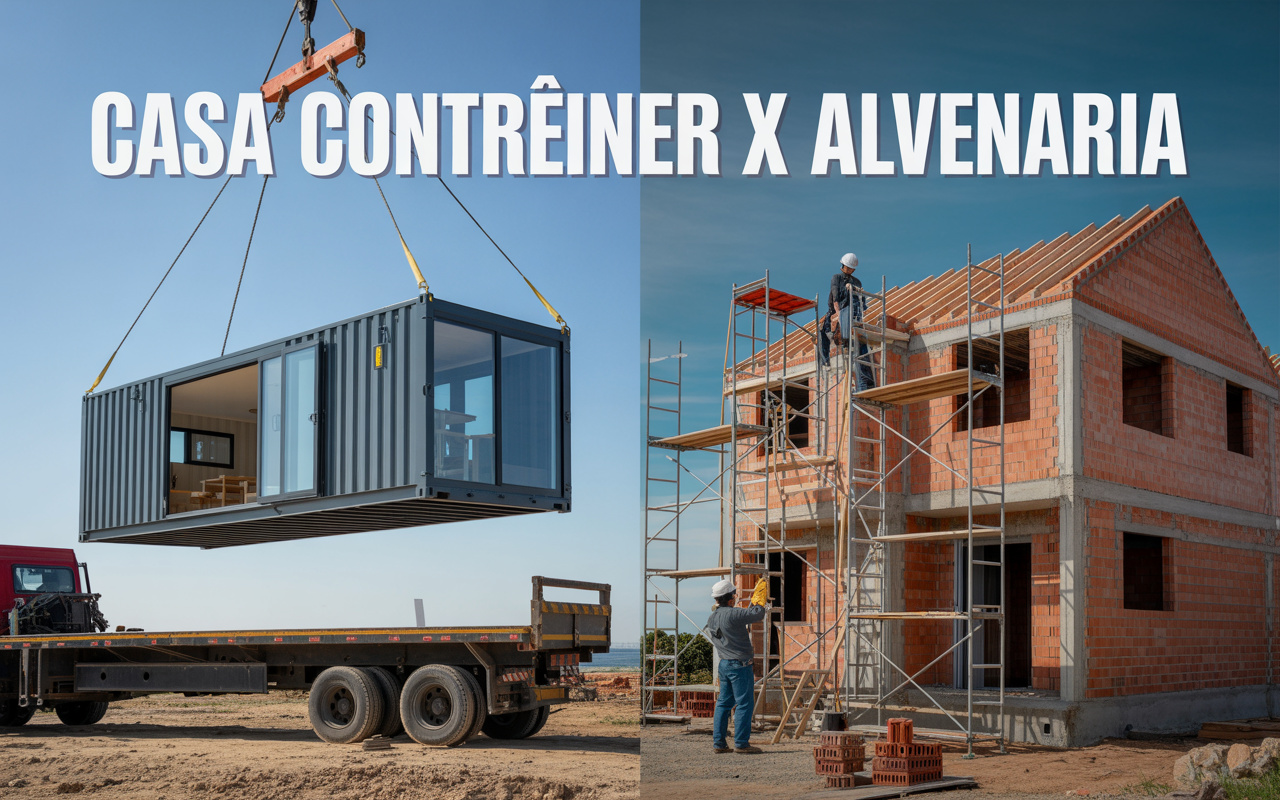


Real Comparison Between Modular Container Homes and Traditional Masonry Homes: Costs, Timelines, Performance, and Challenges of Transport and Insulation.
The competition between modular constructions and traditional masonry houses has gained momentum in recent years in Brazil, driven by rising material prices, the search for faster builds, and the popularization of shipping containers as a structural base. In 2024 and 2025, specialized companies began to provide more accurate figures on costs, timelines, and necessary adaptations, finally allowing for a real comparison between the two models.
In practice, building a modular container home can be cheaper, but this directly depends on the type of finish chosen, the logistics of the land, and the requirements for thermal and acoustic insulation. On the other hand, masonry houses maintain a more predictable initial cost but require a longer execution time, a larger labor force, and bureaucratic processes that continue to drive up the project’s cost.
The Starting Point: The Container Already Comes as a Ready Structure
While a masonry house literally starts from scratch—foundation, slab, walls, installations—a shipping container arrives on-site as a “ready structural box.” The standard 40-foot module is approximately 12 meters long and 30 m² of internal area, which allows two or three containers to easily create a house of 40 to 60 m².
-
Congonhas receives the monorail promised for the 2014 World Cup after more than a decade of delays and becomes the first airport in Brazil with integrated subway.
-
Goodbye, concrete: a new trend in civil construction reduces the weight of the structure by up to 30%, accelerates projects by up to 40%, cuts costs on steel and labor, and improves thermal insulation with EPS.
-
Russian engineers create an innovative propeller blade for aircraft that could completely change the way airplanes and helicopters operate.

-
Couple finishes building PVC chalet on the beach on the last day, with air conditioning and curtains, but discovers the bathroom drain is inverted: water escapes from the drain, risking breaking the floor, and the rush continues before the trip.

The corten steel structure has an average lifespan of 50 years with proper maintenance and supports heavy loads without the need for additional pillars. This structural advantage drastically reduces execution time: while masonry requires 90 to 150 days for a 40 m² house, the container can be transformed into a residence in 20 to 45 days, depending on the project.
Specialized Brazilian companies, such as housing modules and modular solutions in São Paulo, confirm that a basic residential container can be delivered quickly because part of the adaptations is made in the factory—door cuts, windows, reinforcements, and coatings. On-site, only the simplified foundation, module installation, and electrical and plumbing connections remain.
The Real Cost: When the Container is Cheaper and When it Stops Being So
Market studies and data from the SINAPI show that the square meter of masonry for a simple 40 m² house varies by region but usually ranges between R$ 2,000 and R$ 2,700 when considering structure, walls, installations, plastering, and roofing.


The container, on the other hand, has a lower initial cost: a 40-foot module can be purchased for between R$ 12,000 and R$ 23,000, depending on its condition.
However, transforming that module into a complete residence requires finishes, thermal insulation, flooring, windows, doors, and structural adjustments. This results in the final cost per square meter of a container house being between R$ 1,800 and R$ 2,400 in most projects.
That is: the container can be cheaper, but it stops being so when the owner seeks sophisticated finishes, high-durability coatings, or elaborate facades.
Another factor that alters the final cost is logistics: if the land does not allow access for a truck crane, the cost of lifting and transportation can raise the budget by up to R$ 8,000.
In masonry, costs increase mainly due to waste—estimated at 8% to 15% of material and continuous labor throughout the entire construction period. In the container, waste is virtually nonexistent, and the number of workers needed is lower.
Thermal and Acoustic Performance: The Most Sensitive Point of Modular Construction
The corten steel has excellent structural performance, but it is a material that conducts heat. Therefore, no container house exists without proper insulation. The most common solutions in Brazil are rock wool, fiberglass, and polyurethane, all with proven efficiency.
Without insulation, the interior of the house heats up quickly in summer and cools down in winter, making the environment uncomfortable.
With the correct insulation and adequate ventilation, thermal performance approaches that of masonry, especially when using suitable internal and external coatings.

In terms of acoustics, traditional masonry naturally provides better insulation. The modular house requires extra layers to achieve the same performance, although reinforced versions can achieve equivalent results.
The container, however, has a clear advantage in structural resistance: as it was designed to withstand stacking and maritime loads, it performs much better than conventional walls in terms of impact and twisting.
Execution Time: The Major Advantage of the Container
If there is one point where the container completely dominates the comparison, it is time. A 40 m² masonry house takes, on average, three to five months to complete, potentially extending further due to climate issues or lack of labor.
The container, however, can be delivered habitable in just one month, as the process occurs in a hybrid manner between factory and site.
This differential has attracted investors, owners who need quick solutions, and tourism ventures seeking standardized units. In the Northeast and Southeast, hotel projects, inns, and sustainable cabins have utilized containers due to their speed and lower impact on the landscape.
Foundation, Transport, and Adaptations: What Changes in Practice
The container requires a lightweight foundation, usually concrete blocks, footings, or simple beam supports. Weighing between 3.5 and 4.5 tons, it depends on stabilized soil but does not require large excavations.
In masonry, the foundation consumes a significant portion of the budget and requires a thorough analysis of the land. There is a higher likelihood of problems with infiltration and settlement.
The transport of the container is the most critical stage. Trucks and cranes need access to the site, and on narrow or steep streets, this may be unfeasible. In some cases, it may be cheaper to build the entire modular house on-site, using only the metal structure technology without the original shipping container.
Durability and Maintenance: Where Each System Prevails
The container, with anti-corrosive maintenance, can last over 40 to 50 years. It is resistant to termites and impacts. Masonry, on the other hand, can exceed 60 years, as long as it is well-executed and receives periodic maintenance, especially in humid regions.
The container requires anti-corrosion painting and care with cut points in the steel, where oxidation may begin. Masonry requires painting, infiltration treatment, and joint maintenance.
In the End, Which Model Wins? It Depends on the Objective
The container wins in speed, reduced environmental impact, less waste, and competitive cost.
Masonry wins in natural acoustic comfort, traditional property appreciation, and cultural predictability, the market knows and accepts this model better.
What defines the winner is the owner’s purpose: agility, modern aesthetics, and modularity favor the container; classic durability and resale ease favor masonry.
In a scenario of rising costs in construction, comparing the systems has become essential. And the modular work—once seen as an alternative—now competes equally with traditional masonry.









Imprecionante os erros de digitação “Contreiner”
Que reportagem meia boca!
Rodiou, rodiou e não entregou nada.
O título da reportagem fala sobre o que seria mais barato, e no final, não há o resultado.
E aí quanto custa construir uma casa de alvenaria e quanto custa fazer uma de container marítimo???