





 Portuguese
  English
  Spanish
  4 min of reading


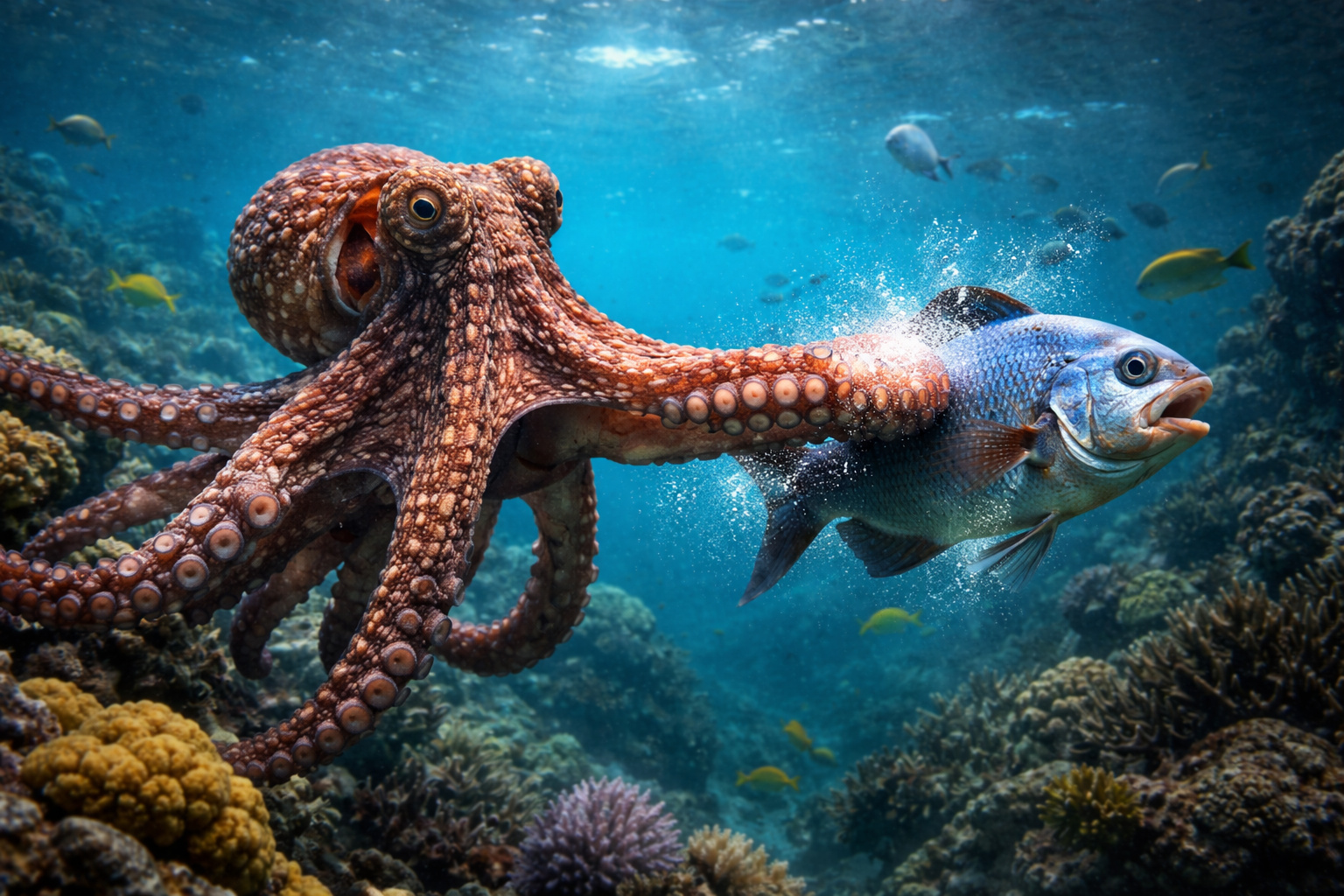
Animal World Curiosities Show That Octopuses Cooperate, Compete, and Even “Punish” Fish During Joint Hunts, Revealing Intelligence, Strategy, and Surprising Social Behaviors.
The animal world curiosities often reveal unexpected behaviors. Still, few scenes capture attention as much as an octopus “punching” a fish in the middle of the ocean. At first glance, the gesture seems aggressive or even impulsive. However, science shows something more complex. This behavior involves cooperation, conflict, and strategy, elements that are rare to observe so clearly in natural environments.
The news gained prominence after the publication of footage analyzed by researchers and published in recent scientific studies. According to the site Octonation, a platform dedicated to scientific dissemination about cephalopods, the behavior occurs during cooperative hunts between octopuses and different species of fish. In these situations, each participant has a clear role. Still, conflicts arise when a fish “cheats.”
Since Antiquity, thinkers like Aristotle have described octopuses as cunning and hard to classify animals. Centuries later, modern science confirms this historical perception. Octopuses exhibit memory, learning, and decision-making abilities, characteristics that place them among the most intelligent invertebrates ever studied.
-
Volunteers are sought to live in the mountains for a month: a study pays people to stay at 2,500 meters, with 24-hour monitoring of sleep, metabolism, and blood pressure.

-
Goodbye to kitchen cabinets: innovation retires the traditional furniture of Brazilian kitchens by introducing modern pantries with modules of up to 2.40 m, 40% more organization, ergonomic access, adjustable shelves, and smart lighting in 2026.

-
After the union of Brazil and China, BRICS plays a leading role in the merger between two powers: Egypt and India move forward with agreements exceeding US$ 4 billion, expanding industrial capacity in strategic sectors and accelerating the establishment of factories and global production chains.

-
Church from 1888 becomes a mansion of over 330 m² in Canada after a renovation of R$ 3.4 million and is eventually sold for nearly R$ 4.3 million.

Cooperation in the Ocean and the Invisible Rules of Hunting
During cooperative hunting, octopuses partner with fish such as groupers and goatfish. Each species contributes in distinct ways. While the fish chase prey in open waters, the octopus explores crevices and holes in the reefs. Hence, the group increases its chances of success.
However, according to studies published in 2022 in the scientific journal Current Biology, this system relies on implicit rules. When a fish attempts to anticipate and catch the prey alone, breaking the cooperation balance, the octopus reacts. It extends one of its arms and delivers a quick strike. The movement is not aimed at killing. On the contrary, it serves as a corrective signal.
This detail is noteworthy because it indicates behavioral control. The octopus does not act randomly. It chooses the moment and the target. Furthermore, often the strike occurs even without the immediate presence of prey, reinforcing the idea of social punishment.
Scientific Records and Historical Context of the Discovery
The first detailed records of this behavior emerged from underwater footage taken throughout the 2010s. However, systematic analysis only occurred years later. According to the researchers, the study that consolidated these observations was published in 2022, following the review of dozens of hours of video.
According to Current Biology, scientists observed that the octopus directs its strikes mainly at fish that fail to cooperate. This pattern reinforces interpretations linked to advanced cognition. After all, the animal evaluates the partner’s behavior before acting.
Historically, the idea of punishment in non-human animals has generated debates. For much of the 20th century, scientists avoided attributing complex intentions to animals. Today, however, this view has changed. Modern ethology accepts that many animals exhibit sophisticated forms of social interaction, even if different from human interactions.
Intelligence of Octopuses and Their Position in Natural History
Among the greatest animal world curiosities, the intelligence of octopuses occupies a central place. They possess about 500 million neurons. More than half is distributed throughout their arms. This allows for independent movements and quick responses to the environment.
Additionally, historical records show that coastal peoples have long recognized these abilities. In Ancient Greece, for example, the octopus appeared in ceramics and stories as a symbol of adaptation. Today, laboratories confirm these empirical narratives through controlled experiments.
According to the site Octonation, studies conducted between 2015 and 2023 demonstrated that octopuses solve problems, use tools, and learn by observation. Thus, the behavior of “punching” fish fits into a broad repertoire of strategic actions.
The Ecological Significance of the “Punch” During Hunting
From an ecological standpoint, the octopus’s gesture helps maintain hunting efficiency. When everyone cooperates, the group captures more prey. Consequently, everyone benefits. The strike, therefore, functions as a mechanism of social regulation.
Furthermore, the behavior reduces prolonged conflicts. Instead of abandoning the partnership, the octopus corrects the deviation. This type of adjustment appears in few documented examples in the animal kingdom, especially among different species.
According to researchers cited by Current Biology, this pattern suggests that inter-specific cooperation may evolve with rules and sanctions, something previously associated almost exclusively with social mammals.
Animal World Curiosities and What Is Still under Study
Despite the advances, many questions remain open. Scientists are still investigating whether all octopuses exhibit this behavior or if it depends on environmental context. Additionally, researchers analyze whether fish learn to avoid punishments over time.
According to academic institutions monitoring the topic since 2022, new observations may arise through the use of underwater drones and artificial intelligence. These technologies allow for the recording of rare interactions without human interference.
Meanwhile, the case reinforces a recurring lesson in animal world curiosities. Nature does not operate solely by simple instinct. It combines evolutionary history, learning, and complex relationships, even in environments where one would least expect it.
By observing an octopus correcting a fish, science does not see just an isolated gesture. It sees a living chapter of natural history, written silently on the ocean floor.





-

2 pessoas reagiram a isso.