





 Portuguese
  English
  Spanish
  5 min of reading
  0 comments


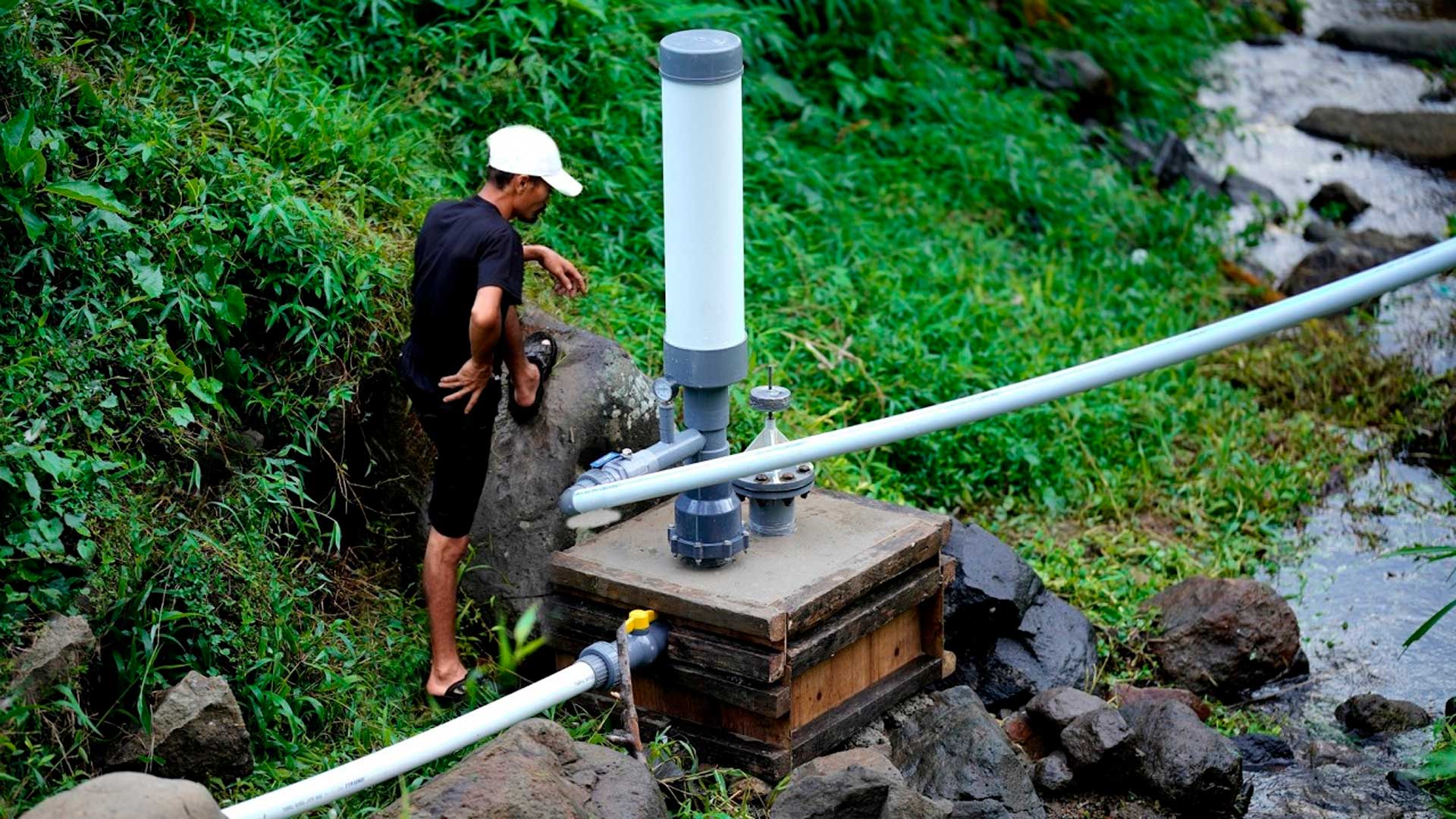
In Video, Man Shows How to Assemble a Pump That Uses Only the Force of Water to Lift Part of the Flow to a Higher Point. The Technology Has Existed for Centuries and Is Still Relevant in Rural Areas Without Electricity.
The scene seems impossible at first glance, but it’s no trick. A man appears assembling a water pump without electricity, and in the end, the system starts to beat in cycles and send water upwards, up the hill, as if there were a hidden motor.
The video published on YouTube shows the step-by-step of a pump known as hydraulic ram pump, also called water hammer pump. The recording describes the design as an alternative used in remote villages without electricity and has gained significant reach on the platform, with over 8 million views.
The interest comes not just from curiosity. In many rural communities, the challenge is simple yet expensive: getting water to tanks and reservoirs at high points without relying on electric pumps, fuel, or infrastructure.
-
From space, Buenos Aires appears as a colossal spot of light surrounded by kilometers of darkness, revealing at a single glance the exact boundary between the metropolis and the countryside, seen from 400 km altitude.

-
NASA spent over 118 million reais to build a single bathroom that works in zero gravity, and it has just gone to space on the first crewed mission to the Moon in more than 50 years.

-
Man never set foot on the Moon? 5 scientific proofs confirm that humanity has been there and definitively dismantle conspiracy theories.

-
The Brazilian Army will adopt humanoid robots to test the concept of future combat, says a website, surprising everyone, but later revealing that it was all just an allusion to April Fool’s Day.


Behind the visual impact lies classical physics and a well-known concept in engineering. The system takes advantage of the elevation difference and the energy of the water flow itself, converting part of that energy into enough pressure to push a fraction of the volume to a greater height.
What the Video Shows in Practice and Why So Many People Share

The content attracts attention because it delivers results with common materials and a straightforward assembly. The video presents itself as a tutorial for building a non-electric pump, associated with the concept of hydraulic ram pump.
The virality is also related to a real global problem. In places where the power grid is unstable or nonexistent, supplying a reservoir can require a generator, diesel, and maintenance, which makes irrigation and even domestic water use more expensive.
Additionally, the sound of repeated beats and the rising jet creates a perfect demonstration effect for social media. However, what seems like magic depends on specific conditions and does not always work as the audience imagines.
How the Hydraulic Ram Pump Works and the Water Hammer
According to Wikipedia, the hydraulic ram is a cyclic pump driven by hydraulic energy, which receives water at a pressure and flow rate and delivers a portion at a higher pressure, at a lower flow rate. The central principle is the water hammer, also known as water hammer, a pressure wave created when the flow is suddenly interrupted.
The typical cycle starts with water descending through a supply pipe to the pump. With the relief valve open, the water gains speed, and when the valve suddenly closes, the inertia of the flow generates a pressure spike.

This spike opens a check valve and pushes a portion of the water into an air chamber and into the delivery pipeline, which heads towards the highest point. The air chamber helps to cushion the shock and stabilize the water delivery over time.
Then, the pressure drops, the delivery valve closes, the relief valve opens again, and everything restarts. The secret of viability lies in the fact that the system trades volume for height: a lot of water passes through, and a smaller portion rises higher.
Academic studies reinforce that performance varies greatly depending on design, input elevation, and delivery height. In a 2024 study in Kenya, a prototype designed for domestic use and small-scale agriculture achieved optimal efficiency of 54% and a delivery flow rate of about 13L per minute in one of the tested configurations.
Where This Technology Still Makes Sense in Rural Communities
The hydraulic ram typically appears as a solution when there is running water available and some elevation, even if small, between the source and the pump location. The very definition of the equipment highlights its use in remote areas, where there is a source of low-fall hydraulic energy and a need to pump to a higher elevation.
In the same 2024 study, the authors describe the practical use of these systems for domestic supply, simple irrigation, and animal husbandry in regions with rivers and streams, precisely because they are cheaper and can be manufactured with local materials.
Limitations, Cautions, and What Tends to Be Exaggerated on the Internet
The main point is that there is no water rising for free. The pump does not create energy; it converts the energy of the descending water into work to elevate part of the volume, and the rest is discarded as waste flow in the cycle. Wired highlights that pumps of this type obey energy conservation and are not an infinite energy scheme.
Another limitation is the dependence on the context. Without elevation and without continuous flow, the equipment cannot maintain the cycle. The greater the delivery height, the smaller the flow rate tends to be, as the pump exchanges quantity for height, and also loses energy due to friction and turbulence.
Construction also requires attention to valves, connections, and the air chamber. In the Kenyan study, systems made by local artisans showed low efficiency and failures when the sizing did not match the conditions of the site, showing that design matters as much as the idea.
Finally, promises of pumping thousands of liters to great heights without explaining available drop, diameters, and losses tend to be the most misleading part of viral content. The technology works, but within a set of very clear and measurable conditions.
In your view, is this kind of pump a real solution for the countryside, or does online enthusiasm lead many to ignore the system’s limitations? Would you install a hydraulic ram pump on your property, or do you think it’s still safer to rely on an electric pump? Leave a comment with your opinion, and if you’ve seen one working up close, share what worked and what went wrong.







-

-

-

-

11 pessoas reagiram a isso.