





 Portuguese
  English
  Spanish
  4 min of reading
  0 comments


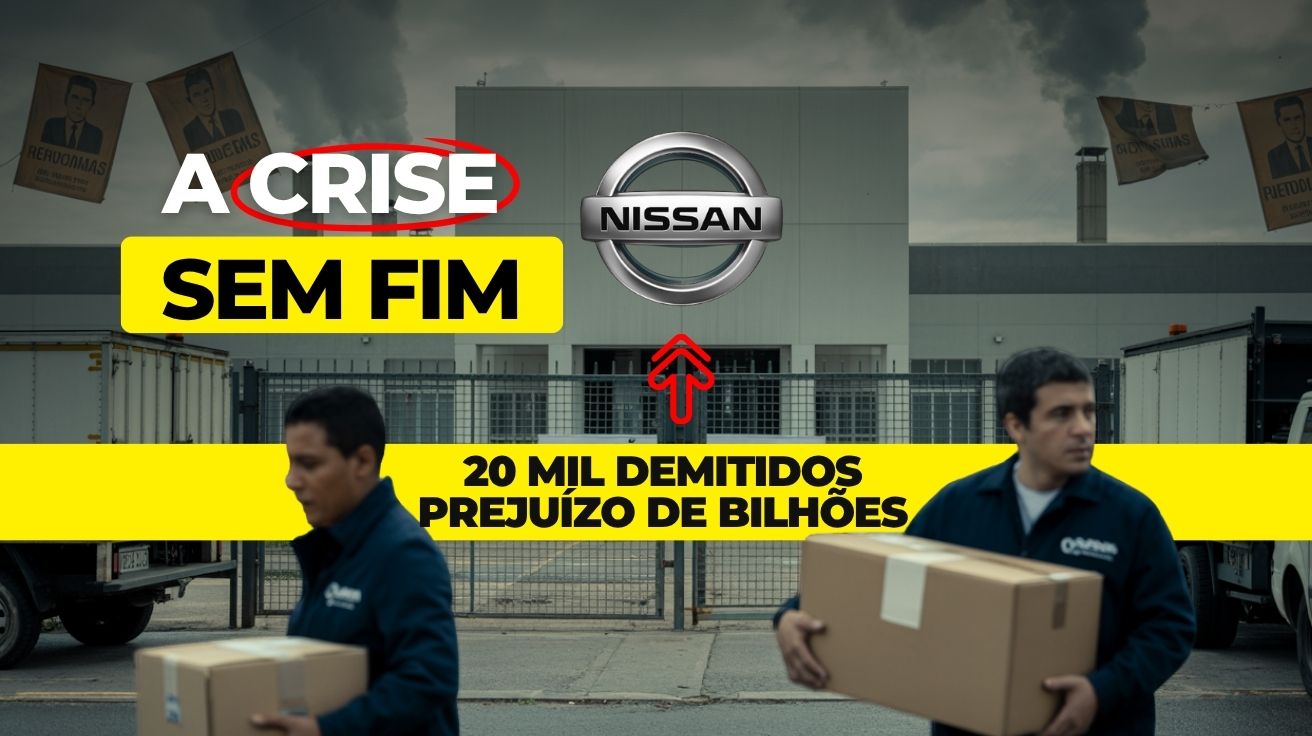
Nissan Faces Largest Loss In Decades And Announces Drastic Measures To Contain The Crisis. Mass Layoffs, Suspension Of Dividends, And Changes In The Company’s Leadership Indicate Unprecedented Instability In The Japanese Automotive Sector.
The Japanese automaker Nissan is undergoing an unprecedented financial and administrative crisis, after reporting a loss of US$ 4.5 billion in the last fiscal year, announcing the layoff of 20,000 employees, and implementing a major overhaul in its board of directors.
At the general meeting held on June 24, 2025, at Nissan’s headquarters in Yokohama (Japan), CEO Ivan Espinosa announced a record net loss of US$ 4.5 billion for the fiscal year ending in March — an amount that represents the company’s worst loss since 1999.
Furthermore, Espinosa did not provide a profit forecast for the new fiscal year, estimating an operating loss of ¥ 200 billion (US$ 1.38 billion) in the first quarter alone.
-
IPTU exemption for seniors in 2026: see how to secure the benefit.

-
The institute that trained the greatest aerospace engineers in Brazil has just opened its first campus outside São Paulo after 75 years: ITA Ceará will have R$ 445 million, new courses in energy and systems, and classes are expected to start in 2027.
-
Luciano Hang, owner of Havan, goes to Juiz de Fora after the tragedy in February, brings R$ 1 million, hands out R$ 2,000 cards, and donates up to R$ 15,000 to victims in the region.

-
The Brazilian passport allows legal residence in dozens of countries without the need for a prior visa, and most Brazilians are unaware that they can apply for residency directly upon arriving in nations in South America, Africa, and even Europe.


In response to the financial collapse, the automaker suspended dividend distribution, causing dissatisfaction among shareholders.
Mass Layoffs And Plant Closures At Nissan
As part of the recovery plan, Nissan accelerated the layoff of 20,000 employees, about 15% of its global workforce, raising the cut — previously estimated at 9,000 — to the current level.
The company also announced the closure of seven out of 17 plants by 2027, reducing its operational scope to just ten units.
The goal is to streamline installed capacity, eliminating around 30% of the infrastructure outside of China aimed at the global market.
Criticism And Changes In Leadership At Nissan
During the meeting, many shareholders criticized the composition of the board and questioned the legitimacy of Makoto Uchida’s previous nomination as CEO, stating that his appointees should also be held accountable for the crisis.
There was a proposal stating that “Uchida’s capability as an executive is extremely low” — however, the motion was rejected by the board.
Nissan replaced Uchida and Jean-Dominique Senard, chairman of Renault’s board, as part of the reorganization at the corporate top.
Still, the internal transition was considered slow by critics, who emphasized that workers are bearing the costs, while top executives maintain their positions.
External Factors Hinder Recovery
The weak performance is compounded by the slowdown in sales in the United States and China, the main markets for Nissan.
In addition to declining sales, there are the effects of the tariffs of up to 25% from the U.S. on imported vehicles, imposed since April under the Trump administration, and pressures from Chinese electric vehicle manufacturers.
Moreover, there have been cancellations of strategic projects, such as the battery factory in Kitakyushu (Japan), whose construction has been suspended in the new plan, and the end of merger negotiations with Honda, which have cost substantial time and investment.
Restructuring Strategy And Recovery Goals
To tackle the crisis, CEO Ivan Espinosa’s plan includes:
Reduction of ¥ 500 billion (approx. US$ 3.4 billion) in operational costs over two years — about 37.5% more than the previous plan led by Uchida.
Reallocation of 3,000 employees to continuous improvement and innovation roles in product development cycles.
Goal to return to profitability by the fiscal year 2026, with projected sales of 3.25 million units, slightly below the 3.3 million sold in 2024.
However, the realization of this plan faces risks — including accusations that the personnel cuts shift the burden of the crisis onto the lower tier, without holding top executives accountable.
Market Reacts With Decline And Downgrade Of Credit Rating
In the past year, Nissan’s shares have fallen by about 36%, reflecting the climate of instability and frustration among investors.
The automaker saw its credit rating downgraded to speculative (junk) due to continued negative cash flow.
Analysts estimate expectations of a potential operating loss of up to ¥ 450 billion (~US$ 2.1 billion) in the year ending March 2026, especially if U.S. tariffs remain in place.
Nissan And The Pressure For Control Over Subsidiaries
Activist shareholders, such as the Strategic Capital fund, have pressured for greater transparency and control over Nissan Shatai — the listed subsidiary of the Renault-Nissan alliance — following Toyota’s example, which plans to privatize Toyota Industries.
The proposal, rejected at the meeting, called for an annual review of the relationship with the subsidiary, but Nissan’s management claimed that changes would hinder operational flexibility.
But will it be enough to restore shareholder confidence, reverse the decline in shares, rebalance the cost structure, and avoid a total collapse of the brand?






-

Uma pessoa reagiu a isso.