





 Portuguese
  English
  Spanish
  5 min of reading
  1 comment


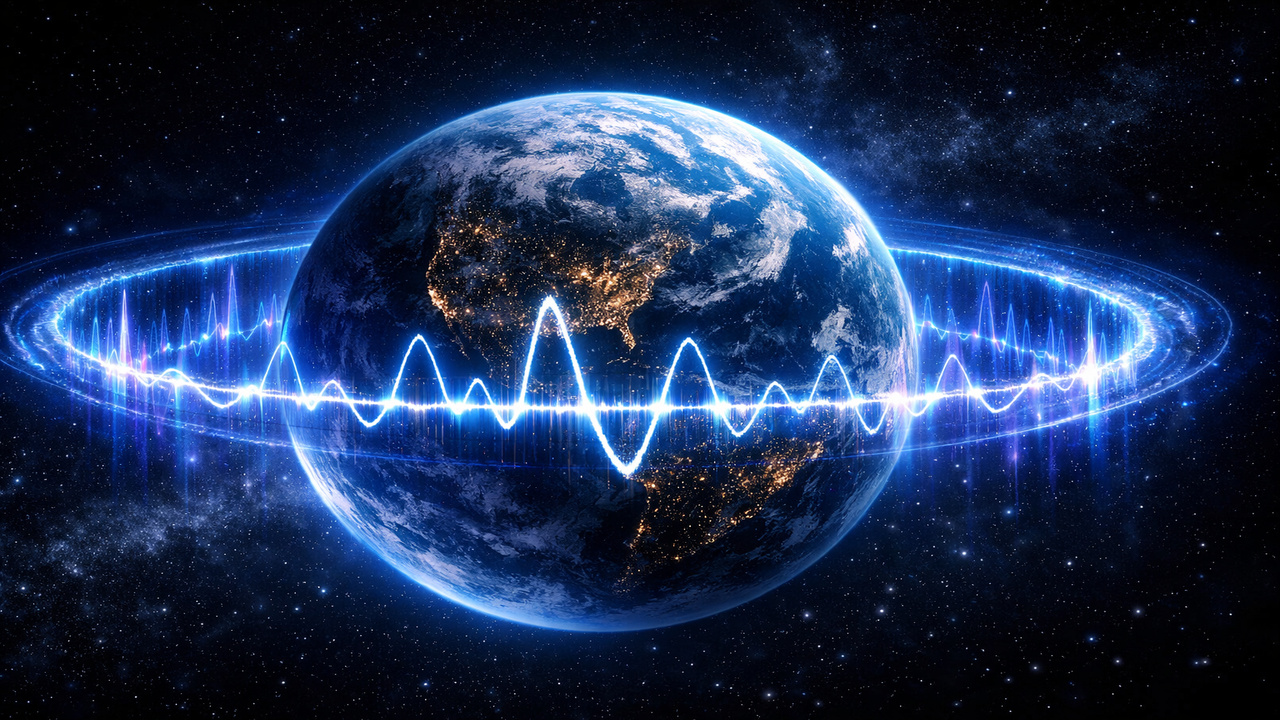


The Earth Emits a Continuous Electromagnetic Signal of 7.83 Hz, Generated Between the Ground and the Ionosphere, Measured Globally and Used to Study Climate and Atmospheric Activity.
The phenomenon known as Schumann Resonance was theoretically predicted in 1952 by the German physicist Winfried Otto Schumann, then a professor at the Technical University of Munich in Germany, and experimentally confirmed in the following years through measurements conducted in various countries. It occurs in the natural “cavity” formed between the Earth’s surface and the ionosphere, a layer of the atmosphere located approximately 60 to 1,000 km above, and is continuously excited by global lightning storms. Today, the phenomenon is monitored by scientific institutions and geophysical networks on multiple continents, including research centers linked to NASA, the NOAA, and European and Asian universities specializing in atmospheric physics and geophysics.
What Is Schumann Resonance and Why Does It Exist
The Earth functions, from an electromagnetic standpoint, as a huge resonant cavity. The “ceiling” of this cavity is the ionosphere, ionized by solar radiation, and the “floor” is the planet itself. Between these two limits, extremely low frequency (ELF) electromagnetic waves can be trapped and propagate around the globe.


Whenever a lightning occurs, there are more than 40 to 50 discharges per second on average around the planet — a portion of the electromagnetic energy enters this global cavity.
-
Supercomputer calculates when humanity may disappear from Earth, predicts a scorching supercontinent, temperatures of up to 70 degrees, and a planet moving towards becoming uninhabitable.

-
INMET danger alert: heavy rains between the 3rd and 4th may drop up to 100 mm/day and winds of 60 to 100 km/h in several regions of Brazil require extra caution.

-
The parts crisis may bring back the drop notch and microSD in 2026; while Windows 11 promises to become lighter, leaks mention batteries of up to 10,000 mAh and 200 MP cameras.

-
In Kenya, engineer Nzambi Matee created “bricks 2.0” using packaging plastic: a mixture with sand, heated and pressed; they are 5 times more resistant, already have official licensing, and are being used in streets and construction projects.


When the wavelength perfectly matches the “size” of the Earth, a standing resonance is formed. The fundamental frequency of this system is 7.83 hertz, accompanied by harmonics around 14.3 Hz, 20.8 Hz, 27.3 Hz and 33.8 Hz.
This set of frequencies is what science refers to as Schumann Resonance, a measurable, stable, and continuous physical phenomenon that has existed since the Earth has had an atmosphere, ionosphere, and electrical activity.
Why 7.83 Hz Is Considered the “Beat” of the Planet
The comparison with a “heartbeat” is not poetic by chance. Just as the heart maintains a continuous baseline rhythm, the Earth maintains a background electromagnetic rhythm that never turns off. Even if all storms temporarily ceased in one hemisphere, other regions would continue to sustain the system.
The value of 7.83 Hz is not arbitrary. It arises directly from the diameter of the planet, the speed of propagation of electromagnetic waves in the rarefied air of the ionosphere, and the electrical conductivity of the atmosphere. Physically, it is the lowest frequency that “fits” in the Earth-ionosphere cavity.
Measuring instruments on different continents register the same signal, with slight variations in amplitude throughout the day, depending on global electrical activity, the season of the year, and the solar cycle.
How This Signal Is Measured in Practice
Schumann Resonance is detected by ELF antennas and extremely sensitive magnetometers capable of recording variations in the magnetic field on the order of picoTeslas, millions of times weaker than the Earth’s magnetic field.
These sensors are installed in locations far from urban interference, such as deserts, remote forests, and polar stations. Global scientific networks cross-reference the data to separate the Earth’s natural signal from artificial noise, such as power transmission lines or industrial equipment.
Research centers associated with the European Space Agency and universities in Germany, Japan, and the United States use this data to study space climate, solar activity, geomagnetic storms and even global changes in atmospheric circulation.
The Direct Link with Storms and Global Climate
Each peak in Schumann Resonance is directly linked to lightning activity on the planet. Tropical regions, especially Central Africa, Southeast Asia, and South America are the main “engines” of the system, as they concentrate the highest rates of convective storms.
When there is a global increase in storms, the amplitude of the resonance grows. In periods of lower electrical activity, it decreases. That is why the phenomenon is used as an indirect indicator of global climatic dynamics.
Research published in geophysics journals shows a correlation between variations in Schumann Resonance and phenomena like El Niño, La Niña and seasonal oscillations of atmospheric circulation.
Popular Myths and What Science Really Says
In recent decades, Schumann Resonance has been appropriated by pseudoscientific discourses claiming that its frequency would be “increasing”, that it would control human behavior or that it would have direct effects on consciousness.

From a scientific perspective, these claims lack support. The fundamental frequency remains stable around 7.83 Hz. What varies is the intensity of the signal, not its base frequency. No serious study has demonstrated direct physiological effects of this natural field on the human brain under normal conditions.
What is real and proven is its value as a planetary monitoring tool, not as a hidden biological mechanism.
Why This Phenomenon Is Considered Essential for Modern Science
Schumann Resonance functions as a sort of electrocardiogram of the planet. It integrates information about:
- global atmospheric electrical activity
- the structure and behavior of the ionosphere
- the interaction between Earth and Sun
- the impact of solar storms
- large-scale climate variations
Moreover, it is one of the rare physical phenomena that can be measured anywhere in the world and still present the same fundamental pattern, reinforcing the idea of the Earth as an integrated physical system.
An Invisible Signal That Never Stops
Even without realizing it, every day we live immersed in this natural electromagnetic field. It does not depend on satellites, electrical grids, or human technology.
It has existed long before civilization and will continue to exist as long as the Earth has an atmosphere, ionosphere, and storms.
The “beat” of 7.83 Hz is not a mystical metaphor, but a measurable physical fact, recorded by scientific instruments, studied for over seven decades, and used as a window into understanding the profound workings of the planet.









Sabemos que terra estar sempre movimento,é vida da humanidade