





 Portuguese
  English
  Spanish
  5 min of reading
  0 comments


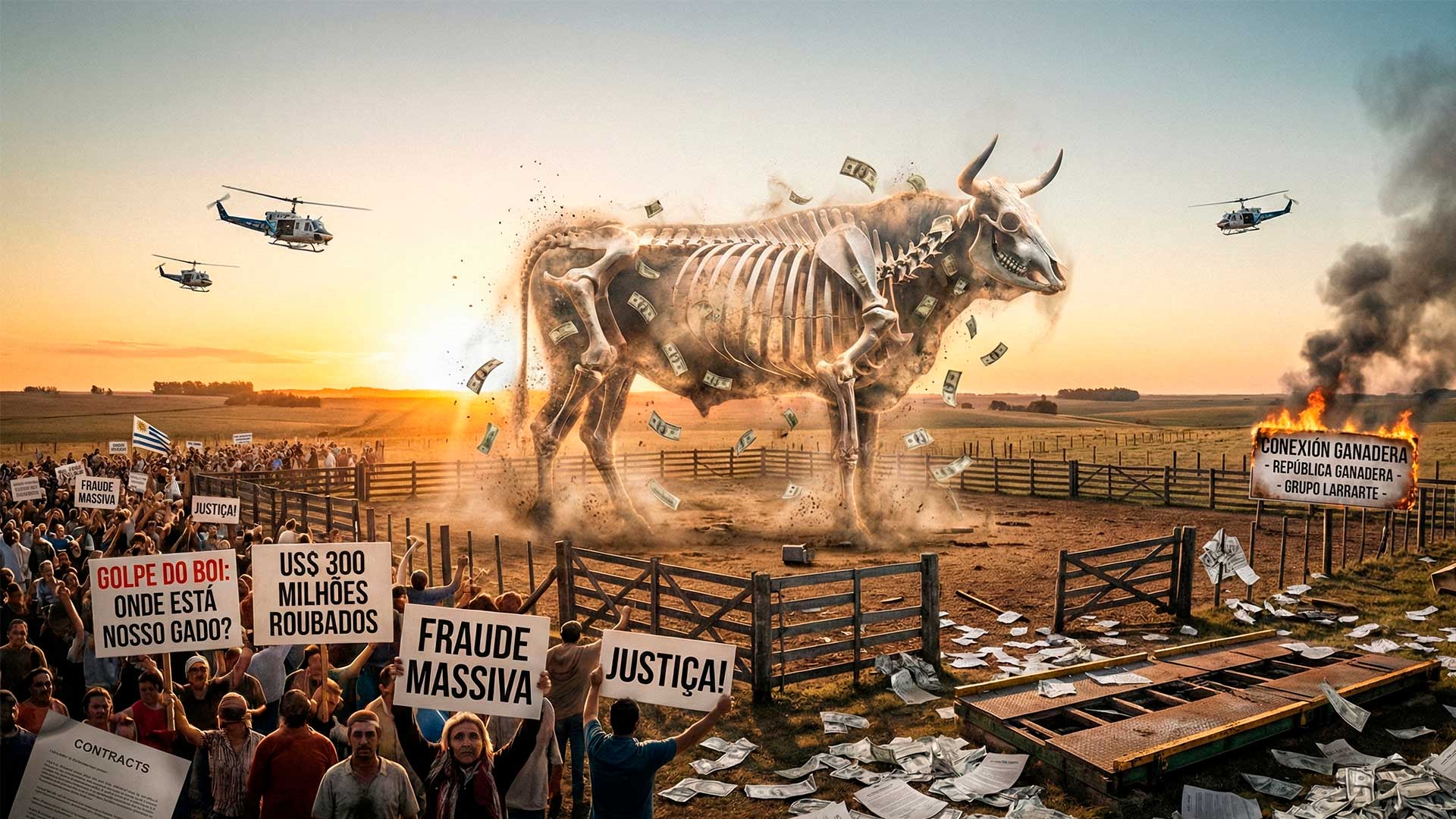
The Collapse of Investment Funds in Livestock Shocked Thousands of Uruguayans and Opened a Crisis of Credibility in One of the Country’s Most Traditional Sectors. Authorities are Investigating Fraud Suspicions While Creditors Try to Recover Funds. The Case Rekindled the Debate on Regulation, Transparency, and Risks in Promises of High Returns in Agriculture.
In 2025, Uruguay saw its livestock sector, a symbol of economic solidity and national identity, become the center of a scandal that left a trail of losses and distrust. The case became known as the Cattle Coup, associated with investments in cattle that ended up in judicial recovery, investigations, and a local billion-dollar deficit.
Estimates of losses vary according to the source and the progress of the processes, but reports indicate a gap of about US$ 300 million, with mentions of losses that may exceed this threshold when effects and liabilities are accumulated.
At the center of the case are companies that offered urban dwellers the chance to “own cattle” without having to go to the fields, with contracts promising profit in dollars and a low-risk narrative. Among those mentioned in reports are Conexión Ganadera, República Ganadera, and Grupo Larrarte.
-
Tourists on Everest were poisoned by guides who mixed substances in food to provoke false symptoms of altitude sickness while helicopter operators and hospitals charged inflated rescue fees to insurance companies.

-
Few people know this, but Neil Armstrong, one of the most famous NASA astronauts in history, survived the Korean War after jumping from the plane during his seventh combat mission aboard the USS Essex aircraft carrier of the United States.

-
Diving with a camera in Lake Furnas reveals a submerged city with an entire street, almost intact houses, a preserved bridge, a wood stove, a Kombi, and even a bus at the bottom of the largest lake in the Southeast.

-
Iceland accidentally drilled into a magma pocket at 2,100 meters and revealed that the extreme heat beneath the crust could pave the way for a new source of continuous energy.


The breakdown of trust was particularly strong because livestock is a structural sector in the country. Reports from Uruguay’s National Meat Institute indicate a herd of around 11.8 million heads in the country, based on MGAP data, and meat continues to be a relevant item of the export agenda.
How the Investment in Cattle That Seduced Small Savers Worked
The model was presented as simple and accessible. The investor would contribute a sum and receive a contract linked to the purchase, fattening, and sale of cattle, with a promise of periodic remuneration or return at the end of the term.
In some products, the offer even combined short terms with significant fixed rates for international standards. Reports describe proposals ranging from 7 percent in six months to bands of 9 to 11 percent in 24 months, generally with minimum entry amounts.
The appeal was based on two pillars. One was the idea that cattle, being a “real” asset, would be safer than traditional financial investments. The other was the marketing of predictability, with returns in dollars and the feeling that the operation had backing in the fields.
What Emerged When the Bill Came Due and the Numbers Did Not Add Up
The turning point in the case was the combination of delays, lack of liquidity, and, mainly, discrepancies between what was in the contracts and what actually existed in terms of assets and animals under management. According to reports, investors began to report difficulty in locating cattle that were supposedly registered in their names, strengthening the suspicion that there were “phantom cattle” in the system.
Investigations also began to focus on the payment mechanism. The suspicion raised in reports is that the machinery had supported itself for a long time with the influx of new resources to honor old commitments, a pattern associated with pyramid schemes.
The scandal gained scale because it was not an isolated or recent case. Coverage indicates that fundraising tied to this type of product occurred over decades and involved hundreds of millions of dollars in contributions.
Why the Shock Was Greater in Uruguay and What This Says About Traceability and Oversight
Uruguay built an international reputation based on pasture-based production, sanitary requirements, and a history of traceability that is often cited as a competitive differential. Exactly for this reason, the revelation of inconsistencies in operations that claimed to be backed by cattle hit the credibility of the ecosystem, not just the companies.
Economically, meat has real weight in the balance. An official guide from the U.S. Department of Commerce lists beef as one of the main export items of the country, with about US$ 2 billion in 2024, which helps explain why the episode resonated outside of Uruguay.
The debate that has opened is straightforward. If an investment sold as backed by a traceable asset can end up in a dispute over the existence of part of the herd, then the failure is not only of private management but also of governance, controls, and transparency in products offered to the public.
Therefore, the case began to be seen as a test for the regulatory framework. Aside from insolvency processes and legal actions, reports indicate increasing pressure for clearer rules for the offering of this type of contract, with investor protection and more robust audits.
The Alert that Crosses Borders and the Comparison with Agricultural Scams in Brazil
The Uruguayan story was quickly compared to episodes in the Brazilian agribusiness, especially the collapse of Fazendas Reunidas Boi Gordo, often remembered as one of the largest scandals in the sector in the country. At the time, the bankruptcy left estimated losses in the billions of reais and affected tens of thousands of investors, according to surveys by Brazilian outlets.
The most dangerous resemblance lies less in the animal and more in the narrative. Promises of above-average returns with the appearance of safety tend to spread through recommendations among friends, family, and local groups, creating a “social seal” of trust that replaces technical analysis.
The practical lesson is that a real asset does not mean low risk. In agricultural investment products, the central question is not just how much it yields, but who controls the backing, how the real stock is measured, who audits, and what happens if there is a rush for redemptions at the same time.
In the end, the Cattle Coup became a landmark for hitting a sector that seemed immune to sophisticated fraud. The judicial outcome still depends on expertise, inventories, and decisions on liability, but the reputational impact has already been established.
What do you think weighed more in this case, state oversight failure or the recklessness of those seeking high returns? Should investment in agriculture have specific rules like traditional financial products? Leave a comment with your opinion, because this discussion tends to divide public opinion and push for changes.




-

-

2 pessoas reagiram a isso.