





 Portuguese
  English
  Spanish
  5 min of reading
  67 comments


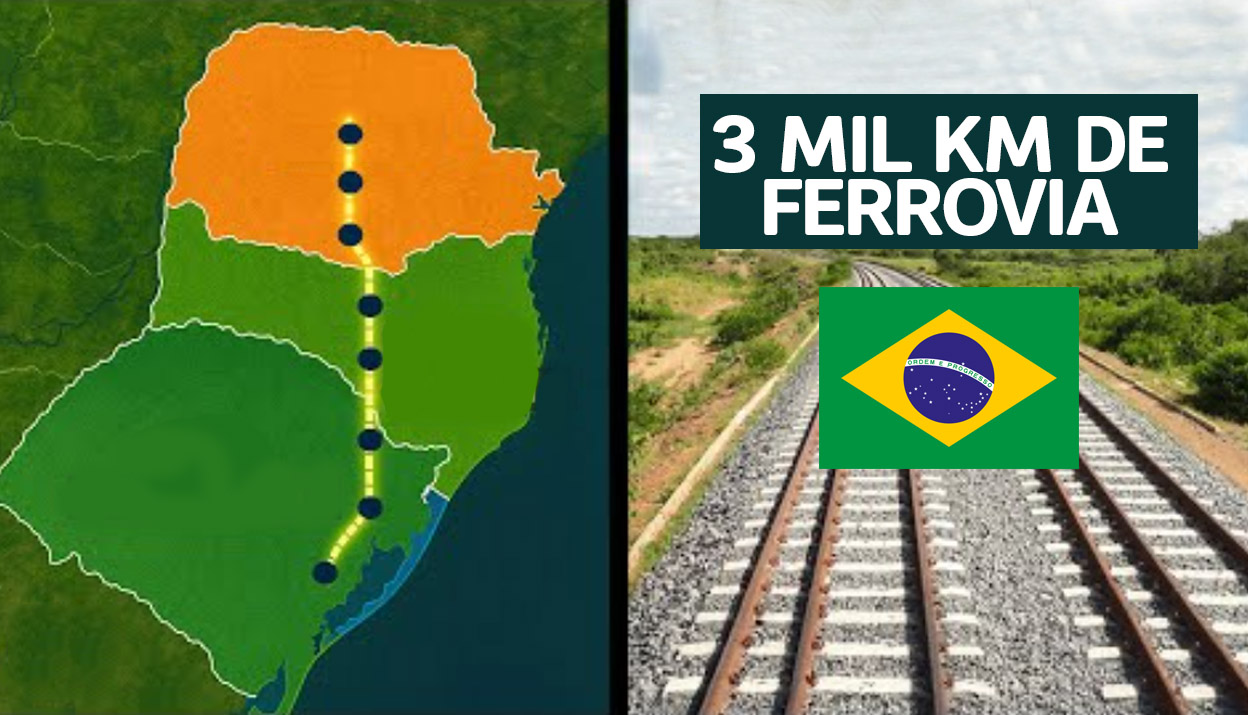


Railway Expansion in Southern Brazil Is About to Transform National Logistics with Modern Tracks, Strategic Connections, and a More Competitive and Sustainable Future for Cargo Transport in the Country.
A silent revolution is about to transform logistics in southern Brazil.
This is an ambitious railway project that promises to radically change the way cargo is transported in three essential states for the country’s economy: Paraná, Santa Catarina, and Rio Grande do Sul.
According to the channel Construction Time, this project has the potential to be a game changer in national infrastructure and usher in a new era for transport in Brazil.
-
End of the 6×1 schedule: how the reduction of hours can affect service companies, industry, and agribusiness.

-
Few remember, but the submarine that disappeared in 1968 with 52 crew members was found after 51 years at the bottom of the sea at more than 2,000 meters, intriguing the entire world.

-
With 1,200 tons suspended, the Japan mega-structure in a grid shape with a floating sphere from Fuji TV features two 25-story towers connected by elevated walkways, titanium panels, and impresses the world with its ability to reduce wind impact.

-
Brazil Ignores Trump’s threats to BRICS, Buys 42 tons of gold and reduces the Dollar’s share by 6.45% in international reserves.


The Expansion of Railways in Southern Brazil
The project foresees the construction of over 3,000 km of new railways, connecting productive areas of the interior of the states to strategic ports on the coast.
This will create a modern and efficient alternative to the current road system.
Today, road transport dominates the logistics of the region, but with the railway expansion, Brazil can redefine how grains, minerals, timber, containers, and industrialized goods are moved.
Although it is a simple addition of tracks on paper, in practice, this transformation can represent a true advance for the national economy and a new model for Brazilian logistics.
In a country of continental dimensions, rail transport proves to be a much more cost-effective solution for long distances compared to road transport.
The New Ferroeste: The Heart of Transformation in Paraná
The main line of this project in Paraná is the New Ferroeste, which will feature 1,567 km of new tracks.
The route of this railway begins in Maracaju, in Mato Grosso do Sul, and extends to the port of Paranaguá, one of the busiest in Brazil.
Along the way, several important cities in Paraná’s interior, such as Cascavel, Guarapuava, and Ponta Grossa, will be directly connected to the coast.
In addition, the New Ferroeste will include additional branches: One will connect the city of Foz do Iguaçu to Cascavel, providing a connection to Paraguay.
The other will extend the route to Chapecó, in Santa Catarina.
With this structure, Paraná expects to create the second-largest export route in Brazil, with the capacity to move 38 million tons per year.
To give you an idea, this amount is equivalent to more than 1.5 million trucks removed from the roads each year.
Direct Impact on Agricultural Production and the Protein Chain
Grains, cellulose, fertilizers, and even proteins will be the big beneficiaries of this railway expansion.
Paraná and Santa Catarina together represent more than 70% of Brazil’s pork exports and nearly 70% of chicken meat.
This means that with the new railway, the transport of protein cargo can be done with greater predictability, efficiency, and lower cost.
Another important point is the connection with Paraguay, which opens new possibilities for exports from South America, with Foz do Iguaçu as a strategic point.
In addition, the New Ferroeste promises to directly benefit about 9 million people, combining logistical efficiency with environmental preservation.
Santa Catarina: The Connection with the Port of Itapuá
In Santa Catarina, the focus is on improving the railway infrastructure of the port of Itapuá, one of the most modern in Latin America, with 70,000 containers handled per month.
The proposal is to create two new railway sections: Itapoá – Araquari (113 km) and Itapoá – Morretes (83 km).
These connections will integrate the state with Paraná’s railway network, creating a strategic corridor for cargo flow in the southern part of the country.
The port of Itapuá is preparing to operate with ships 366 meters long, which requires equally modern and efficient land infrastructure for the flow of goods.
These new railway branches will meet this growing demand, ensuring that the port of Itapuá continues to be a prominent logistical hub in Brazil and the world.
Rio Grande do Sul and the Terra Roxa Railway
In Rio Grande do Sul, the Terra Roxa railway will be responsible for connecting the terra roxa, in Paraná, to the coastal region in Arraial do Sal.
With a length of 1,549 km, this railway will cross agricultural, industrial, and urban areas, playing a crucial role in the flow of local production and international exports.
The construction of a new port in Arraial do Sal, with federal investments of R$ 1.3 billion, will be a key piece for the success of this railway.
The union of the Terra Roxa railway with the new port on the coastal region will form a fundamental logistical axis for the export of products such as grains, minerals, and other goods.
A Railway Network Connecting Brazil from North to South
This railway expansion in southern Brazil can be viewed as building a true backbone of tracks that will cut through the country from north to south.
The goal is to replace trucks on long routes, while road vehicles will only be responsible for short and urban stretches.
This promises to bring significant reductions in operational costs, as well as fewer accidents, less pollution, and more efficiency in cargo transport.
Logistics in 2025: Integration of Modalities and the Revolution in Transport
With the construction of these new railways, Brazil will begin to abandon the road model that has dominated since the 20th century, truly entering the 21st century of integrated logistics.
Brazil, which until today heavily depends on roads, will be able to improve its logistics infrastructure with fewer trucks on the roads, less congestion, lower risk of accidents, and less wear on the roads.
The expansion of the railway network represents a smart strategy to reduce environmental impact and enhance the country’s economic efficiency.
This could be the first step toward a new development model, where infrastructure and logistics go hand in hand to ensure that Brazil becomes a more competitive export hub.
The Future of Brazilian Logistics Is on the Tracks
The railway expansion project in southern Brazil is not just a promise, but a reality in the making.
With over 3,000 km of railways planned, Brazil is preparing to leave behind the outdated road model and embrace a new, more efficient and sustainable logistics era.
Although the project is still in licensing and concession phases, the billion-dollar investments ensure that these plans will be realized and soon transform national logistics.
These changes can elevate the country to a higher level of global competitiveness, improving not only infrastructure but also the economy, quality of life, and environmental preservation.
The future of logistics in Brazil is on the tracks and, without a doubt, this revolution will be felt across the entire national territory.
What do you think of this great project? Will we see the completion of this project in the coming years? Leave your opinion in the comments!





Só acredito vendo
Só promessas que ficam no papel! Tonto que acredita!
Eu estive na Europa frankfurt e visitei outros Lugares distantes e trem é a prioridade de todo o escoamento que produzem na Alemanha, Porque Brasil tem a maior Produção Agrícola do Muito ,Carros ,motores entre outros e não se adaptou-se até agora Porque a governança não Aqueriu esta estratégia. As estradas ficam menos carregadas por em si ,e temos menos Poluição Admosfera para o ser humano. Plantar mais verde ,Árvores Plantas que tem mais Flores para as abelhas fazer seu mel ,E não passar veneno ou ensenticida para matar tudo .