





 Portuguese
  English
  Spanish
  6 min of reading
  0 comments


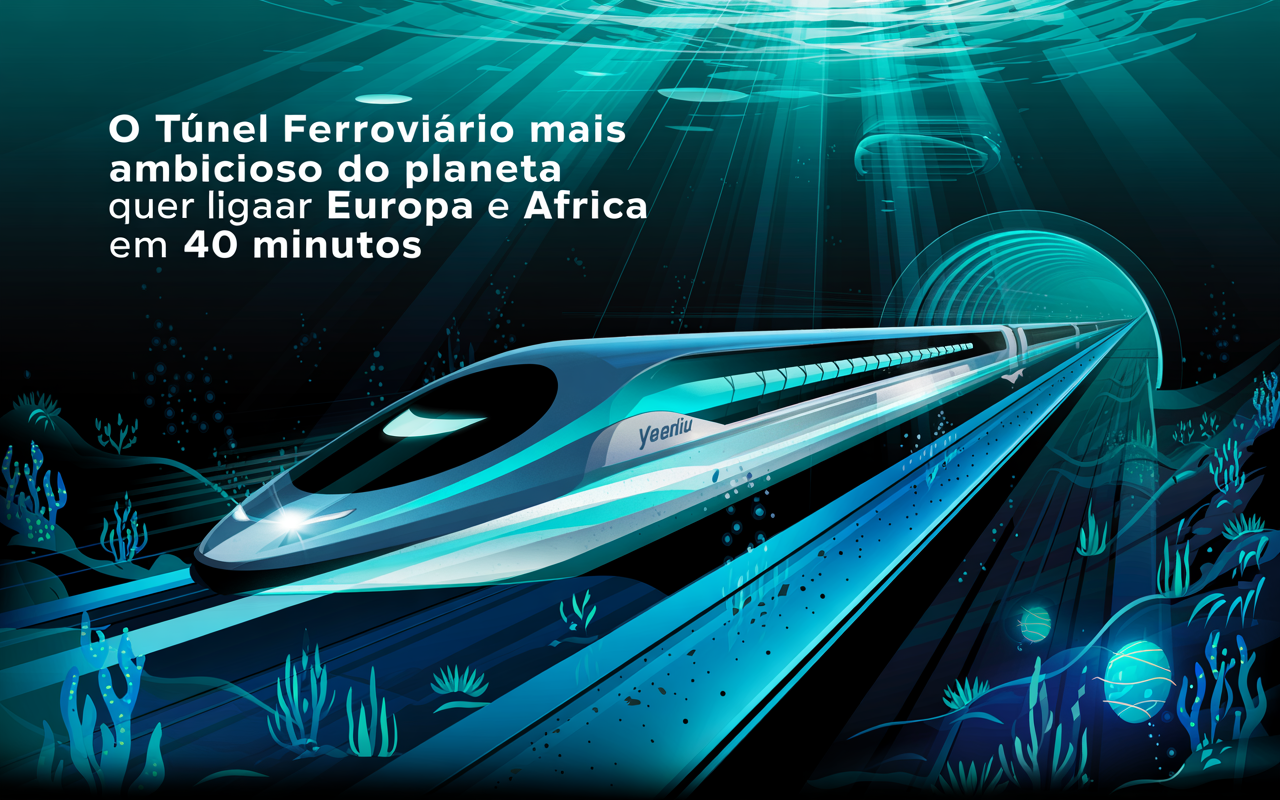
Submarine Tunnel Between Europe and Africa Could Connect Spain to Morocco in 40 Minutes with Magnetic Trains Traveling at 1,000 km/h. Learn All About the Project.
In the world of energy and transport infrastructure, few projects are as bold as the planned railway tunnel between Europe and Africa. Designed to cross the Strait of Gibraltar, the tunnel promises to connect Spain and Morocco in as little as 40 minutes, utilizing a future generation of magnetic trains — potentially based on hyperloop technology. This project, which had been considered unfeasible for decades, has returned to the forefront of discussions with technological advancements in high-speed underwater trains and the renewed impetus given by Spanish and Moroccan authorities in bilateral cooperation. The ambition is to create not only an unprecedented engineering feat but also a bridge between continents, cultures, and economies.
Gibraltar Strait Tunnel: Where the Impossible Begins to Take Shape
The Gibraltar Strait tunnel, initially proposed in the 1970s, has regained momentum in 2023, when the governments of Spain and Morocco announced the reactivation of feasibility studies, under the leadership of the Spanish Society of Studies for Fixed Communication through the Strait of Gibraltar (SECEGSA) and its Moroccan counterpart.
According to Euronews and El País, the current plans foresee a submerged railway tunnel approximately 42 km in length, of which about 28 km would run under the sea. The maximum depth could reach 300 meters, which requires highly specialized engineering solutions.
-
American Airlines starts selling trips as if they were flights, with check-in and baggage check at the airport, but on short routes, passengers board luxury buses connecting cities to major hubs in the U.S.

-
São Paulo surprises the world with a colossal railway network project that promises over 1,000 km of tracks, R$ 194 billion in investments, and 40 projects connecting the capital to the interior with fast and sustainable trains.
-
The world’s largest escalator, measuring 905 meters in China, reduces urban travel time from 1 hour to about 20 minutes and transforms mobility in mountainous regions with an engineering solution adapted to the terrain.

-
A R$ 300 million logistics giant is taking shape in Serra with over 100,000 m² and raises a question: how can this transform e-commerce and distribution in the state?

The tunnel would connect Punta Paloma, on the southern coast of Spain, to the region of Tangier, in Morocco, creating a fixed link between Europe and Africa for the first time in modern history.
Magnetic Trains and Hyperloop: The Promise of High-Speed Travel
The proposal to use magnetic trains with hyperloop-inspired technology represents one of the biggest innovations associated with the project. The hyperloop system — conceived by Elon Musk and developed by companies like Virgin Hyperloop and Zeleros — promises to achieve speeds of up to 1,000 km/h through magnetic levitation and low-pressure tubes.
Although it is still in the experimental phase, the technology has already undergone tests with passengers and is being considered for practical applications in various countries, including India, the United Arab Emirates, and Spain.
The use of magnetic trains in underwater tunnels would allow for an almost silent journey, with low energy consumption and zero carbon emissions, positioning the project as a milestone in terms of renewable energy and green infrastructure.
Logistical and Commercial Impact: The Birth of a New Intercontinental Corridor
The Europe-Africa railway tunnel has the potential to become a strategic corridor for international trade, connecting not just two countries, but two economic blocs.
Studies presented by the Spanish Ministry of Transport indicate that the infrastructure could move millions of tons of cargo per year, in addition to thousands of passengers per day. This would reduce dependence on ferries, decrease maritime traffic, and alleviate logistical bottlenecks between the ports of Algeciras, Tangier-Med, and other port cities in the region.
Furthermore, the tunnel could be a crucial element in the energy integration between Europe and Africa, facilitating the transport of green hydrogen, electricity, and other forms of renewable energy between the continents.
Energy Infrastructure and Sustainability: The Role of the Tunnel in Europe’s Green Future
With Europe’s increasing dependence on clean sources, the tunnel could be adapted to transport submarine energy cables and even hydrogen pipelines. The Spanish government, in partnership with the European Union, is exploring turning the Strait of Gibraltar into a strategic energy corridor.
According to the IEA (International Energy Agency), North Africa has vast solar potential, especially in regions like the Moroccan Sahara. With the support of solar plants and wind farms, the African continent could export energy to Europe, making the tunnel a key piece in the integration of global energy infrastructure.
Feasibility and Costs: The Price of Uniting Two Worlds
The technical challenges are monumental, and the estimated costs are significant. According to official data from SECEGSA and reports from Bloomberg Green, the initial budget could exceed US$ 10 billion, varying according to the chosen technology (traditional train, magnetic train, or hyperloop).
Funding is expected to come from an international consortium, with strong participation from the European Union, the African Development Bank, and bilateral cooperation between Spain and Morocco. There is also room for public-private partnerships and foreign direct investment, especially from the Middle East.
The Geological and Technical Challenges of the Gibraltar Strait
The Gibraltar Strait is one of the most geologically complex areas on the planet. The region is subject to seismic activity, has strong ocean currents, and high underwater pressures, which pose a challenge for constructing any fixed structure.
According to Spanish civil engineers cited by El País, one possibility under study is the construction of a submerged floating tunnel anchored to the seabed, similar to projects being tested in Norway. Another option could be a tunnel excavated by high-pressure tunneling machines, like those used in the Eurotunnel between England and France.
The Precedent of the Eurotunnel: Lessons from a European Success
The project between the United Kingdom and France, known as the Eurotunnel, is one of the largest technical references for the Gibraltar Strait tunnel. Built between 1988 and 1994, the 50 km railway tunnel connects southern England to the city of Calais in France, under the English Channel.
The experience of the Eurotunnel shows that, with the right technology, political will, and robust funding, megaprojects of this nature are possible. However, it also provided lessons regarding cost control, safety, and international logistical integration.
Political Cooperation Between Spain and Morocco: A New Chapter
The diplomatic rapprochement between Spain and Morocco in 2023 paved the way for the resumption of technical studies. Both countries consider the tunnel a strategic priority for the coming decades, especially in light of the migratory, trade, and energy challenges affecting the region.
According to Morocco World News, the Moroccan government announced an investment package to modernize the railway infrastructure in the northern part of the country, laying the groundwork for future connections with Europe. For its part, Spain signaled support from the European Union and is considering alternative connection routes.
When Could the Tunnel Become a Reality?
Despite the enthusiasm, experts warn that the tunnel is still in the feasibility study phase and that its construction will take at least 15 to 20 years from the final approval. This means that the inauguration of the railway tunnel between Europe and Africa could occur between 2040 and 2045, barring delays.
In the meantime, advancements in magnetic trains and the maturation of solutions like hyperloop will be crucial in defining which model will be economically viable and sustainable.
The railway tunnel between Europe and Africa is not just a megainfrastructure project. It is an idea with the potential to change the geography of global trade, mobility, and energy infrastructure. In an increasingly interconnected world, this physical link between two continents symbolizes an era of economic, technological, and sustainable integration.
Despite the costs, technical challenges, and long timelines, the Gibraltar Strait tunnel project is one of the greatest bets of modern engineering. With the unification of underwater trains, hyperloop, and green infrastructure, the future of intercontinental connection may be closer than we think.
Sources:
- SECEGSA – Government of Spain
- Euronews – EU-Morocco Infrastructure Projects
- Morocco World News – North Africa Infrastructure
- IEA – International Energy Agency
- El País – Infrastructure of the Strait
- Bloomberg Green – Hyperloop & Green Energy










Seja o primeiro a reagir!