





 Portuguese
  English
  Spanish
  5 min of reading
  0 comments


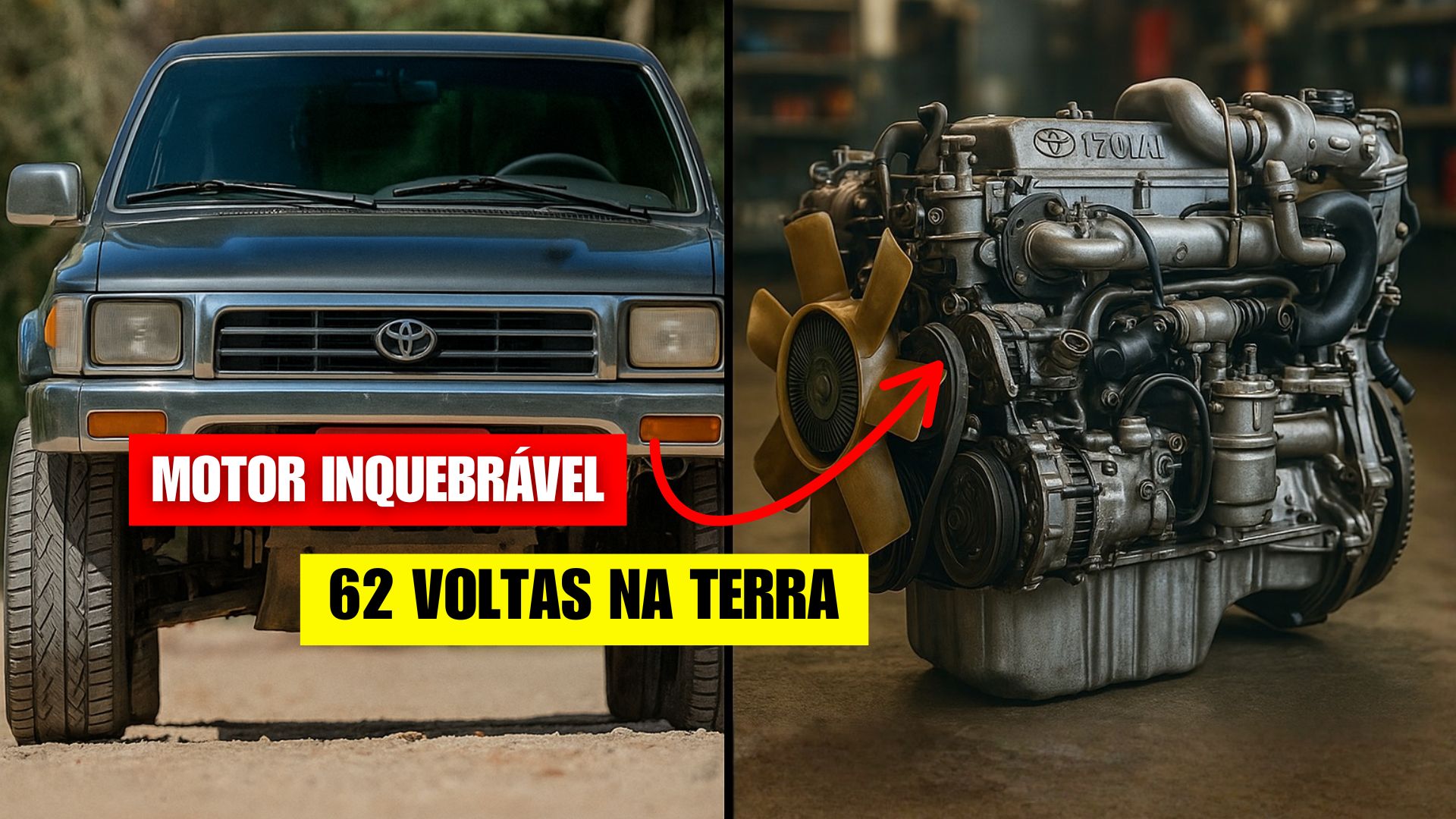
A 1998 Toyota Hilux with Original Engine Traveled 2.5 Million Kilometers in Brazil, Keeping 33 Tires, Factory Exhaust, and Spare Tire. The Owner, a Paulista Biologist, Adapted the Suspension to Reach Remote Areas of the Country.
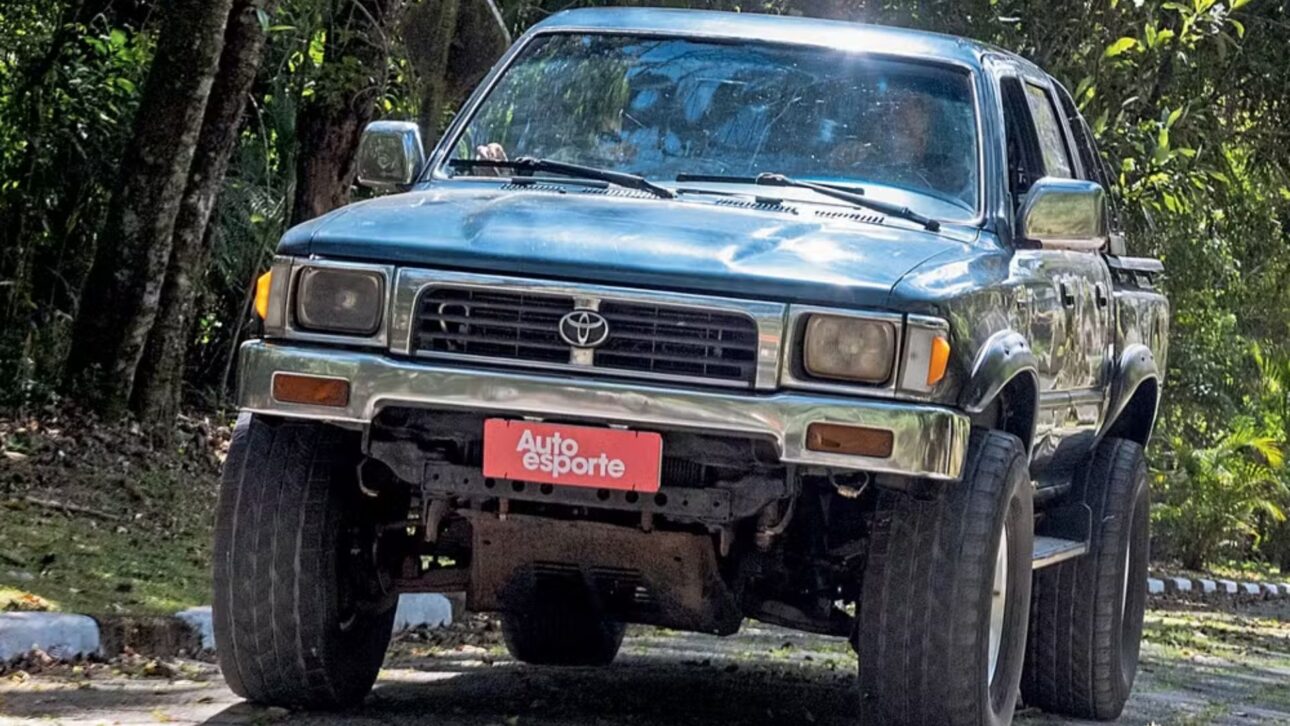
A 1998 Hilux SR5 4×4 has accumulated 2.5 million kilometers in Brazil, with a original engine and up-to-date maintenance, which is equivalent to 62 laps around the Earth.
The owner, Paulista biologist Paulo Martuscelli — known as Paulão or Falcon — purchased the truck brand new in April 1998, and to reach remote areas of the country, he adapted the suspension to accommodate 33 tires on 16-inch rims.
Even after decades of hard work, the truck remains active, with the factory exhaust and the spare tire untouched since 1998.
-
The war in Iran could be the push needed for the electric vehicle market to truly explode because when the price of oil exceeds 100 dollars a barrel, combustion cars become a luxury, and China already dominates 60% of the global electric market.

-
Fiat is preparing an offensive with a 7-seater SUV larger than the Fastback, debuting in October 2026 with the Smart Car platform, electric versions with up to 400 km of range, turbo hybrid, new pixelated LEDs, and an advanced ADAS package.

-
OMODA 7 transforms the car into a global aesthetic expression by combining automotive design and fashion in London.
-
JAECOO takes the lead in global strategic markets and accelerates its trajectory to become a “global blockbuster maker” in the automotive industry.


A Biologist’s Journey and the Origin of the Mileage
Over the years on roads and trails, the Hilux traveled from São Paulo to Bahia, Piauí, Mato Grosso, Rio de Janeiro, and Santa Catarina, among other destinations.
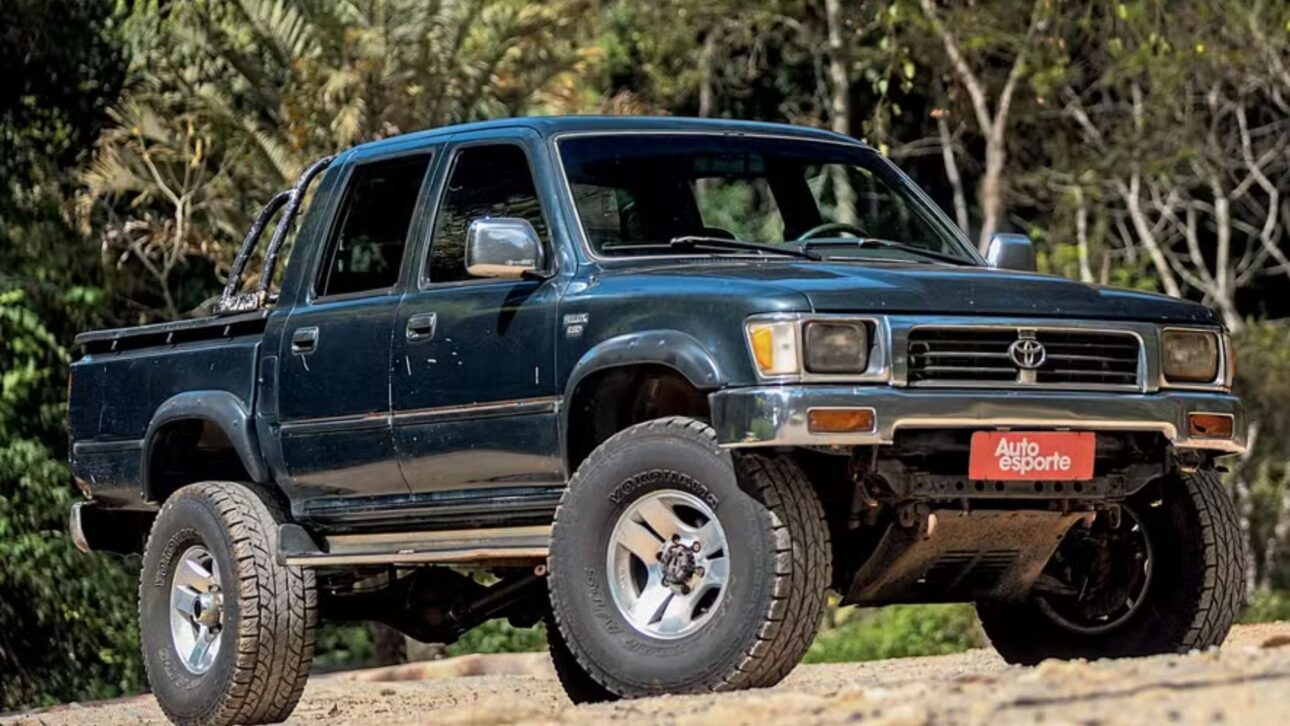
Frequent work trips, many for collecting in conservation units and remote areas, explain the unusual mileage on the odometer.
Falcon reports that the truck has always been a field tool, more than a passenger vehicle.
The longest recorded journey set off from Serra da Cantareira (SP) heading to São Gonçalo do Gurgueia (PI), in the south of the state, covering about 2,000 km each way.
It took three days to reach the destination, two weeks traveling in the region, and three days back.
Adding up the travel and local work, the expedition accumulated approximately 6,000 km.
On shorter routes, the owner maintains what he calls the “round trip” to Florianópolis (SC), for a journey of around 1,500 km in a single day.
Mileage Control After Odometer Failure
In the late 2000s, with nearly 1.2 million km, the steel cables of the gear that drives the odometer broke.
From then on, lifetime management began to be done through records of tire replacements.
The Geolandar Yokohama ATS 33 tires typically last between 80,000 and 100,000 km per set.
Based on the notes and replacement timelines, Falcon calculates the mileage progression and schedules preventive maintenance.
Why Choose the Naturally Aspirated Version of the Hilux
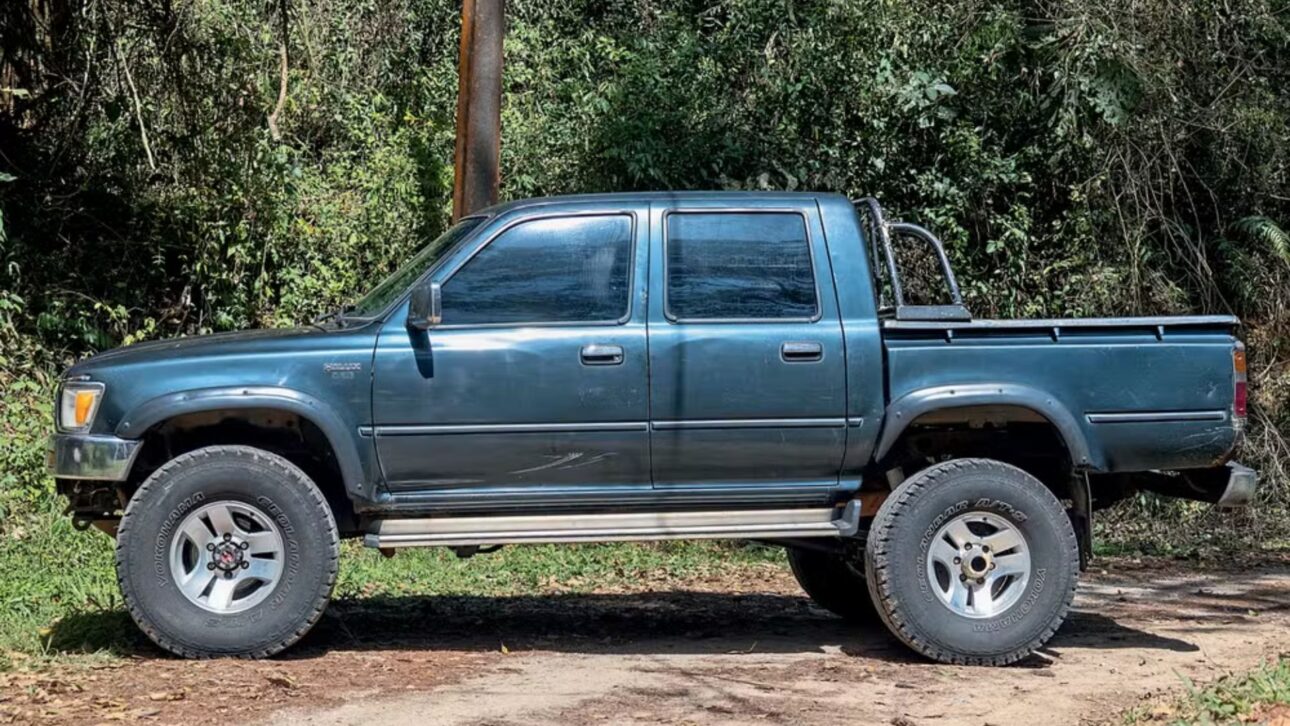
When he bought the utility, the biologist was looking for a simple and reliable set.
The Hilux had been launched in Brazil in 1992, initially imported from Hamura (Japan), and started being made in Zárate (Argentina) from 1997.
At that time, there were already more powerful turbodiesel versions, such as the 2.8 with 91 hp and the 3.0 with 116 hp.
Still, he chose the 2.8 naturally aspirated specifically for its less demanding maintenance.
“I chose the Hilux because it was the only one that delivered what I needed,” recalls Paulo.
He says he compared the truck with the Mitsubishi L200 — which he used during his work at the Northern-South Railway (MA) — and with the Land Rover Defender, used in services in Acre.
In his assessment, durability and cost-effectiveness weighed against the greater agility of competitors.
Robust Mechanics and Modest Performance
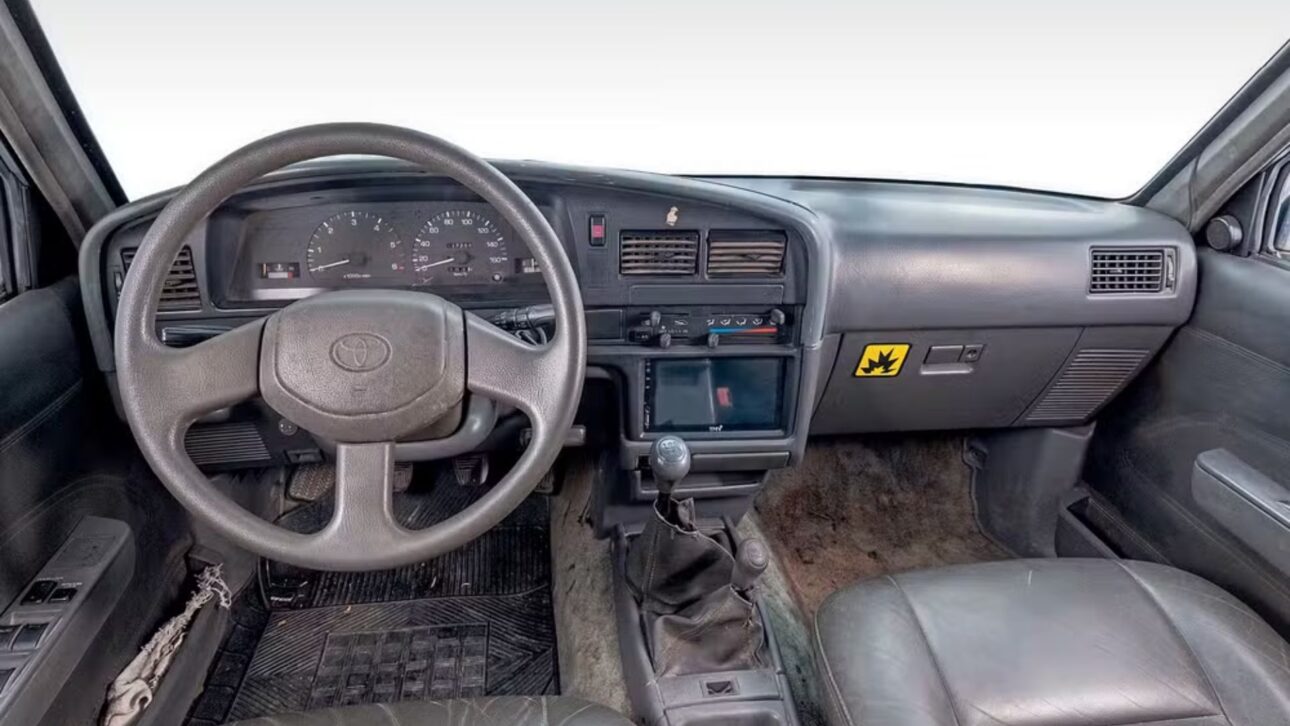
The 1998 Hilux SR5 of Falcon features a 2.8 naturally aspirated diesel engine, four cylinders, 78 hp and 17.7 kgfm, coupled to a five-speed manual transmission and 4×4 drive.
Performance is not the focus: the acceleration from 0 to 100 km/h takes 25.5 s and the declared top speed is 133 km/h.
Internal noise is high, and the shifts are tougher than current standards.
In practice, the owner states that what matters is the ability to arrive.
Suspension and the Early Mistakes
To accommodate the 33 tires, workshops initially resorted to trial and error solutions.
The front axle received wideners directly on the torsion bar, a measure that alters geometry and center of gravity, increases the stress on hubs, bearings, and arms, and can compromise safety.
At the rear, the original leaf springs were removed and the iron was arched to increase the angle, but the part was not designed for that deformation, returning to shape until it broke after strong impacts.
“Putting axle wideners is a crime against the engineering of the car, as is arching the leaf springs,” summarizes Falcon.
The adjustment came a decade later when he found a professional who lowered the body onto the chassis with urethane bushings, without stressing the torsion bar.
At the rear, he installed forged springs with the correct angle, increasing the strength and stabilizing the assembly.
Disciplined Maintenance and Original Parts
With the truck dedicated to work, preventive maintenance became routine.
Oil changes, spark plugs, timing belt, water pump, and essential items follow rigid intervals.
The clutch has been replaced twice due to natural wear, the first time with about 1.3 million km.
The special shock absorbers are replaced around 100,000 km.
The internal upholstery has been renewed, but the spare tire remains untouched since 1998, and the exhaust is still original.
To cope with adverse field conditions, the battery was upgraded from 75 Ah to 90 Ah.
Outside, the bodywork has marks of use that tell the story of a vehicle with thousands of travels in severe environments.
According to the owner, the Hilux has almost never seen a car wash; the focus has been on what keeps the vehicle operational.


New Reinforcement: The 1996 SW4 Joins the Story
Starting in 2010, with about 1.6 million km already traveled by the Hilux, Falcon acquired a 1996 SW4 V6 3.0 turbodiesel (152 hp) for demands that required more speed.
On missions involving cargo and where there is no rush — he reports that, in daily use, he avoids exceeding 80 km/h — the 1998 Hilux remains the first choice, taking advantage of its cargo capacity of approximately 1,000 kg.
Toyota Bandeirante and the Legacy of Endurance
The reputation for robustness of Toyota in the country was solidified with the Bandeirante, produced in São Bernardo do Campo (SP) between 1962 and 2001, with 104,621 units manufactured.
In October 2024, the author of the original report tested the last unit made on November 28, 2001, a symbol of what the brand would come to consolidate in the pickup line.
The 1998 Hilux of Falcon, still active, appears as a direct heir to this tradition, converting the discourse of durability into concrete data of intense use.
The Symbol of Trust from Toyota
More than numbers, the history of the unit shows a resilient project operating within predictable maintenance routines.
Even with a modest powertrain, the truck fulfilled the proposal of reliability, especially after the suspension adjustment.
The mileage control, reconstructed from tire records, allowed the mechanical schedule to be maintained without relying on the original odometer.
The question that remains is: what care and configuration practices would allow a modern utility vehicle to repeat 2.5 million kilometers under similar conditions?






-

Uma pessoa reagiu a isso.