





 Portuguese
  English
  Spanish
  6 min of reading
  0 comments


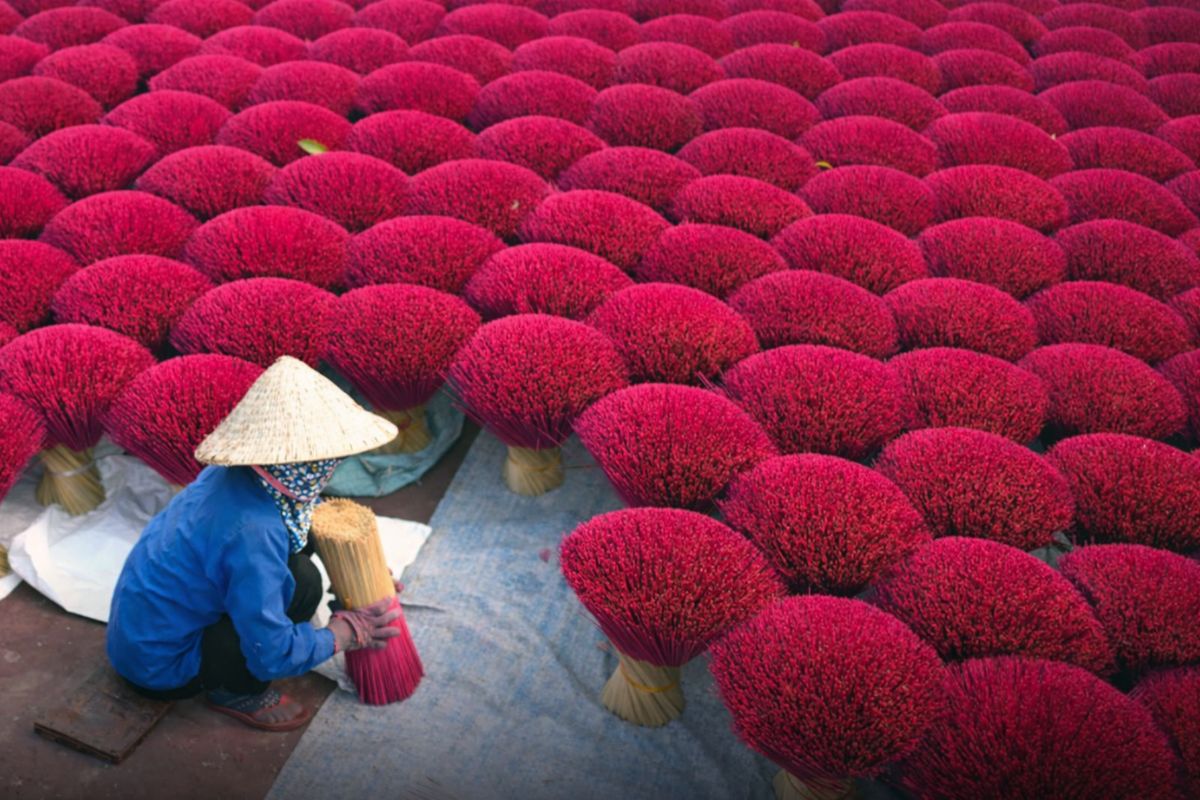
From Incense Sticks to Silk Cocoons, Vietnamese Villages Produce on an Industrial Scale Without Losing Their Artisanal Soul, While Trying to Keep Youth and Customers Close
The Vietnamese villages go into full operation mode when the year begins: streets, courtyards, and squares transform into drying, assembly, and packaging areas, as if the very map of the place turned into a production line. In one of them, the landscape changes color and becomes a sea of pink because the incense needs to be ready in time for Tet, the Lunar New Year.
What seems like just folklore tradition is, in practice, real economy. Thousands of communities live off this, with incentive programs, exports, and cooperatives. However, the engine of this system depends on something fragile: keeping the craft alive in a time when the younger generations leave and entire markets can close overnight.
What Are the Villages of Vietnam and Why Did They Become “Open-Air Factories”
Instead of large isolated industrial centers, many Vietnamese villages operate with the community itself as the productive structure.
-
He sold his share for R$ 4 thousand, saw the company become a giant worth R$ 19 trillion, and missed the opportunity of a lifetime.

-
Elon Musk’s Starship megafrocket puts $8 billion at risk, raises alarms in the market, and could affect technology, mining, and space internet startups in the coming years.

-
Airfare prices may rise with increasing fuel costs, and the government is considering urgent measures to avoid a direct impact on the wallets of Brazilians.

-
Chocolate prices soar nearly 15% and become a luxury item for Easter 2026, with increases surpassing inflation and changes in Brazilian consumption habits.


Nearly everyone participates in some stage: harvesting, preparing raw materials, drying, finishing, and selling. The result is a model that blends artisanal work and scale, with a strong local identity.
These communities are part of a broad universe of “craft villages,” traditional craft towns spread across the country.
In different regions, there is production of handmade fishing baskets, raising rare chickens valued as gifts and for competition, printing traditional paper, and producing silk through lengthy and meticulous processes.
Incense for Tet: When a Village in Vietnam Turns Into a Sea of Pink

In Quang Phu Cau, one of the Vietnamese villages best known for incense, the pace is peak season.
Production can reach 50,000 sticks per day to supply Tet, and the aesthetic of the process is striking: the sticks are dyed and placed to dry in large pink “fans.”
The incense has two parts: the stick and the aromatic powder. The bark is harvested, weighed, and sold. Then, locals divide the bark into smaller sticks and let them dry in enormous piles around the town.
With machines, it is possible to cut tens of thousands of sticks in a day, speeding up what was previously slow and manual.
In the factory, the sticks are organized into bundles, dipped in buckets of dye, and spread out to dry in the sun. The pink represents the lotus flower, a national symbol, and the red refers to the flag.
It is a job that requires good temperature and plenty of sun, because if the incense is damp, it doesn’t burn properly.
The “Secret” of the Aroma and the Step That Defines If the Incense Works
The incense powder also has its engineering. In the village, a local resin from Canarium is mixed with charcoal to form the characteristic black color, and the proportions are kept secret. This mixture is what gives the fragrance when the stick is burned.
After drying, the dyed sticks go through machines that automatically apply the powder. Then, they dry again and go to the final stage: packaging in plastic and sale to wholesalers.
The product is used in religious ceremonies in temples throughout the year, and during the Tet period, the volume increases because demand surges.
When the Market Disappears: The Crisis That Made the Villages of Vietnam Reinvent Themselves
For a long time, a significant portion of the incense was sold to foreign buyers. There were big sales to India, including substantial annual volumes. However, in 2019, India partially restricted the import of Vietnamese incense, which hit the heart of the business.
At the same time, another factor tightened the system: youth leaving the village for other jobs. The result: tradition under pressure and income threatened.
To sustain the activity, a local producer decided to adapt the product to Vietnamese taste: longer sticks, pink color, added fragrance.
He also installed machines to speed up the process, increasing production from 500 sticks a day to 50,000 with mechanical support.
Cooperative, Traceability, and Internal Buyers: The Plan to Survive
The turnaround came with organization. The producer launched a cooperative with 12 other incense manufacturers, allowing them to hire external workers and increase capacity. Next, he sought new buyers within Vietnam to replace part of the lost market.
Another step was to formalize and trace: he registered the product with the National Office of Intellectual Property and began using barcodes to simplify domestic wholesale sales.
Today, he sells about 80 tons per year in the domestic market, less than a third of what he previously sold to India, but with reinforced production to meet Vietnamese consumers, especially in the period leading up to Tet, when revenue can increase and the team steps up the daily pace.
It’s Not Just Incense: Baskets, Traditional Paper, and Dragon Chickens Worth Thousands
The production map of the Vietnamese villages is diverse. In Thu Sy, locals weave fishing baskets by hand. In Bac Ninh, there is printing of traditional Vietnamese paper.
And in Dong Tao, breeders work with a rare bird known as the “dragon chicken,” a chicken valued for its appearance and tradition.
These chickens have been raised by families for decades and gain status as gifts on special occasions, such as Tet itself. The selection is rigorous: out of 500 chicks, only 15 can qualify for sale as gifts.
There are intense care routines before the sale or competitions, including specific diets and cleaning of the legs, along with aesthetic criteria such as symmetry and uniform coverage of feathers.
The value can reach thousands of dollars, and there are even cases of eggs seized in smuggling attempts, showing how demand also attracts illegality.
The Role of Dó and the Battle Against the Disappearance of the Craft

In Dương Ổ, the traditional dó paper, giay do, has ancient roots and was once central to the local economy. It was used for historical records and folk art. However, the pressure from industrial production is strong: in 2020, 75% of paper in Vietnam was made in factories, and the demand for artisanal products plummeted.
An artisan who started young and has worked for decades keeps the process alive with a small team: tree bark is cut, separated, ground into pulp, and mixed with resin that acts as glue.
The formation of the sheets requires skill trained over years, using hand-made sieves and screens. An experienced worker can form 1,300 sheets in a day, but the greater challenge is not productivity: it’s succession. The fear is that the craft will end with the last generation.
To react, a nonprofit project created in 2013 buys this paper to produce items like postcards, jewelry, and artworks, using the revenue to support artisans and encourage young people to learn and utilize the material.
In nine years, the project has reached dozens of young artisans and helped restore the pride of being a traditional papermaker.
Silk: A Long, Expensive Process Passed Down from Family to Family
Silk is another symbol of what the Vietnamese villages do best: turning patience into a high-value product. The country is the second-largest producer of raw silk in the world, and the silk villages operate with a detailed process with many stages.
Families raise silkworms and work with leaves that feed the worms, which eat in short cycles, requiring a heavy routine.
The cocoons are harvested by hand, boiled, soaked, and turned into thread through delicate techniques passed down through generations.
There are artisans with decades of experience unrolling small daily amounts, while machines reel the thread and cooperatives weave and dye, sometimes repeating the dye bath in natural colors multiple times until achieving the desired result.
A Government Program and a Bigger Question: Can Tradition Be Competitive
Some of these Vietnamese villages participate in the One Commune One Product program, which promotes local products, such as Nam Cao silk.
Studies indicate that the program has generated thousands of jobs, and exports are said to be generating about US$ 1 billion per year.
Still, the numbers are tight: tradition needs buyers, needs youth, and needs adaptation without becoming just an empty tourist attraction. In many cases, the strategy is clear: modernize production without losing identity.
In your opinion, what weighs more in keeping Vietnamese villages alive: technology and cooperatives or the cultural pride of families passing down the craft?







Seja o primeiro a reagir!