





 Portuguese
  English
  Spanish
  3 min of reading
  0 comments


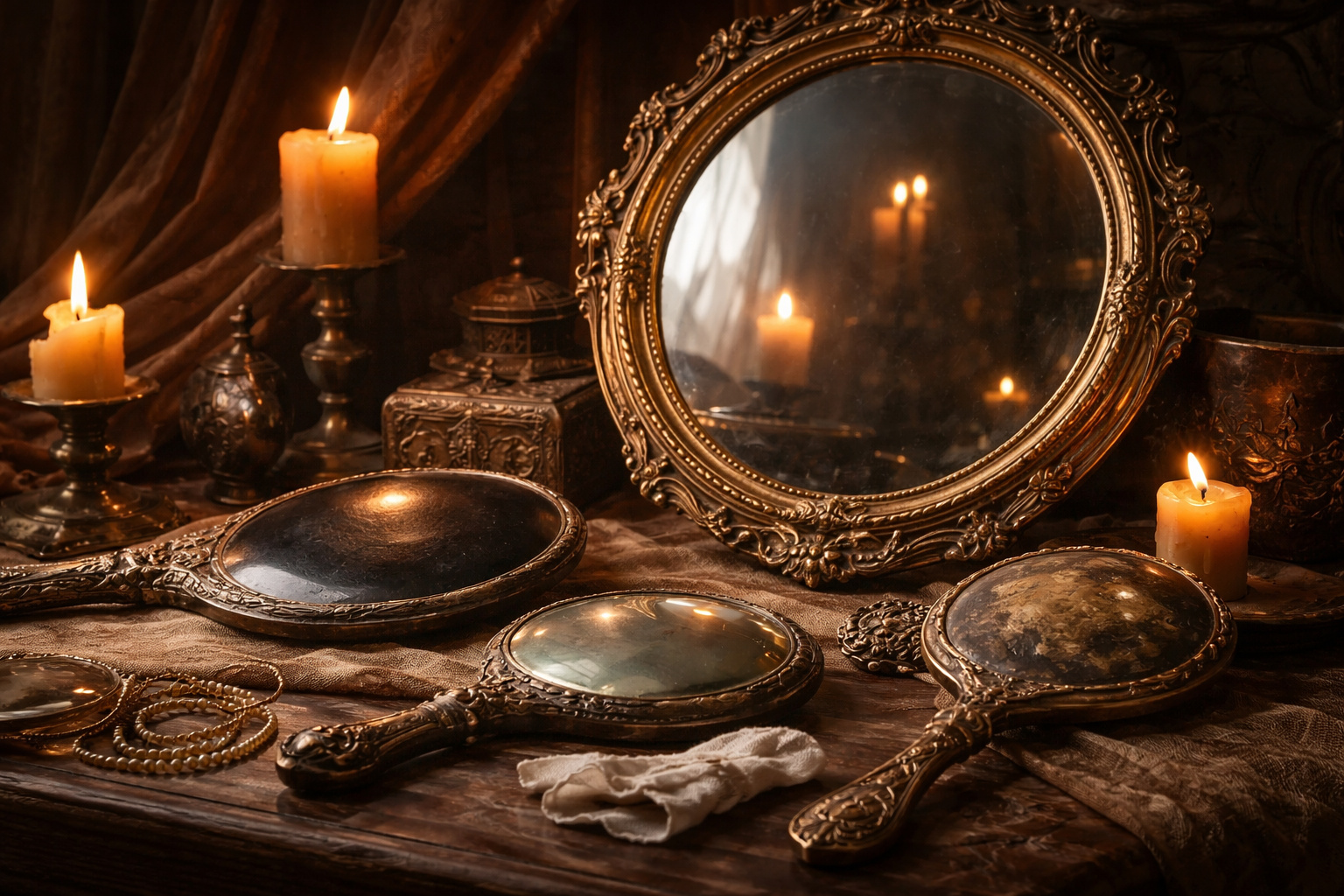
The History of Mirrors Reveals How Humanity Learned to Observe Its Own Image, Refining Techniques That Spanned Millennia and Redefined the Use of Light and Reflection
A slow but decisive technological transformation marked the relationship between humans and their own image over time.
Initially, ancient societies relied on reflective natural surfaces, such as still water, to observe reflections, albeit in an unstable and imprecise manner.
However, as the centuries passed, this practice gradually evolved, keeping pace with the technical and cultural advancement of civilizations.
This historical process reveals how the need to see oneself drove increasingly sophisticated solutions.
The First Artificial Mirrors Appeared in Antiquity
Around 6000 BC, communities in the Anatolia region, in present-day Turkey, produced the first known artificial mirrors.
They used polished obsidian, a naturally shiny volcanic glass, capable of reflecting images in a rudimentary way.
Although simple, these objects already represented a significant technological leap for the time.
Moreover, archaeologists identified these artifacts as personal and symbolic items, reinforcing their cultural importance.
Shortly thereafter, between 4000 and 3000 BC, civilizations in Mesopotamia and Ancient Egypt began to manufacture mirrors made of polished copper and bronze.
These metals offered more defined reflections than stone or water.
Thus, metal mirrors became more functional and valued.
Still, their use remained restricted to social elites.
-
Home environment can influence the brain, mood, and well-being: studies indicate an increase of up to 15% in productivity, a reduction of 12% in stress with plants, and a direct impact of the circadian rhythm on the 24 hours of the day.

-
A Brazilian millionaire couple restores a farm over 150 years old in the interior of São Paulo and transforms the historic property with Portuguese tiles, antique furniture, and new spaces into a refuge that blends tradition, comfort, and sophistication.

-
Submerged city in a lake in Minas reveals intact streets, preserved vehicles, and houses after more than 60 years, impressing divers.

-
Yellowstone has started to rise again in an area of the caldera, and the movement rekindles fears surrounding the U.S. supervolcano, as scientists monitor the deformation and try to understand what is happening underground.


Mirrors as Status Objects in the Ancient World
In Greece and Rome, during the classical period, mirrors continued to be associated with social prestige.
Produced with a high level of polish, they were expensive and difficult to manufacture.
Consequently, only privileged groups had access to these objects.
In addition to everyday use, many cultures attributed symbolic and ritual meanings to mirrors, enhancing their value beyond practical function.
The Decisive Transition to Glass
The major technological change occurred many centuries later, during the European Middle Ages.
In the early 14th century, craftsmen in Venice, Italy, developed mirrors made of glass with a reflective metal layer applied to the back.
This technique used an amalgam of mercury and tin, providing sharper reflections.
However, the process was complex, costly, and kept secret by local guilds.
As a result, Venetian mirrors became luxury items in European courts.
Still, this innovation marked the beginning of the path to modern mirrors.
From that moment on, glass became the main medium for artificial reflection.
The Industrial Revolution of the Mirror in the 19th Century
The decisive breakthrough occurred in 1835, when German chemist Justus von Liebig developed a chemical method to deposit metallic silver onto glass.
This process allowed for the production of mirrors with higher quality, lower cost, and in large quantities.
Thus, the mirror ceased to be a rare object and became part of people’s daily lives.
With industrial production, mirrors spread to homes, businesses, and public spaces.
In addition, the new technique drove scientific, medical, and optical applications.
In this way, the mirror became an essential tool of modern life.
A Long-Term Historical Journey
Over thousands of years, mirrors evolved from unstable reflections in water to highly precise glass surfaces.
Each stage of this process reflected technical advancements, cultural changes, and new social demands.
Today, the mirror is a common object, but its history reveals a complex trajectory of continuous innovation.
How do you assess the impact of an apparently simple invention that has spanned millennia and shaped how humans perceive themselves, given this slow and cumulative evolution?









-

-

-

4 pessoas reagiram a isso.