





 Portuguese
  English
  Spanish
  6 min of reading
  0 comments


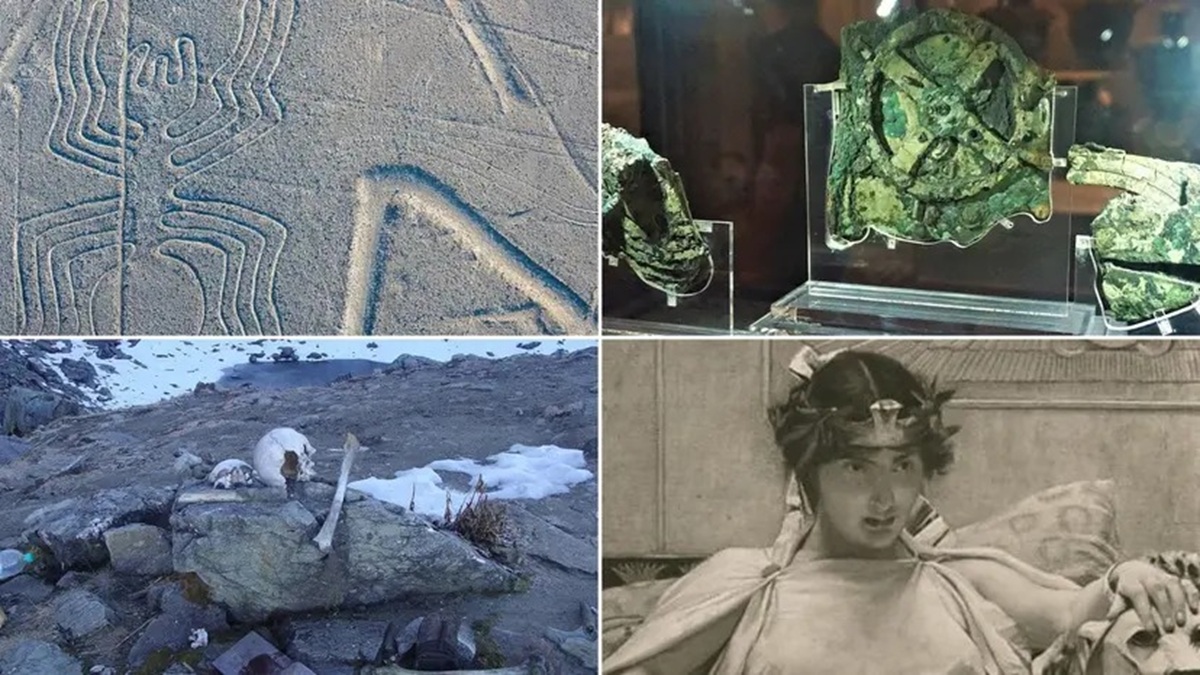
From Lost Cities to Never-Located Tombs, 7 Historical Mysteries Without Solutions Involve Explosions of 1908, Ancient Burials, Lost Colonies, Civilizational Collapses, Giant Geoglyphs, Deaths in Glacial Lakes, and Advanced Technologies Dating Back to 100 BC
Modern science has radically expanded the investigation of the past by allowing genetic analyses, underground mapping, and internal examinations of ancient artifacts, yet some historical events remain unexplained due to the irreversible loss of evidence.
Despite technological advancements, earthquakes, climate changes, erosion, and human interventions have erased essential traces, while certain occurrences seem to have happened in such a unique way that they defy complete reconstructions, leaving persistent gaps in the historical record.
Among unexplained explosions, abandoned settlements, missing burials, and technologies appearing long before their time, these cases lie at the boundary between what can be demonstrated and what can only be inferred.
-
A rare storm phenomenon in the United States alerts meteorologists worldwide due to four different forms of water falling from the sky, which freeze immediately upon touching the ground, poles, cars, or trees.

-
He has been using a wheelchair for almost 10 years, lives alone, is independent, and decided to become a delivery driver for an app: Samuel makes up to 6 deliveries a day, covering routes of 1 km in his wheelchair and has even managed to do 2.5 km in a single run.

-
An island of 7,500 people received 38,000 bananas by mistake, was left unsure where to store everything, and turned the error into a viral case with donations, hustle, and fruit overflowing everywhere.

-
A promise made to their father led three men to unearth a forgotten house that had been swallowed by time for over 70 years, in a story of memory, abandonment, and reconstruction that seems straight out of a movie.


The seven mysteries presented are based on documented events and credible evidence, not myths, reinforcing that even with advanced scientific methods, history does not always fully reveal its secrets.
The Tunguska Event of 1908 in Russian Siberia

On June 30, 1908, an extremely powerful explosion occurred over a remote area of Siberia, near the Tunguska River, devastating about 80 million trees spread over more than 2,000 square kilometers.
The intensity was such that seismic waves were registered in various regions of Eurasia, while unusual atmospheric disturbances were observed even in Western Europe, indicating a phenomenon of continental scale.
Despite the magnitude, no impact crater or conclusive macroscopic fragments have been identified, creating a scientific paradox between the energy released and the absence of direct physical traces.
The most accepted explanation points to the airburst of a fragment of an asteroid or comet, a phenomenon known as atmospheric explosion, capable of releasing immense energy before hitting the ground.
Computational simulations and field surveys support this hypothesis, but uncertainties persist regarding the exact size, composition, and trajectory of the object that triggered the event.
Other hypotheses, such as that of a cometary body rich in volatile materials, continue to be considered due to the scarcity of preserved material evidence in the region.
Over a century later, Tunguska remains the largest known impact event in recorded human history, with its physical mechanisms still being refined by modern planetary science.
The Missing Tombs of Cleopatra VII and Alexander the Great
The burial sites of Cleopatra VII of Egypt and Alexander the Great, two of the most renowned rulers of antiquity, remain unknown despite centuries of systematic archaeological searches.
Ancient accounts describe Cleopatra buried alongside Mark Antony in a royal tomb near Alexandria, but earthquakes, ground subsidence, and rising sea levels have profoundly transformed the original landscape.
Much of ancient Alexandria is now submerged or buried, making it difficult to locate the precise burial structures described in historical sources.
Alexander died in 323 BC, and his body was said to have been transported to Egypt, where it was buried in Alexandria and later visited by Roman emperors.
With the end of antiquity, references to Alexander’s tomb disappear abruptly, with no clear records of destruction, removal, or deliberate concealment.
Excavations in Alexandria and nearby sites, such as Taposiris Magna, have revealed promising indications, but no definitive evidence has been confirmed to date.
Continuous urban growth, historical looting, and environmental changes may have erased the traces, leaving the very existence of these tombs uncertain.
The Lost Colony of Roanoke in North America
Founded in 1587 on Roanoke Island, near present-day North Carolina, the Roanoke Colony represented England’s first effective attempt to establish a permanent settlement in North America.
When Governor John White returned from a supply mission three years later, he found the site completely abandoned, with no signs of armed conflict or remains.
The only visible clue was the word “CROATOAN” carved into a post, reference to a neighboring island inhabited by indigenous peoples of the region.
Archaeological research indicates that the colonists may have dispersed and integrated into local communities, motivated by food shortages, diseases, or regional political tensions.
However, no confirmed traces of the settlers have been conclusively identified, making it difficult to accurately reconstruct the final fate of the group.
No single explanation can encompass all available evidence, keeping Roanoke as one of the most enigmatic episodes of early colonial history.
The Lost Cities of the Amazon and the Decline of the Indus Valley
For decades, it was believed that the Amazon rainforest could not sustain dense and complex societies, an assumption refuted by archaeological research and lidar surveys.
These studies revealed extensive networks of roads, plazas, fortified settlements, and managed landscapes hidden beneath dense vegetation, indicating large-scale organized human occupation.
The findings suggest populations of millions of inhabitants before European contact, but the reason for the collapse of these societies remains without a definitive answer.
Hypotheses include diseases, environmental changes, and social ruptures, although the absence of written records limits more precise conclusions about the process.
A similar situation occurred with the Indus Valley Civilization, which declined around 1900 BC, with cities abandoned gradually and non-violently.
Geological evidence points to river changes and prolonged droughts, but the still undeciphered writing of the civilization prevents understanding of their political and social responses.
In both cases, highly organized societies disappeared without clear historical documentation, leaving gaps that archaeology attempts to fill incompletely.
The Nazca Lines in Southern Peru
Between approximately 500 BC and 500 AD, large geoglyphs were carved into the arid plains of southern Peru, forming the known Nazca Lines.
The figures represent animals, plants, geometric shapes, and straight lines extending for miles, being fully visible only from great altitudes.
The lines were created by removing dark stones from the surface, exposing the lighter soil below, a technique that allowed their preservation for centuries in the dry climate.
Archaeological research associates the geoglyphs with religious rituals, water management, or ceremonial paths linked to seasonal cycles of the region.
Some figures exhibit alignments with specific celestial events, but no single interpretation explains the entire diversity and complexity of the designs.
The absence of written records from the Nazca culture prevents confirmation of their exact purpose, keeping the enigma active for generations of researchers.
The Skeletons of Roopkund Lake in India
Near a glacial lake called Roopkund, in the high Indian Himalayas, remains of hundreds of individuals have been found scattered around the shore.
Radiocarbon dating and genetic analyses indicate that the deceased belonged to multiple groups, originating from different regions and separated by nearly a thousand years.
One of the groups is thought to have died around the 9th century AD, possibly due to an extreme and sudden climatic event.
Studies suggest that large hailstones caused fatal head injuries, consistent with the cranial fractures observed in the analyzed skeletons.
Subsequent groups may have been pilgrims or travelers, but their exact destinations varied, complicating the mystery.
Despite significant scientific advancements, questions remain about the reasons for repeated journeys to such a remote location and the recurrence of fatal deaths there.
The Antikythera Mechanism of Ancient Greece
The Antikythera Mechanism was recovered from a Greek shipwreck dated around 100 BC and is considered the most complex mechanical device of the ancient world.
Built with interlocking bronze gears, the artifact was capable of predicting eclipses, planetary movements, and astronomical cycles with remarkable precision.
Modern examinations, including X-ray tomography, revealed detailed inscriptions and mechanical systems far more sophisticated than any other known from the period.
Although much of its functioning has been reconstructed, central questions remain about who designed it and how widespread this technology was.
There is also no consensus on why this level of mechanical knowledge vanished for over a millennium, with no apparent continuity in subsequent civilizations.
The mechanism challenges traditional chronologies of technological development and offers a rare glimpse into lost scientific traditions that were never fully transmitted.








-

-

6 pessoas reagiram a isso.