





 Portuguese
  English
  Spanish
  6 min of reading
  39 comments


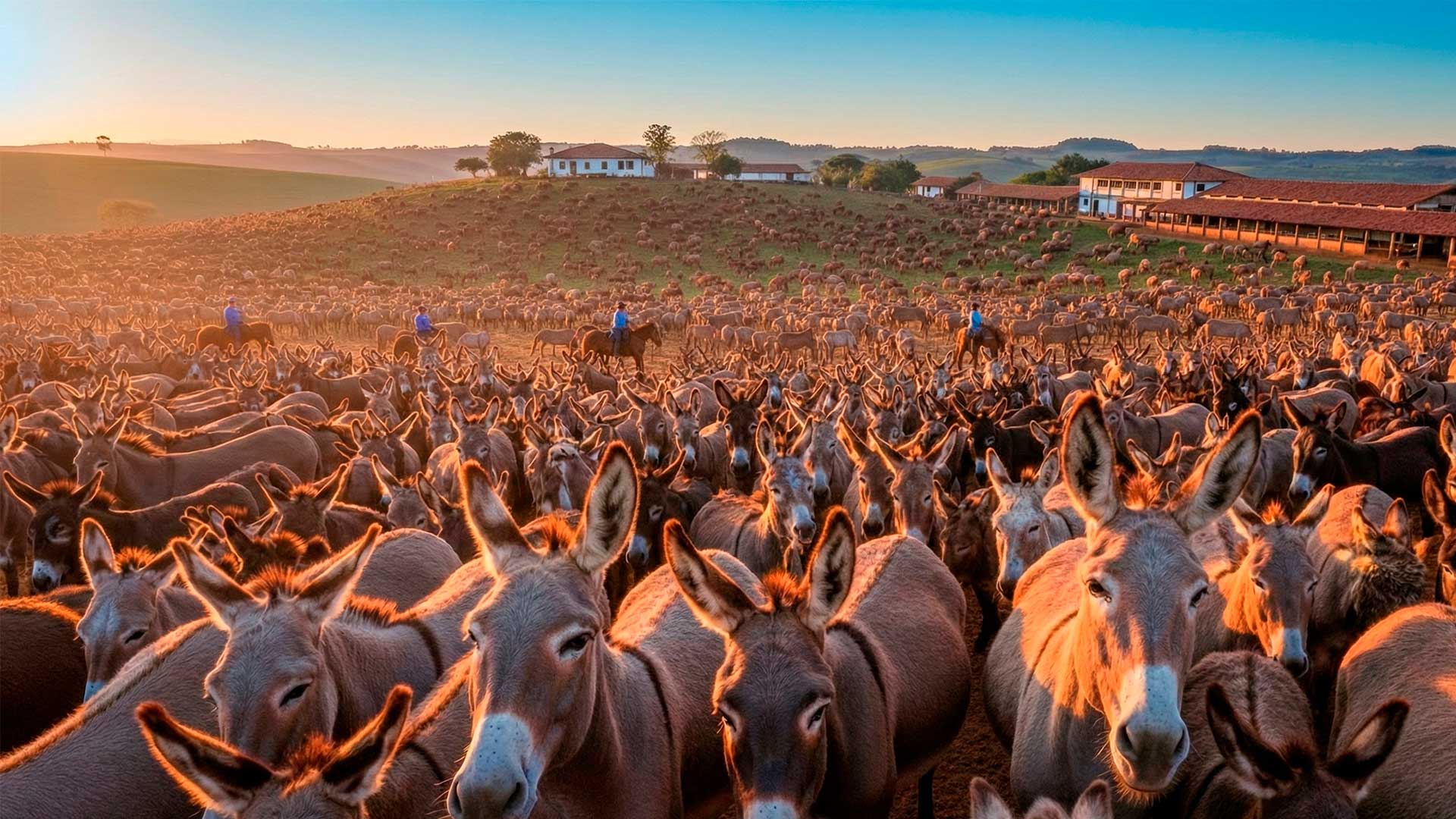


Tropeira Tradition, Selective Genetics, and a “Mule Factory” on Four Farms in São Paulo Transformed the Barnabé Family into a National Reference in the Breeding of Donkeys and Mules for Work, Linking Colonial Past and Modern Agribusiness.
The scene is impressive. There are hundreds of animals lined up in pens, stables, and corrals, all prepared to face hills, stones, and long distances in the fields. For many farmers, these donkeys and mules are more than just working animals; they are indispensable tools for managing the day-to-day operations of the farm.
In the interior of São Paulo, the Barnabé family, from Indaiatuba, Ourinhos, and Garça, turned this vocation into a large business specializing in service mules.
A report from the portal Compre Rural indicates that Tércio Barnabé is now known as the “King of Mules”, leading a herd of around 550 animals distributed across four farms, in an area exceeding 380 hectares.
-
According to an analysis by NASA, only one human-made structure is visible from space, and it is not the Great Wall of China or the Pyramids of Egypt.

-
After 377 years of history, the Brazilian Army will have its first female general: Colonel Claudia Cacho has been promoted to brigadier general by Lula and will receive the sword and command baton this Wednesday in Brasília.

-
A Mercado Livre customer opened their package and found 32 resumes of people looking for jobs crumpled as protective paper inside the box, exposing names, addresses, documents, and phone numbers of dozens of candidates.

-
Iceberg A23a, one of the largest in the world, is undergoing accelerated collapse and may disappear: what explains the end of the ice giant?


According to the same study, in just one year, Tércio managed to sell around 600 donkeys and mules, serving farms in states such as Mato Grosso, Goiás, Amazonas, Pará, Rondônia, and Acre. In practice, it operates like a true “mule factory,” focused on serving a niche that remains hot even with the advance of mechanization.
Behind these numbers lies a century-old story linked to the trail drivers and the formation of Brazil. There’s also a fact that many urban residents are unaware of, but experts in equine breeding emphasize: mules remain essential in hard-to-reach areas, in mountains, valleys, and places where tractors and pickup trucks simply cannot go.
From Colonial Trail Drivers to the Largest Breeder of Donkeys and Mules in Brazil


The use of donkeys and mules for transporting goods in the Americas began during the colonial period, driven primarily by the Spanish who dominated regions like Bolivia, Peru, and Argentina, where the mountainous terrain required very sturdy animals. Studies on trail driving show that mules were essential for carrying heavy loads over narrow trails and long distances.
In Brazil, trail drivers quickly adopted these animals on the routes connecting the interior to the coast. Research on troops and trail drivers highlights that mules became the primary means of transporting goods between gold, sugar, and coffee production centers and the ports, in a period generally spanning from the 18th century to the end of the 19th century.
These caravans traversed mountains, rivers, and areas lacking structured roads. It was literally “on the backs of mules” that riches left Minas Gerais, the sugar-producing Northeast, and the coffee-producing Southeast headed toward international trade, consolidating the role of these animals in the country’s economic development.
What Makes Donkeys and Mules So Valuable in the Brazilian Countryside
From a biological standpoint, mules are hybrids generally resulting from the crossbreeding between donkey and mare, resulting in a male donkey and a female mule. When the crossbreeding is done between horse and jenny, the result is a hinny, which is much rarer in Brazilian farms.
Technical texts in animal science and agricultural portals highlight that mules possess important characteristics: strength and size inherited from horses, combined with the endurance, hardiness, and intelligence of donkeys. This makes them sure-footed and careful where they tread, ideal for narrow paths, slopes, stones, and rugged terrain, common in many rural regions of Brazil.
Another advantage is the economy. Studies indicate that mules consume about 25 percent less food than a similar-sized horse and require less water to maintain, a valuable trait in hot and dry areas. Additionally, they accept simpler forage, dry grasses, and show greater resistance to heat and certain diseases, which reduces management costs.
Inside the “Mule Factory” of the Barnabé Family in SP
The Barnabé family’s relationship with mules began in the 1920s when Ário Barnabé started breeding donkeys and mares of the Mangalarga Marchador breed to produce donkeys and mules in Indaiatuba, in the interior of São Paulo. Over time, the activity passed to his son, Tércio Barnabé, now recognized in specialized portals as the largest breeder of mules and donkeys in Brazil.
Today, the group maintains four farms dedicated to the breeding of mules and Nelore cattle. The Campo Bonito farm in Indaiatuba, Santa Helena and São Francisco in Ourinhos, and São João in Garça total more than 380 hectares, with around 550 animals, including donkeys, jennies, breeding mares, and a robust herd of donkeys and mules for work.
The structure includes spacious corrals, ventilated stalls, paddocks with quality pasture, and specific training areas. According to rural reports, the management is overseen by veterinarians, ensuring balanced feeding and a focus on well-being, which reinforces the image of a high-quality herd among buyers from various regions of the country.
The main focus is the production of service mules on a large scale, ready for daily work on farms with beef cattle, dairy farming, or extensive management activities. There are already trained animals available for immediate use and others “wild” for breeders who prefer to train them their way, broadening the audience served.
Not surprisingly, many farmers wait for months for new shipments of animals, especially well-mannered mules and donkeys that are highly valued at auctions and events linked to agribusiness.
Tradition, Genetics, and the Thriving Mule Market in Brazil
In addition to the physical structure, the genetics of Barnabé animals is a central point of the business. Reports from the breeder himself and from specialized auctions indicate that over decades, the family has carefully selected bloodlines of Pêga donkeys and Mangalarga mares, seeking animals with strength, docility, good gait, and great work capacity.
These efforts resonate with studies on the so-called “Horse Agribusiness Complex,” which includes horses, donkeys, and mules and involves a broad range of activities, from supplies to services. Research indicates that, combined, horses, mules, and donkeys total around 8 million heads in Brazil, placing the country among the global leaders in this segment.
Despite tractors, trucks, and ATVs reducing the space for traction animals in some regions, academic works and reports from producers remind us that mechanization has not signaled the end for mules. In steep, flooded, or dense forest areas, they remain unbeatable in cost, safety, and access capacity.
At the same time, donkeys and mules are gaining traction in other uses. Rural portals report an increase in the participation of these animals in horseback rides, functional trials, rural tourism, and cultural events tied to trail driver memory, reinforcing a symbolic and historical value that goes beyond heavy work in the field.
In this context, farms like the Barnabé family’s occupy a strategic position. They meet the demand for high-performance animals while also helping preserve a culture that risks being lost in the era of machines, keeping alive an important part of Brazilian rural identity.
And you, what do you think about this? Do you believe that the Barnabé family’s “mule factory” represents an example of intelligent tradition that Brazil should value, or do you think the country should accelerate replacing donkeys and mules with machines in all regions? Leave your comment, share if you have seen the work of these animals up close, and join the debate about the future of mules in the Brazilian countryside.









Excelente reportagem, precisamos de mais informações. Agora, perdoe-me ,como o nosso povo é tamanha ignorância.
Todos esses jumentos, são eleitores do **** de nove dedos.
São petistas esperando abaixar a picanha mas **** tá só aumentando os impostos e tachando os brasileiros e os petistas aplaudindo em pé