





 Portuguese
  English
  Spanish
  5 min of reading
  0 comments


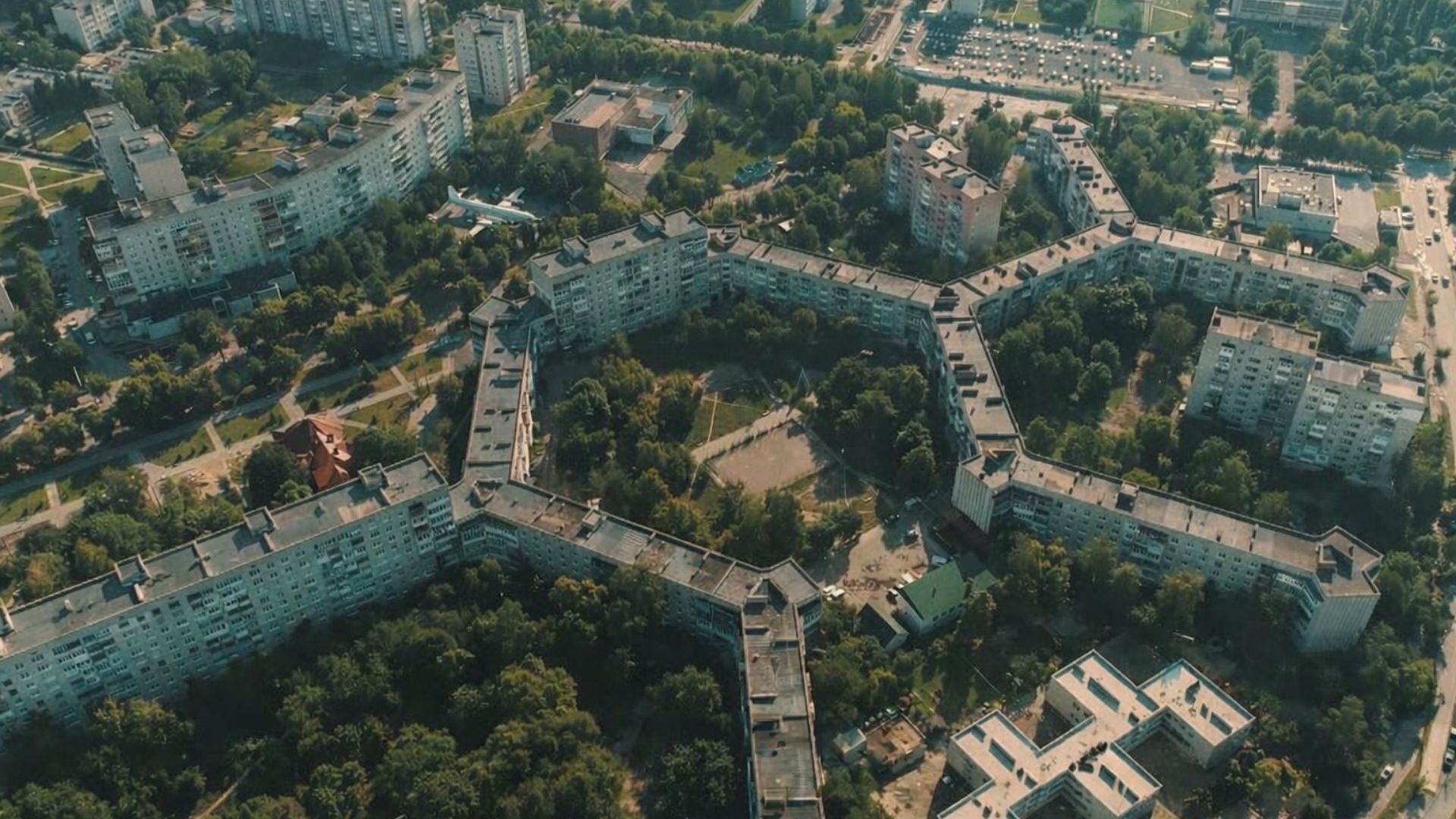
Monumental Construction in Ukraine Gathers Thousands of Residents in a Single Urban Complex, Marked by Unusual Architecture, Record Dimensions, and a Labyrinthine Design That Has Become a Local Symbol and World Reference in Large-Scale Cooperative Housing.
The residential building identified as the longest in the world is located in Lutsk, a city in northwestern Ukraine, and extends for nearly 2.8 km when its various “arms” and branches are added together.
According to the Ukrainian news program TSN, aired on channel 1+1, the complex reaches a total length of 2,775 meters in this expanded measurement, which takes into account all the interconnected extensions of the complex.
Although treated as a single building, what is seen on the map and at street level is a large ensemble articulated by curves, courtyards, and passages, formed by dozens of sections connected to each other.
-
China retires the J-7 fighter after years of military protection and can now transform military items into drones, following more than 60 years of operation of the J-7, derived from the MiG-21, with thousands of units produced and strategic use in the PLAAF and PLANAF.

-
Volunteers are sought to live in the mountains for a month: a study pays people to stay at 2,500 meters, with 24-hour monitoring of sleep, metabolism, and blood pressure.
-
Goodbye to kitchen cabinets: innovation retires the traditional furniture of Brazilian kitchens by introducing modern pantries with modules of up to 2.40 m, 40% more organization, ergonomic access, adjustable shelves, and smart lighting in 2026.

-
After the union of Brazil and China, BRICS plays a leading role in the merger between two powers: Egypt and India move forward with agreements exceeding US$ 4 billion, expanding industrial capacity in strategic sectors and accelerating the establishment of factories and global production chains.


In this unusually designed residential space, around 10,000 people live in over 3,000 apartments, distributed across approximately 156 entrances.
Why the Complex Gained the Nickname “Great Wall of China”

The comparison with the Great Wall of China is not related to military function or antiquity, but rather to the sense of scale. It is a continuous block, extensive enough to traverse different areas of the neighborhood and assert itself prominently in the urban landscape of Lutsk.
In addition to this nickname, the building is also known as “bee-hive house”, a name inspired by the design seen from above and how the residential volumes fit into a single integrated structure.
The image evokes honeycombs, reinforcing the idea of repetition and connection between the parts.
According to TSN, the complex is considered a record-holder in length among residential buildings.
The report notes that there are complexes in Japan measuring around 2 to 2.5 km, but emphasizes that none of them present such complex multi-sectional architecture or house such a large population in a single building.
Labyrinthine Architecture and 120-Degree Curves
The most striking element of the project is its geometry. Instead of a linear layout, the complex was designed with characteristic curves at 120-degree angles, connecting multiple segments into a single continuous structure.
According to TSN, the building consists of about 40 interconnected sections, with heights varying between 5 and 9 stories.
This combination creates an irregular and dynamic silhouette, responsible for both the visual impact and the difficulty of navigating the interior of the complex.

At street level, the experience may be less intuitive than the monumental appearance suggests.
As reported by the news program, early residents often got lost trying to locate their apartments, as the curves and passages form a true residential labyrinth.
Even today, simple everyday references still play an important role in internal navigation.
Plantings, flowerbeds, and other visual landmarks serve as an informal compass, especially for those not familiar with the building’s design. To reduce confusion, each section has its own official address, facilitating deliveries and services.
A City Within a City in Lutsk
The numbers help explain why the complex is often described as a city within a city.
There are thousands of apartments distributed across internal courtyards and open areas, interconnected by corridors and passages that repeat throughout the complex.
In addition to residential areas, the building houses stores, playgrounds, and community spaces, integrated into the daily routine of its residents.
In Lutsk, this combination has made the building a recognized landmark both for those living in the city and for visitors.
The distribution of the complex across different sections of the neighborhood reinforces the feeling of a microcity.
Instead of an isolated block, what exists is a continuous urban fabric, stitched together by arches, courtyards, and internal pathways that follow an almost organic succession.
In practice, this scale influences everyday habits. While some residents traverse long internal routes before reaching the main street, others live in sections with direct access to commercial areas or busier courtyards.
On the other hand, the same diversity of pathways that facilitates internal circulation also increases the chances of disorientation.
Construction in the Soviet Modernism Period

The origin of the building helps to understand its unusual design. The construction spanned more than 11 years, from the end of the 1960s to the beginning of the 1980s, a period marked by the pursuit of large-scale housing solutions.
According to TSN, the construction took place between 1969 and 1980, during the peak of Soviet modernism, when residential projects prioritized formal innovation, standardization, and urban efficiency.
In this context, the Lutsk complex emerged as an ambitious response to housing demands.
The reports credit the project to architects Vasyl Malovytsia and Rostyslav Metelnytskyi, who conceived the building as a single interconnected structure capable of accommodating thousands of people in one ensemble.
Over time, the building evolved from merely a housing solution to a urban landmark.
In Lutsk, it became a symbol of the city, both for its size and the social impact of gathering thousands of residents under a single architectural “body”.
TSN itself summarizes this perception in a frequently quoted phrase from reports about the location:
“Lutsk’s bee-hive house is not just a record-holder in length; it’s also an extremely interesting object that has become a city symbol. Its size, complexity, and social impact impress and remain unique in global architectural practice.”
Outside Ukraine, what stands out the most is the combination of factors. It’s not just about length, number of entrances, or population count, but the sum of length, branches, 120-degree curves, and interconnected sections, which transform the building into something akin to an entire neighborhood concentrated into a single structure.




-

-

-

-

-

22 pessoas reagiram a isso.