





 Portuguese
  English
  Spanish
  3 min of reading
  0 comments



The Story of the Autistic Boy Who Learned English on His Own Reveals How His Family Used Hyperfocus to Stimulate Speech and Communication Before Portuguese
Six years ago, the story of Rafael, an autistic boy living in Timbó, in the interior of Santa Catarina, drew the attention of specialists and family members due to the peculiarity of his development. At just over 4 years old, he surprised everyone by starting to communicate fluently in English, even though he lived in an environment where no one spoke the foreign language, overcoming the initial isolation of his condition.
The boy, who was the third of Valir and Juliana’s four children, showed difficulties in interaction before finding in technology a gateway to speech.
While the parents sought ways to stimulate his development after the diagnosis, the boy used a tablet to watch cartoons and online content, which triggered an impressive self-taught learning that even challenged the professionals who accompanied him.
-
Brazil’s nuclear submarine with a speed 5 times greater than normal advances after nearly 50 years and R$ 40 billion spent.

-
A Brazilian island charges R$ 0.50 to receive visitors and prohibits any new residents.

-
Why was the Great Wall of China built? The truth that many are unaware of!

-
At 73.8 meters tall, the world’s tallest teapot-shaped building has 15 floors, ensures stability, and impresses with an internal space of 28,000 cubic meters.


The Diagnosis and the Use of Technology
The first signs appeared when Rafael was one year and eight months old. His parents noticed that he did not interact, showed communication difficulties, and often played alone in isolation.
After a series of tests and consultations, the family received confirmation that he was an autistic boy.
The parents’ initial concern, according to reports from that time, was not with the diagnosis itself, but with the fear of how he would behave in relation to society and whether he would be able to be independent.
In an attempt to stimulate their son, the parents taught Rafael to use a tablet. The boy began to browse the internet and chose cartoons in English.
Thanks to his keen visual memory, he began to repeat what he heard and suddenly started communicating with his family only in that language. His mother even recorded a video of the moment he counted past 100 in English and identified colors, ignoring commands in Portuguese.
The Language Barrier and Hyperfocus
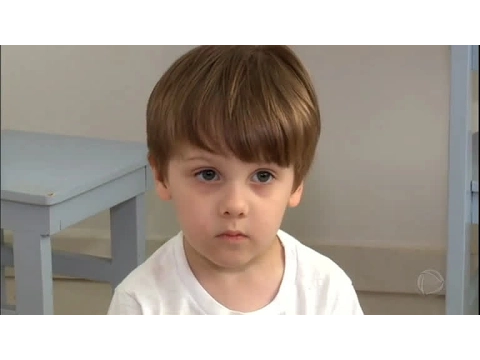

Although the development of speech was an advancement, the situation created a new challenge: the family did not speak English. In the region where they lived, the common second language was German, and no one in the house, not even close relatives, was fluent in the language that the autistic boy adopted.
This left the parents apprehensive, as they often could not understand what the child wanted or needed, since his feedback was exclusively in a foreign language.
Experts explained that the phenomenon occurred due to hyperfocus, a common characteristic in the autism spectrum. The foreign language captured Rafael’s attention more, and by associating images with words in the videos he watched, he quickly memorized the content.
For the speech therapy professionals who attended him, this was a novelty, as they had never treated a patient who had developed speech in this manner.
Learning Libras and Returning to the Mother Tongue
In addition to English, Rafael’s curiosity led him to learn another form of communication on his own: Libras (Brazilian Sign Language).
Also through the internet, the autistic boy memorized the manual alphabet and even taught the letters to those he interacted with, demonstrating an acute cognitive capacity for visual languages.
However, the focus of treatment at the time needed to be redirected. The speech therapist worked to stimulate the boy to speak Portuguese, using associations with everyday objects, such as “cat,” “heart,” and “moon.”
The goal was to prepare Rafael for regular school and ensure his socialization, since mastering the mother tongue was essential for him to communicate with everyone around him and achieve the independence that his parents so desired.
English, however, was recognized as the fundamental gateway that opened up to bring the child out of silence.
And you, do you know any inspiring stories of how technology has helped the development of atypical children?








Seja o primeiro a reagir!