





 Portuguese
  English
  Spanish
  3 min of reading
  0 comments


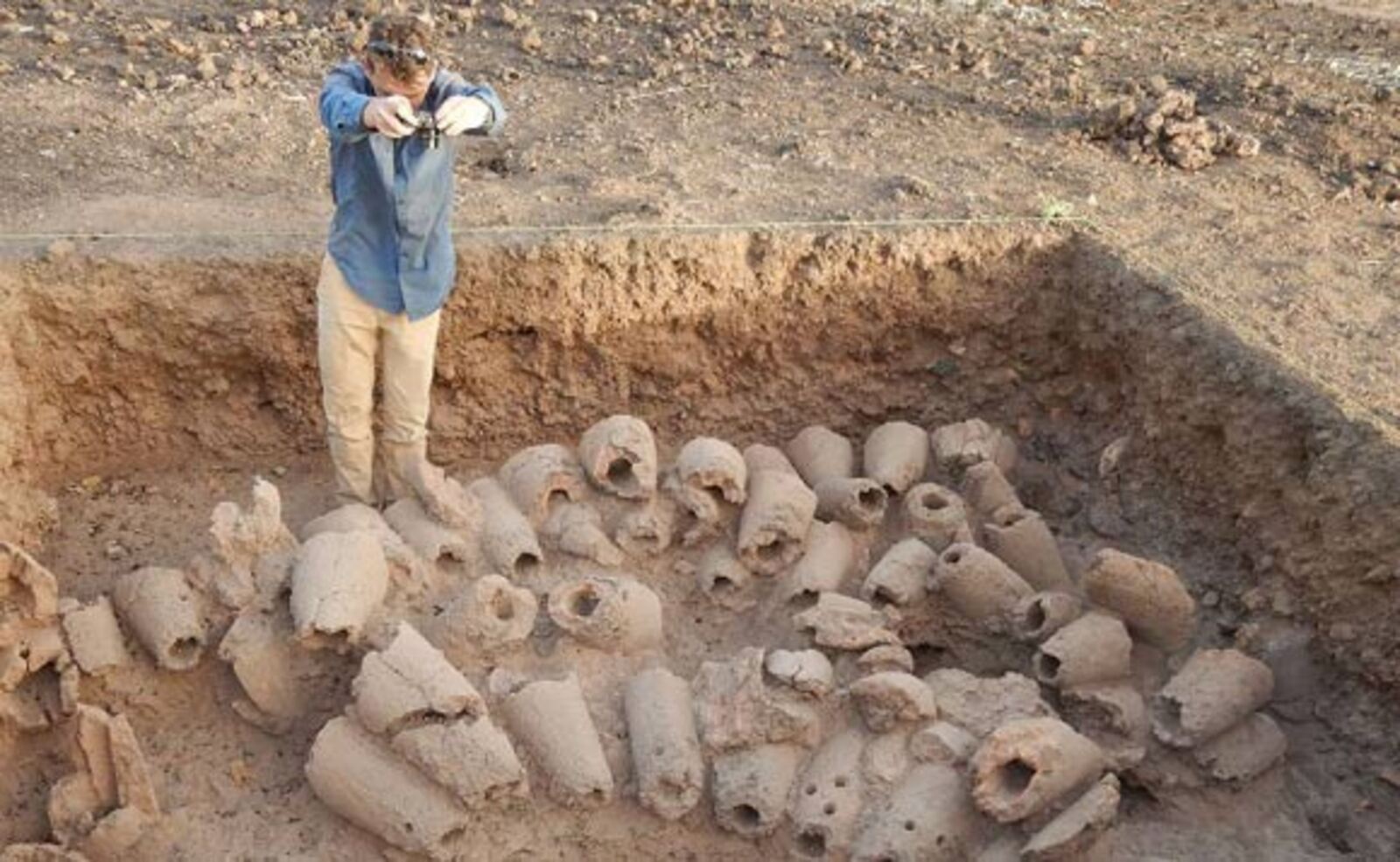
Excavations in Senegal reveal iron smelting workshop used for almost eight centuries, with 100 tons of slag and rare technique
Excavations at Didé West 1, in eastern Senegal, identified an exceptionally preserved iron metallurgy workshop, dated between the 4th century BC and the 4th century AD, with nearly eight centuries of activity and rare technical evidence in West Africa.
Workshop preserved for centuries
The discovered structure features a large pile of about 100 tons of slag, as well as a semicircular arrangement formed by approximately 30 tuyères used, the clay tubes responsible for carrying air to the furnace.
In the same set, archaeologists found 35 circular bases of furnaces, each about 30 cm deep.
-
Four humans are flying towards the Moon inside the Orion capsule launched by the SLS rocket, and on April 6, Artemis II will disappear behind the far side of the Moon without communication with Earth for nearly an hour.

-
Worlds covered by water, atmospheres filled with hydrogen, and the possibility of life beyond Earth: ocean planets are rewriting the map of cosmic search and forcing scientists to rethink where to look.

-
Argentina achieves the unimaginable after more than 110 years and reintroduces the largest native herbivore of South America to the Chaco to restore a lost link in nature.

-
Returning to the Moon now costs a billion-dollar bill and reignites the competition between the USA and China for science, technology, and rare minerals on lunar soil.


The state of preservation of the site allowed for a clear observation of the spatial organization and the residues related to production.
The workshop was dated between the 4th century BC and the 4th century AD, indicating an extremely long period of use.
The interval represents almost eight centuries of continuous activity related to iron metallurgy at the Senegalese site.
What the find reveals
For Mélissa Morel from UNIGE and her colleagues, the site sheds new light on the emergence of iron metallurgy in West Africa.
The set was described as truly unique due to its age, preservation, and technical characteristics.
According to the researchers, iron and steel production likely occurred on a small scale to meet local needs.
Among the main uses were the manufacture of agricultural tools, indicating an activity focused on the daily lives of the communities.
The long duration of the system in operation also offers a rare opportunity to study the continuity and adaptation of a smelting technique over time, without a marked rupture in the main structure of the complex.
Identified technical tradition
At the Didé West 1 site, the spatial organization, the morphology of the furnaces, and the associated residues point to the tradition known as FAL02.
This tradition is marked by small circular furnaces with a removable chimney at the top.
Another feature described by archaeologists is the use of large clay nozzles. The vents do not have a single air outlet, but multiple small openings connected to the main channel by perpendicular side ducts.
This design allowed for air distribution to the bottom of the furnace. Researchers also recorded the use of palm seeds as filling material at the base, a practice not previously documented in this type of context.
Continuity in production
Anne Mayor from UNIGE and the Institute of Global Studies stated that the tradition of iron metallurgy remained remarkably stable during the long operation of the workshop, with only minor technical adjustments over the centuries at the site.
This continuity, according to the archaeologists, contrasts with other African metallurgical contexts and reinforces the importance of understanding the technical and cultural choices made by early metallurgists in iron production.
With information from SCI News.







Seja o primeiro a reagir!