





 Portuguese
  English
  Spanish
  6 min of reading
  0 comments


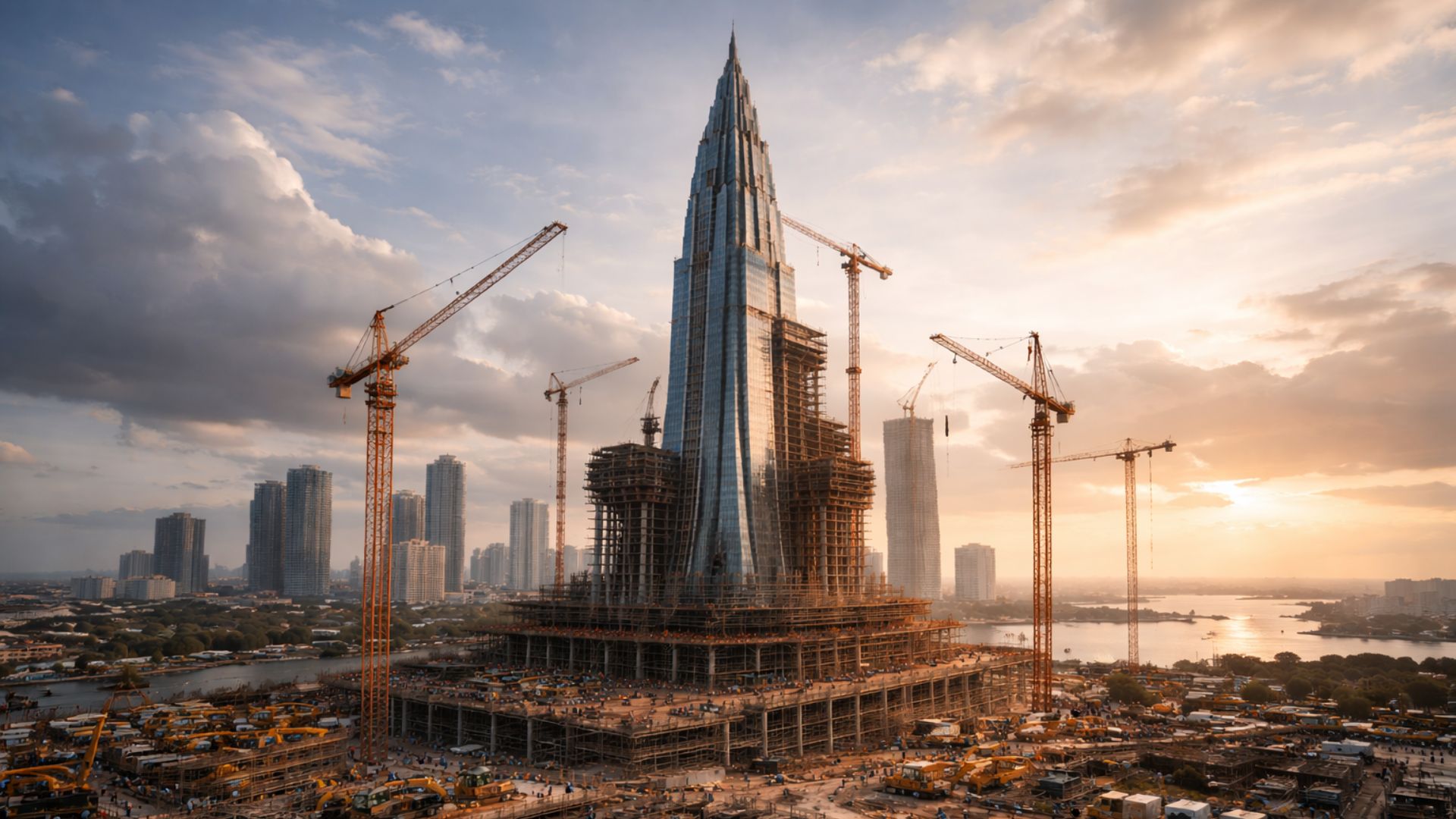
State Tower in Abidjan Advances With Ambition to Redesign the Urban Horizon, Concentrate Public Bodies, and Place Côte d’Ivoire on the Global Map of Large Buildings, in a Dispute That Mixes Engineering, Administrative Efficiency, and Symbolic Weight in the Political and Financial Center of the City.
The Tour F, under construction in the Plateau district of Abidjan, was designed to gather public bodies currently scattered throughout the economic capital of Côte d’Ivoire while simultaneously redefining the urban landscape of the city with an architectural height of 421 meters to the top of the spire.
According to public information about the project, the building will have 76 floors above the monumental ground floor, in addition to three basements, with a scheduled completion in 2026.
More than an unusually tall skyscraper for West Africa, the tower has been incorporated into the Ivorian State’s administrative reorganization plan.
-
The project that was supposed to be ready for the 2014 World Cup in Brazil debuted with a 12-year delay and nearly R$ 6 billion invested: the Line 17-Gold of the São Paulo monorail opened with reduced hours and is only expected to operate fully in October.
-
Neither the Pyramids nor the Great Wall of China, this gigantic construction in Spain is the human mark on planet Earth that intrigues the most when seen in images from space.
-
Surrounded by cliffs, mist, and chilling stories, the ancient Hotel del Salto has been reborn as a museum while still unable to shake off its reputation as a haunted place.

-
This star-shaped fortified construction, hidden near the border of Spain, may be the largest fortress on the planet.

The official proposal is to concentrate services and teams in a single address, reduce rent expenses, and expand the capacity of the Cité administrative, which already includes the A, B, C, D, and E towers.
Tour F in Abidjan and the Centralization of Public Services
The origin of Tour F dates back to an older urban design, mentioned in public presentations as part of the planning of the area since the 1970s.

The project has gained traction in recent years in response to the demand for new administrative offices in Plateau, a neighborhood that concentrates financial and institutional functions and houses a significant portion of the public machinery of the Ivorian economic capital.
According to PFO Africa, responsible for showcasing the project in its portfolio, the tower will have approximately 140,000 square meters of gross constructed area.
The published program includes reception areas, food spaces, meeting rooms, amphitheaters, and a vertical circulation structure with 21 elevators, two freight elevators, and a panoramic elevator for access to the upper area open to visitors.
The institutional material presents the central justification combining administrative efficiency and real estate rationalization.
The company claims that verticalization allows for better utilization of a valuable plot in the center of Abidjan, while simultaneously doubling the capacity of offices and parking spaces in the Cité administrative.
In practical terms, the tower is regarded as a tool for state centralization, rather than merely a large-scale architectural gesture.
Height of the Tour F and the Impact on the Skyline of Abidjan
The most visible dimension of the project lies in its height.
PFO Africa’s presentation distinguishes the tower with a height of 333 meters from the spire that brings the total to 421 meters of architectural altitude, which helps explain why the building has been considered a candidate for the new African record when completed.
Currently, the tallest completed building on the continent is the Iconic Tower in Egypt, standing at 393.8 meters, according to the CTBUH.
This point is relevant because the Tour F is still under construction and therefore does not currently hold the title of the tallest building in Africa.
What public records indicate is that, if the final height is maintained at delivery, the tower in Abidjan is expected to surpass the Egyptian mark and take the continental lead among completed buildings.
At the top, the so-called “lantern” has become one of the most emphasized elements in the project’s narrative.

The official description speaks of a large internal volume under the terrace, with a panoramic view of 360 degrees over Abidjan and the Ébrié Lagoon, as well as public access.
In buildings primarily designed for administrative use, this type of visitor access is not a secondary detail: it alters the relationship of the building with the city and enhances its symbolic function.
The formal language of the tower has also been crafted to communicate identity.
The Bureau Greisch, the office that participated in the structural studies, states that the faceted and symmetrical geometry of the building evokes the visual strength of an African mask.
This association helps position the Tour F not only as state infrastructure but as a piece of urban representation in a neighborhood already marked by institutional buildings.
Engineering of the Tour F, Foundations, and Double Skin Facade
The engineering required for a building of this size helps explain why the Tour F has been featured in international lists of tall buildings.
PFO Africa states that the structure will support a mass of around 170,000 tons and that special foundations associated with a reinforced concrete raft 3.5 meters thick were necessary for this.
The Bureau Greisch confirms the presence of this thick raft and records its involvement in studies of soil-structure interaction.
In the body of the tower, the structural system combines cast-in-place concrete and pre-cast elements, with bracing concentrated in a central core.


Greisch also states that it worked on optimizing wall thicknesses and in interactive models capable of considering, in an integrated manner, the effects of wind and the response of the foundations, within a process associated with BIM.
In very tall buildings, this control is crucial to limit deformations, vibrations, and variable stresses along the height.
Another point of attention is the facade.
PFO Africa describes a double skin system, with a conventional inner layer and another outer layer that acts as a brise-soleil.
The external shell totals 36,000 square meters, with 16,000 glass panels, and includes a technical walkway between the two layers to facilitate maintenance and operation.
The project is also presented as adhering to the EDGE standard, associated with criteria for energy efficiency and sustainable construction.
Pierre Fakhoury, Besix, and the Global Reach of the Project
In the public records consulted, the architect associated with the project is Pierre Fakhoury, identified by PFO Africa as the maître d’œuvre and listed by the CTBUH as architect of record.
The Bureau Greisch informs that it was mobilized by Besix to carry out optimization studies and structural execution, while the CTBUH lists Besix itself as the main contractor and consultant in specific areas, such as wind and facade.
These details help explain why the Tour F has transcended local discussions and has been viewed as a barometer of Abidjan’s urban ambition.
Rather than emerging as a residential or private corporate venture, the tower was designed to condense state functions and reinforce the centrality of Plateau at a time when several African capitals are seeking to project a new international image through large constructed landmarks.
At the same time, the project reinvigorates a recurring discussion in major metropolises: the real weight that an iconic building can have on administrative and urban routines.
In the case of the Tour F, the declared bet combines operational efficiency, better use of central land, and global visibility.
The concrete result of this equation will depend less on the imposing silhouette and more on the building’s capacity to function, in fact, as an accessible, operable, and integrated administrative center.






-

Uma pessoa reagiu a isso.