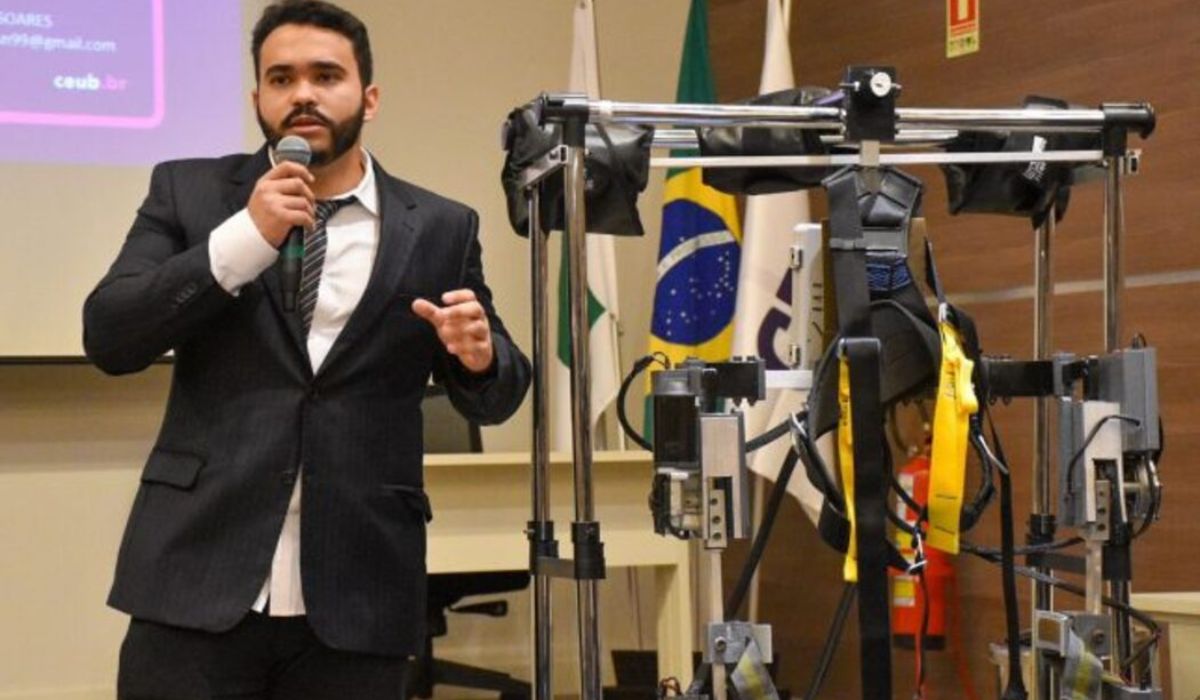
A family experience led an Electrical Engineering student to transform academic knowledge into an experimental exoskeleton, bringing together 3D printing, aluminum, motors, and digital control in an attempt to enhance mobility and support rehabilitation processes.
The loss of movement faced by his grandmother after a stroke led the Brasilia native Matheus Soares Nascimento to design an exoskeleton for lower limbs.
The project came to life in 2022, as the Final Project for the Electrical Engineering Course at the University Center of Brasília, CEUB.
The first version was produced with 3D printed parts, but the structure could only support about two kilograms.
-
Roman house buried by imperial palace reappears with preserved frescoes and mosaics, showing how a republican residence remained hidden for almost two thousand years beneath one of Rome’s most important hills.

-
A small town in Rio hides a 2.2 km railway tunnel opened in the Serra do Mar over 160 years ago to transport coffee from the interior to the capital.

-
Railway plan of around R$ 3.3 trillion aims to connect European capitals with high-speed trains by 2040 and compete with short flights, but it depends on governments and investors to finance new lines, tunnels, and incompatible systems.

-
With a 30.1% increase in launches and 13.7% in deliveries, Brazil’s real estate market closed 2025 in strong expansion, driven by the Minha Casa Minha Vida program, with São Paulo leading and generating 42.6 billion reais in sales.


To increase strength, the student replaced some of the plastic components with aluminum and built a second prototype equipped with four independent motors at the hip and knee joints.
According to a report published by Correio Braziliense, the effective development of the prototype took approximately eight months.
The motivation arose when Matheus was still at the beginning of his undergraduate studies.
His grandmother had lost movement on the left side of her body and began to need assistance to perform daily activities.
She died before her grandson completed the invention.
“Unfortunately my grandmother passed away, but the idea of being able to help people in similar situations stayed in my mind,” said the student in an interview published in June 2022.
Exoskeleton began as an Electrical Engineering project
Matheus was 22 years old when he presented the equipment.
The work was supervised by Professor Hudson Capanema Zaidan and also received academic guidance from faculty members related to the areas of control and mechanical engineering.
The prototype was developed to provide external support and reproduce part of the leg movements.
Instead of replacing a limb, as with a prosthesis, the exoskeleton surrounds the body and uses a mechanical structure to assist movement.
The four motors were installed at points corresponding to the hip and knee joints.
Each of these parts has an independent command, allowing the system to control different phases of the movement.
The structure also incorporates sensors and a small computer responsible for identifying the user’s position.
Based on this information, the system sends commands to the motors to execute pre-programmed movements.
“The exoskeleton contains a mini computer that detects the user’s position, tracking their movements,” explained Matheus.
According to him, the use still depended on an auxiliary walking device, such as a walker or support structure.
Digital control coordinates the four motors
The prototype’s operation uses a control known as PID, an acronym for proportional, integral, and derivative.
This type of system compares the desired position with the position identified by the sensors and continuously adjusts the motors’ response.
In simple terms, the controller tries to prevent the joint from moving beyond or below the programmed point.
To do this, it calculates the difference between the received command and the executed movement, correcting speed and position during operation.
Matheus developed an independent digital control for each joint.
The separation allows for individual control of hips and knees, although all motors need to work in sequence to reproduce a gait.
The equipment, however, did not yet reproduce a natural walk.
Tiago Leite, a professor at CEUB and a Ph.D. in Mechanical Sciences, stated at the time that aspects related to speed and acceleration needed to be refined.
This limitation is relevant because human movement does not rely solely on bending hips and knees.
Walking involves balance, weight transfer, coordination between different joints, and constant adaptation to floor conditions.
First 3D printed version supported two kilograms
3D printing manufacturing allowed Matheus to produce gears, boxes, and other parts of the prototype with reduced initial costs.
The technique also facilitated changes in the design of the parts during testing.
The plastic used in the first construction, however, did not offer the necessary resistance.
According to the report by the CEUB News Agency reproduced by the Jornal de Brasília, the structure could not support a load greater than two kilograms.
The next stage combined plastic components with rods and aluminum elements.
The change increased the support capacity but also brought new challenges related to the weight of the device itself, comfort, and adaptation to each user’s measurements.
The version presented by CEUB was described as capable of supporting the equivalent of the lower limbs of a person weighing up to 76 kilograms and 1.80 meters.


This information does not mean that the prototype was cleared to fully support a person or to be used without support.
The project employed a modular structure, with fixed, movable, and adjustable extension parts.
The proposal was to allow adaptations for users of different heights without the need to manufacture a completely new device for each person.
Prototype had not been tested on patients
When the project was disclosed in 2022, the exoskeleton remained in the academic phase.
The next stage planned by CEUB consisted of improving a reduced version, seeking partners, and preparing future tests with humans.
The reports consulted do not indicate that the prototype has undergone clinical trials, received authorization for medical use, or been tested by people with lower limb paralysis.
No reliable public updates were found confirming the performance of these tests, the transformation of the work into a commercial product, or the continuation of development after the versions presented in 2022.
For this reason, the equipment should be described as an experimental prototype, not as a medical solution available to patients.
In Brazil, devices developed for diagnosis, treatment, or rehabilitation can be classified as medical devices.
The current regulation of the National Health Surveillance Agency establishes risk classification, safety requirements, documentation, and notification or registration regimes for products that will be placed on the market.

Assistive technology could support mobility and physiotherapy
Matheus’s proposal had two main applications.
The first would be to assist people with loss of leg movements during locomotion activities, always with adequate support and after adaptations to the equipment.
The second possibility would be to use the exoskeleton in physiotherapeutic rehabilitation processes.
In this case, the motors could help repeat leg movements in a controlled manner, under professional supervision.
This application, however, would depend on safety evaluations, patient testing, and definition of the profiles that could use the device.
People with motor limitations may have different conditions of balance, muscle strength, bone health, and trunk control.
Matheus also indicated that he needed to study content outside of Electrical Engineering, including knowledge of mechanics, physiotherapy, and medicine.
Another difficulty reported was finding professionals capable of making some adjustments required by the structure.