





 Portuguese
  English
  Spanish
  4 min of reading
  1 comment


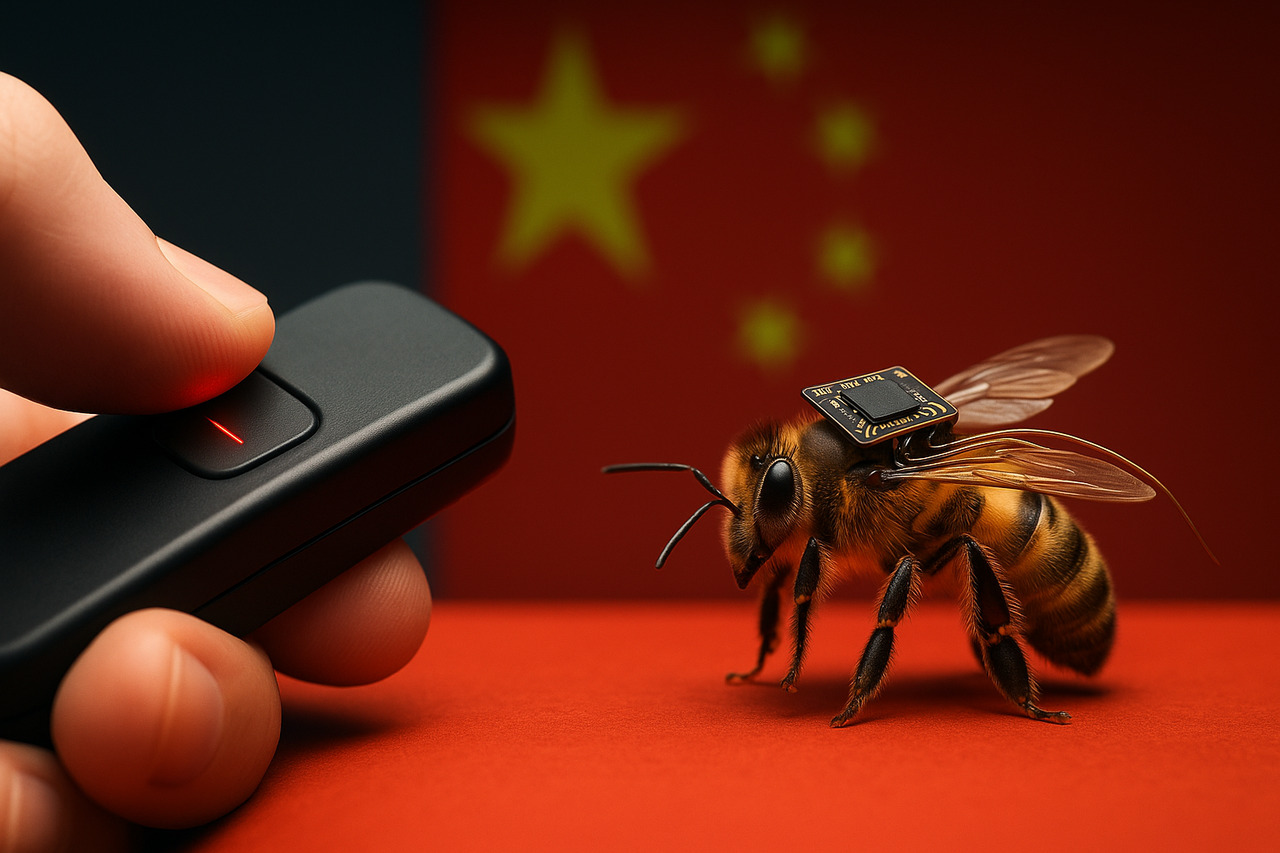


Chinese Researchers Control Live Bees with Brain Microchips and Pave the Way for Unprecedented Advances in Biohybrid Robotics and Rescue
Chinese scientists have taken an unprecedented step by transforming live bees into cyborgs through a microchip that allows them to control their movements. The experiment was conducted by researchers at the Beijing Institute of Technology and reported by the South China Morning Post. The technology used represents an advancement in biohybrid robotics, blending precision engineering with living organisms.
How the Chip Installed in Bees Works
The highlight of the innovation lies in the size of the developed chip. It weighs only 74 milligrams, light enough not to hinder the bee’s natural flight.
This microchip is attached to the insect’s body and connects three ultrafine needles directly to the animal’s brain.
-
They were brilliant! Scientists discover that our ancestors in China were already making super advanced tools 160,000 years ago, changing everything we knew.

-
Scientists unveil 3 million years of climate secrets hidden in the ice of Antarctica.

-
Ancient farmers created “aggressive plants” that changed nature forever.

-
Astronomers find a “backward” solar system that ignores all the rules of space and leaves scientists scratching their heads!


These needles are responsible for sending electrical impulses that mimic sensory signals. These stimuli cause the bee to change direction or even stop, as if obeying remote commands.
With this, researchers were able to direct the bees in real-time, something that had never been successfully achieved with other insects, such as cockroaches.
The accuracy of the control drew attention. In conducted tests, nine out of ten bees complied with the received commands, altering their trajectories as programmed.
This shows that the technology has reached a high level of efficacy without compromising the insect’s natural abilities.
Possibilities for Real-World Use
The natural characteristics of bees make this innovation even more promising. These insects can fly up to five kilometers without stopping and with low energy consumption.
With the use of the microchip, they can be programmed for missions that require agility and range.
Among the suggested uses is the search for survivors in disaster-hit areas. The lightness of bees and their efficient flying capability could overcome the limitations of larger drones and robots, which struggle in narrow spaces or unstable terrains.
The idea also paves the way to explore dangerous or inaccessible regions for humans. As they move easily and require small amounts of energy, cyborg bees can carry out specific tasks quickly and safely.
Technical Limitations Still Exist
Despite the promising results, the technology is still far from being applied outside of testing environments.
Currently, the controlled bees are tethered to cables, which restricts their movement. This means they can only be used in controlled areas.
To overcome this barrier, researchers are working on wireless power systems. The goal is to allow the chips to function autonomously, maintaining control of the bees even in open spaces. This step is crucial for the innovation to have practical application on a large scale.
Another challenge involves the health of the insects. It is still unclear how long a bee can survive with the implants.
Therefore, tests continue to be conducted with attention to the safety and well-being of the animals. Scientists emphasize that the integrity of the bees is a priority in the development of the technology.
Ethical Discussions Gain Strength
In addition to the technical advancements, the project raises important debates about ethics and privacy. One of the main concerns is the use of bees for surveillance.
Although the initial goal is search and rescue, remote control could be adapted for other purposes.
The fear is that in the future, cyborg bees could be used to spy on people or gather information secretly.
Since they are small and silent, they would go unnoticed in many environments. This possibility worries experts and raises questions about the line between innovation and invasion.
Another point debated is the control of living beings by humans. Even if the intentions are positive, some believe that interfering so directly in an animal’s behavior can be a dangerous path. Technology requires clear regulations to prevent abuse.
Paths for the Future
The cyborg bee project is just the beginning of a new phase of robotics. The next step will be to test wireless power sources to free the insects from cables and enhance the practical utility of the invention.
Meanwhile, scientists continue to investigate how to ensure that bees can live with the implants without harming their health.
In the long run, the challenge will be to balance the benefits of innovation with responsibility and respect for ethical boundaries.
With information from Daily Galaxy.








Acho improvável funcionar numa colmeia real. Uma abelha pesa cerca de 100 a 120 mg e o chip citado tem 74 mg — quase o mesmo peso do inseto, o que comprometeria voo e comportamento. Além disso, as abelhas reconhecem umas às outras pelo odor da colônia e rejeitam qualquer indivíduo alterado, atacando ou expulsando quem “não cheira certo”.