





 English
  Francês
  Alemão
  Italiano
  Japonês
  Norueguês
  Portuguese
  Spanish
  8 min of reading


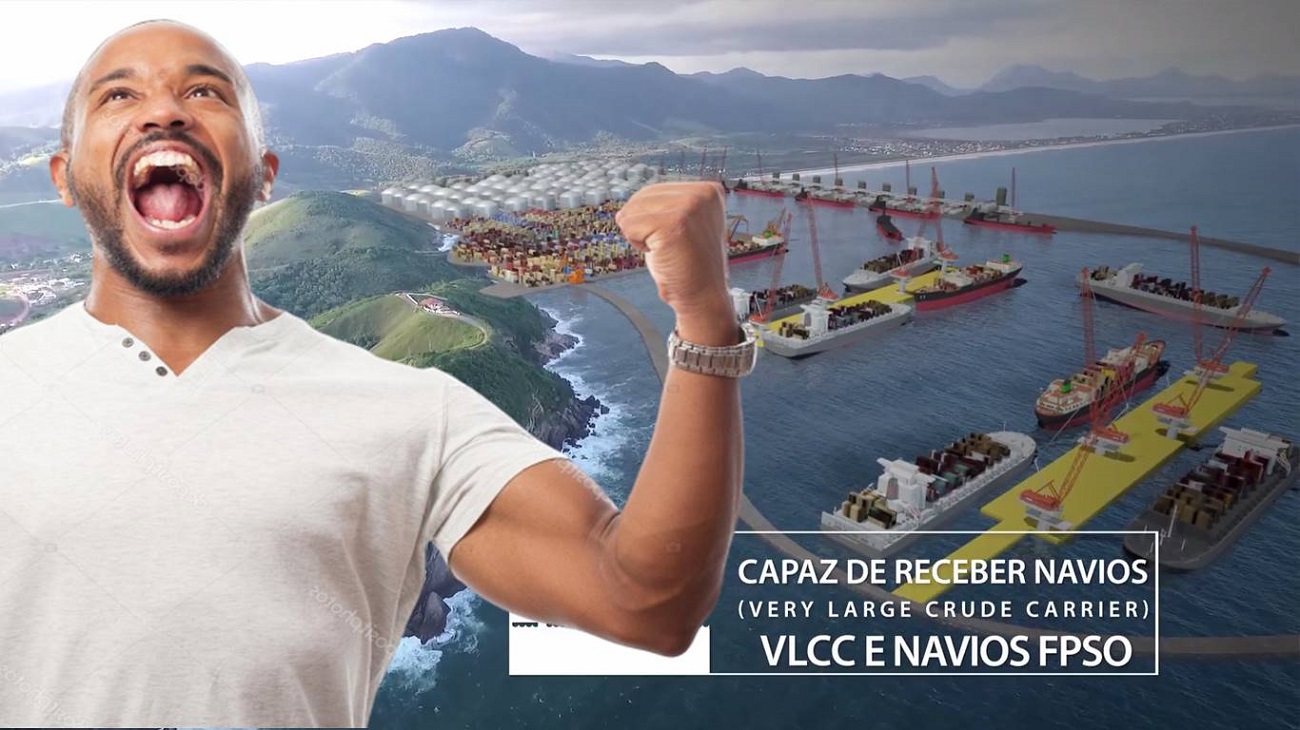
The Installation License (LI) for the Construction of the Ponta Negra Port Terminal (TPN) in Maricá, Rio de Janeiro, Was Obtained by DTA Engenharia and Will Be the Largest Port Project in the Country. The Area, Covering 5.5 Million Square Meters, Was Acquired by the Company About 10 Years Ago. The LI Is the Final Phase of the Environmental Licensing.
DTA received the Installation License (LI) for the construction of the largest 100% private port terminal, located at the Jaconé beach corner in Maricá, Rio de Janeiro. This will be the largest 100% private port terminal in the country and promises a new reality for the state of Rio de Janeiro, potentially boosting pre-salt oil movements, Gaslub Hub activities, and large Petrobras operations. This information came through a press release on 12/29/2021 to the CPG Portal.
Read Also
As early as 2011, DTA received support from the federal, state, and municipal governments for the port terminal project. However, a legal issue during the environmental licensing process led to the project’s halt. Thus, the construction of Brazil’s largest port terminal, a private investment, was paused for nearly ten years.
Watch the Video That the City Hall of Maricá Presented at the Mipim Fair in Cannes, France in 2016, Featuring the Presentation of the Ponta Negra Port Terminal (TPN) Project


Project for the Construction of the Largest Port Terminal Was Halted for 10 Years Due to Environmental and Historical Issues
It all began after DTA Engenharia obtained the Preliminary License (LP) in 2016, which is nothing more than the environmental viability of the project. The next step would be to obtain the Installation License (LI) and then start construction. However, due to a public civil action that claimed the site housed beach rocks, necessitating its preservation, the entire landscape of the port terminal project in Maricá, Rio de Janeiro, changed, leading to a loss of billions in investments and the generation of thousands of direct and indirect jobs for a long period.
-
New shoe factory in Ceará is expected to create 400 jobs and strengthen the local economy.
-
No one imagined it, but a mixture of sawdust with a mineral that fights fires surprises scientists with a result that changes the course of fire-resistant construction.

-
From empty land to a high-end house, wooden construction uses a lightweight system, metal structure for the foundation, ventilated ceramic cladding, and special windows to create an efficient and comfortable living space throughout the year.
-
From vacant land to a high-end house, wooden construction uses a lightweight system, a metal structure for support, ventilated ceramic cladding, and special windows to create an efficient and comfortable living space throughout the year.

The construction of the port terminal was interrupted until July when DTA Engenharia received news about the suspension of the sentence, and all that remained was the Installation License (LI) for DTA to proceed with the work.
Resumption of Negotiations for the Construction Project of the Port Terminal May Be Responsible for Meeting Movements of Pre-Salt Oil, Gaslub Hub in Itaboraí, and Large Petrobras Operations.
The port terminal project in Maricá, Rio de Janeiro, is advancing again. The area for the construction of the port terminal, covering 5.5 million square meters, was acquired by DTA Engenharia about 10 years ago. The Installation License (LI) is the last phase of the environmental licensing. The notice was published last Thursday, December 23, in the Official Gazette, after approval by the State Environmental Control Commission (CECA), obtaining a wide margin of 10 favorable votes out of 12 voters.
The opinion of the State Institute of the Environment – INEA, the environmental agency of the state of Rio de Janeiro, concluded that “considering the information presented and the positive aspects for the development of the state of Rio de Janeiro, especially for the region of the enterprise; that the entrepreneur sought in every way to meet INEA’s request with socio-environmental solutions to mitigate the project’s effects on the environment; and the technical proposals presented for the mitigation of identified negative impacts, the technical team of INEA suggests granting the LI, provided that the Environmental Compensation Commitment Term (TCCA) is executed, and the proposed conditions of the license contained in this opinion are respected.”
With the decision made, the next step for DTA Engenharia is to resume negotiations and presentation rounds for updates on the construction project.
Berth Equipped with Tubes Designed to Remove Oil Stored in Ships
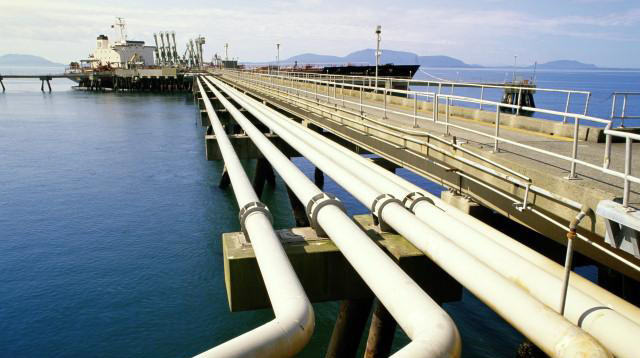
The complex could be responsible for practically all daily pre-salt and post-salt oil movements, as well as the future Gaslub Hub of COMPERJ, located 35 km in a straight line from TPN, along with other Petrobras operations, via the Rota 3 gas pipeline of 24 million m3/day, which runs inside TPN and was the first unit to be installed by Petrobras within the terminal.
Maricá Has the Potential to Become One of the Largest Industrial Hubs in the Country
In an interview granted to the City Hall of Maricá at the signing of the cooperation agreement aimed at implementing the Maricá Industrial Park and the Ponta Negra Terminal (TPN) on November 26, 2021, and consolidating local productive arrangements, Governor Cláudio Castro stated that “the Maricá Industrial Park and the Ponta Negra Terminal are strategic and fundamental logistics infrastructure elements for the economic growth of the state.”
Maricá Signs Agreement for the Implementation of Industrial Park

Also according to the Governor, “through these facilities and others such as the airports of Galeão and Cabo Frio, we will requalify Rio as the Brazilian hub for export, import, cargo distribution, and passenger movement.” On the same occasion, Mr. Vinicius Farah, State Secretary of Economic Development, Energy, and International Relations, stated that the partnership will further foster the Maricá region. For him, Maricá has the potential to become one of the main industrial hubs in the country.
Port Terminal in Maricá Has Strategic Proximity to Gaslub Hub
This is a highly ambitious project in the city of Maricá, strategically positioned in the state of Rio de Janeiro, mainly due to its proximity to the Gaslub Hub. TPN will be installed in the Municipality of Maricá, at Jaconé beach, in the state of Rio de Janeiro. The land, rail, and maritime access are favorable and are as follows, according to the Environmental Impact Report (RIMA) of the enterprise:
- Land: RJ-104 highway, crossing with RJ-118 highway, reaching the boundaries of DTA’s land. The advantage is the proximity to Comperj, reducing logistics costs and interference with local communities;
- Rail: proximity to the right of way of the former Maricá Railway/Cabo Frio Branch (which is not operational);
- Maritime: natural depth of 30m near the coast, allowing large vessels to operate. This permits reduced dredging volumes for the implementation of the access channel and the evolution basin for the ships and the related environmental impacts.
DTA Engenharia’s executive foresees investments of around US$ 2.45 billion in the project, approximately R$ 12.8 billion. The plan is to build four structures, one terminal for liquid bulk, another for natural gas, a third for containers, and a repair shipyard, constituting an operational area that totals 3.5 million m².
The initial phase, including the construction of the breakwater, the back area, dredging, among other preparatory works, will be executed by DTA itself, which specializes in engineering for the port sector.
Throughout the project’s structuring, a highlight has been its proximity to the Gaslub Hub, located in the area housing Comperj, in Itaboraí. Petrobras’s installation anticipates operations for lubricants, natural gas processing, and possibly a thermoelectric plant.
TPN will allow COMPERJ to access its 440,000 barrels of oil per day very economically, given the proximity of the future terminal. Currently, Brazil lacks any project capable of meeting this demand for oil in STS – Ship-to-Ship operations. The area features 1,800 meters of seafront, with a differentiating factor: 30 meters of natural depth just 500 meters from the coast. No project in the Atlantic Ocean possesses such an outstanding natural attribute, enabling the design of an onshore port with breakwaters using the high-quality gneiss rock existing within the area, without requiring future maintenance dredging, solely for implementation, ensuring the lowest operational costs in the country.
Port Terminal in Maricá, Rio de Janeiro, Will Be the Largest and Most Modern Oil Transshipment Terminal in Brazil
Another positive point is that the Rota 3 gas pipeline, which connects the Santos Basin pre-salt hub to Gaslub, will run through the area of the future TPN, opening up the possibility of access to the port terminal.
The new port will feature large-capacity tankage for oil and derivatives, allowing the classification of oil according to its API degree, while the Rota 3 gas pipeline, which will be connected to the refinery of the Rio de Janeiro petrochemical complex (Comperj), will send 24 million cubic meters per day, along with an area for general cargo. The enterprise is located 35 kilometers from COMPERJ in a straight line, where the shore approach has already been constructed, everything that Petrobras aimed for. DTA conducted a thorough study of the area, looking for the right location to invest and meet the currently suppressed demand.
Concept Images of the Internal Yards of TPN and Structure of the Enterprise – Terminais Ponta Negra (TPN)
-
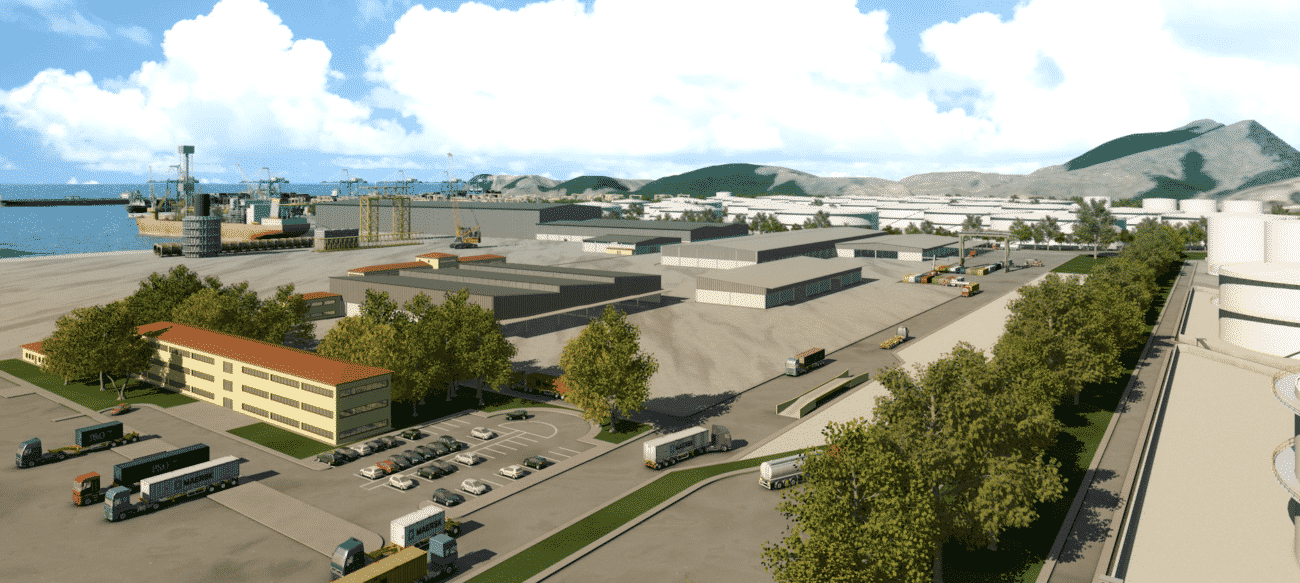
IMAGE: Panoramic View of the Project for the Internal Yards of TPN. SOURCE: RIMA TPN TERMINAIS PONTA NEGRA. -
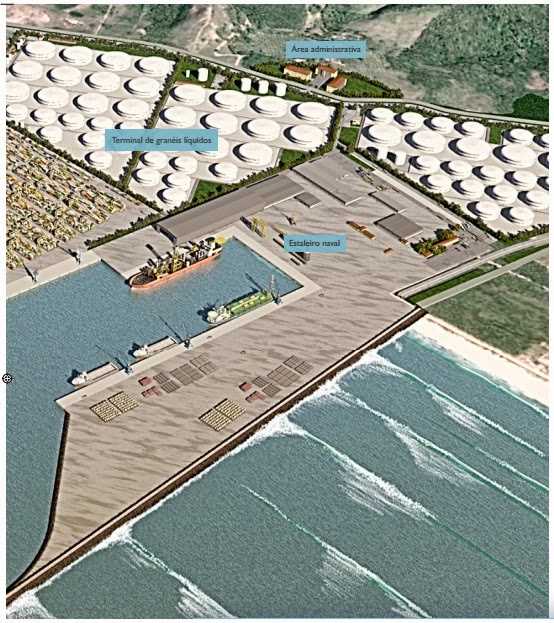
IMAGE: Panoramic View of the Implementation Project. SOURCE: RIMA TPN TERMINAIS PONTA NEGRA.
The president of DTA Engenharia, Mr. João Acácio Gomes de Oliveira Neto, highlights that “this news comes at a time when Brazil already produces 2 million and 700 thousand barrels per day, with 60% being pre-salt. Of this total, 1 million and 600 thousand are produced at the front in Maricá. Additionally, currently, this type of ship-to-ship operation is performed offshore or in the Bay of Montevideo. The new facility will be ready for this purpose.”
Port Terminal Will Receive Giant Ships
TPN will be the largest liquid bulk terminal in the southern hemisphere and will also be an important source of tax revenue for the State of Rio de Janeiro. According to PGE-RJ, the Ponta Negra Terminal (TPN) has the potential to generate annual taxes of R$ 230 million (ISS, ICMS, Cofins, IR).
Cargoes that cannot be handled by the terminals in Guanabara Bay and Angra dos Reis will be absorbed by TPN, allowing for lower operational costs and greater logistical security for the oil refineries in Rio de Janeiro and Minas Gerais. Furthermore, it will house the largest container terminal in Latin America, capable of receiving ships with large capacity, which will lead to a decrease in freight costs in the market.
In 2024, the first ship is expected to dock if everything goes as planned!








-

Uma pessoa reagiu a isso.