





 Portuguese
  English
  Spanish
  3 min of reading
  0 comments


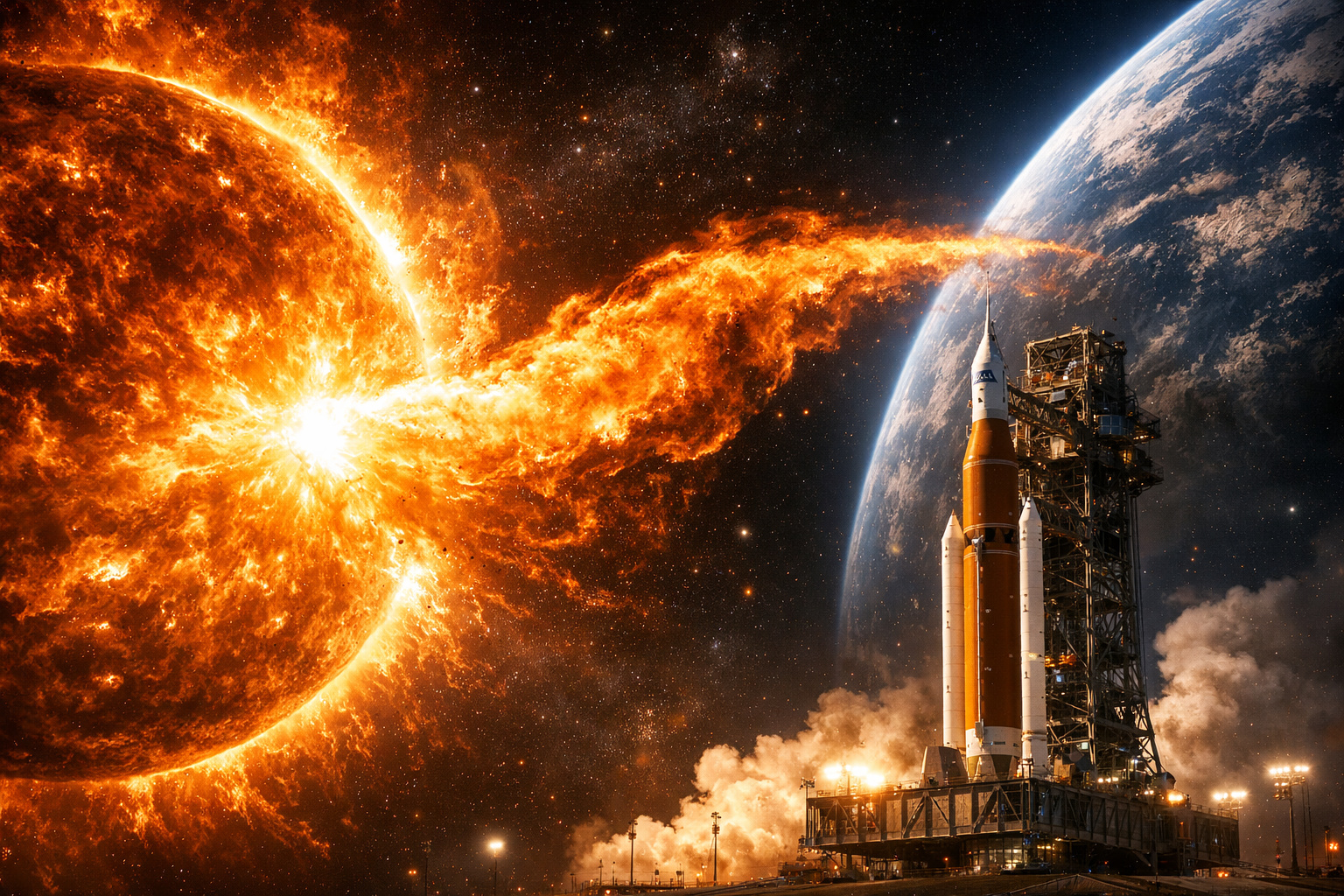
Rare phenomenon registered on March 30 raises global alert and raises questions about impacts on communications, technology, and ongoing space missions
A extremely powerful solar explosion registered on Monday (30) triggered an immediate alert among scientists and space weather experts worldwide. The phenomenon, classified as high intensity, can launch a huge amount of energetic particles and plasma towards Earth, raising concerns about impacts on technological systems and space missions.
The information was released by the NOAA Space Weather Prediction Center, which identified the eruption as a class X1.4 solar storm, one of the most intense categories within the scale used to measure such events. Additionally, the phenomenon caused a R3 (strong) radio blackout, temporarily affecting communications in certain regions of the planet.
In this sense, experts emphasize that solar explosions of this magnitude are not just impressive astronomical events but also pose real risks to modern infrastructures. This is because they can directly interfere with communication systems, electrical grids, and even satellite navigation technologies.
-
Scientists are developing a self-repairing asphalt that can close microcracks on its own before they turn into potholes, a technology that could drastically increase the lifespan of roads and reduce billions in maintenance worldwide.

-
Scientists from USP issue a warning about the air in the countryside after a study indicates that breathing outside of São Paulo may conceal silent risks, with evidence that worries experts about health impacts.

-
The change in weather arrives tomorrow: heavy rains and storms return to the Central-South after a hot week, with a cold front along the coast bringing instability between Santa Catarina, Paraná, and the Southeast, affecting capitals strongly until Thursday.

-
The rapporteur of the critical minerals project said today that Brazil will not create a state-owned mining company, but Lula has already discussed the creation of Terrabras with ministers last Friday, and the United States has already invested 565 million dollars in a Brazilian mining company without waiting for a response from the government.


Furthermore, the coronal mass ejection — known as CME — generated during the event is still being analyzed, increasing expectations about possible broader impacts in the coming days.
Geomagnetic storms may affect Earth in the coming days
Based on initial analyses, the forecast indicates a sequence of geomagnetic storms that may hit the planet throughout this week. Initially, the expectation is for a G1 (minor) storm on Monday (30), followed by an intensification to G2 (moderate) on Tuesday (31).
Subsequently, on Wednesday (1st) — exactly the day scheduled for the launch of the Artemis II mission — activity is expected to return to G1 (minor). Still, even levels considered lower can cause interference in sensitive systems.
Thus, attention is growing regarding possible impacts on:
- Radio communications
- GPS and navigation systems
- Electrical grids
- Satellite operations
Consequently, constant monitoring of these conditions becomes essential, especially at a critical moment for space exploration.

NASA monitors situation and keeps launch plan for Artemis II
Despite the alert scenario, NASA has adopted a cautious yet reassuring tone. According to the agency, initial observations indicate that the coronal mass ejection is not expected to impact the launch of the Artemis II mission, scheduled for April 1, 2026.
Still, the space agency emphasized that it continues to monitor the situation in real-time. This is because the behavior of space weather can change rapidly, requiring constant reassessments.
Moreover, NASA highlighted that it has a fleet of spacecraft dedicated to monitoring the Sun and the space environment around Earth, ensuring updated data for strategic decisions.
It is worth noting that solar eruptions are extremely intense energy explosions, capable of affecting not only technology on Earth but also posing risks to astronauts and equipment in orbit.
Therefore, even without confirmed immediate risk, the scenario requires continuous vigilance.
Artemis II mission remains a historical milestone in space exploration
Meanwhile, the Artemis II mission continues to be considered one of the most important projects of the new era of space exploration. The mission plans to send four astronauts to orbit the Moon, without landing, marking a fundamental step for future crewed missions.
The launch depends on the completion of final tests without setbacks, and the launch window remains open throughout April, with six more opportunities available.
Additionally, the Orion spacecraft, designed to accommodate up to four astronauts for up to 21 days, represents a significant advancement in space technology.
In this context, any external event — such as a solar explosion — naturally increases the level of global attention on the mission.
Solar impact raises debate on global technological vulnerability
In light of this scenario, experts emphasize the importance of investing in space monitoring and resilient systems. After all, extreme solar events can expose weaknesses in critical infrastructures.
On the other hand, the fact that NASA is maintaining the schedule demonstrates confidence in the current data and risk mitigation capabilities.
Thus, although the solar explosion registered on the 30th has generated concern, the current outlook indicates that the launch of Artemis II remains on track — at least until new updates.
With information from: CNN Brasil






Seja o primeiro a reagir!