





 Portuguese
  English
  Spanish
  5 min of reading
  0 comments


China And India Compete For The World’s Largest Territorial Border As Tension Between The Asian Giants Grows
Imagine one of the most tense regions on the planet, where two of the largest countries in the world face each other every day, separated only by frozen mountains. On one side, China, the superpower that keeps growing. On the other, India, its increasingly influential neighbor with a population rivaling that of China. In between, an ancient territorial dispute that has never been resolved and still generates clashes between soldiers. In this article, you will understand how this dispute began, why it continues, and how it could affect not only Asia but the entire global geopolitical balance.
A Natural Wall Separates The Two Giants
The border between China and India is marked by a true colossus of nature: the Himalayan mountain range. These mountains have always served as a natural barrier between the two countries. But even with all the difficult access, the region has become the stage for one of the world’s largest territorial disputes.
It is not just a matter of territory. We are talking about two powers with increasingly divergent economic, political, and military interests. China is betting on an ambitious project for commercial integration with its neighbors, while India responds by reinforcing its armed forces along the border.
-
Iran authorizes the passage of ships with essential goods in the Strait of Hormuz, requires coordination and protocols; UN postpones resolution to reopen the oil route, while China, France, and Russia reject the use of force.
-
The Ukraine war exposes the strength of the M113 armored vehicle amid modern warfare with military drones.

-
Maritime geopolitics: China and the USA compete for strategic ports in Peru.
-
Iran shoots down two US aircraft: F-15 fighter crashes in mountainous area, one crew member is rescued and another is still missing; second crash in the Persian Gulf exposes still active air defense, says US intelligence.

The Conflict Has Deep Roots
To understand how this situation reached this point, we must go back over a century. In 1914, when India was still a British colony, the so-called McMahon Line was established to delineate the border with Tibet. However, China has never recognized this line, considering it illegitimate.
The catalyst occurred in 1962, when Chinese troops invaded the Indian territory of Aksai Chin. Since then, this region has remained under Chinese control, and clashes have never completely ceased.
Today, the dispute is concentrated in three main areas:
- Kashmir (a highly militarized region and the focus of constant clashes);
- Aksai Chin (under Chinese administration but claimed by India);
- Arunachal Pradesh (controlled by India but claimed by Beijing).
The Complicated Legacy Of British Independence
The situation worsened after the independence of India and Pakistan in 1947. During the partition, the states of the former British colony were offered the opportunity to choose which country to join.
There emerged a major impasse: the region of Kashmir was ruled by a Hindu Maharaja but had a predominantly Muslim population. When the Maharaja decided to join India and asked for military assistance against Pakistani militias, the First Kashmir War erupted.
To this day, the struggle for Kashmir involves three actors:
- India (which controls part of the region and claims the entire territory);
- Pakistan (which controls a portion and contests Indian control);
- China (which administers Aksai Chin, an area claimed by India).
According to the Institute for Defence Studies and Analyses (IDSA), the Kashmir region remains “one of the biggest points of instability in South Asia”.
The Chinese Belt Tightens The Noose
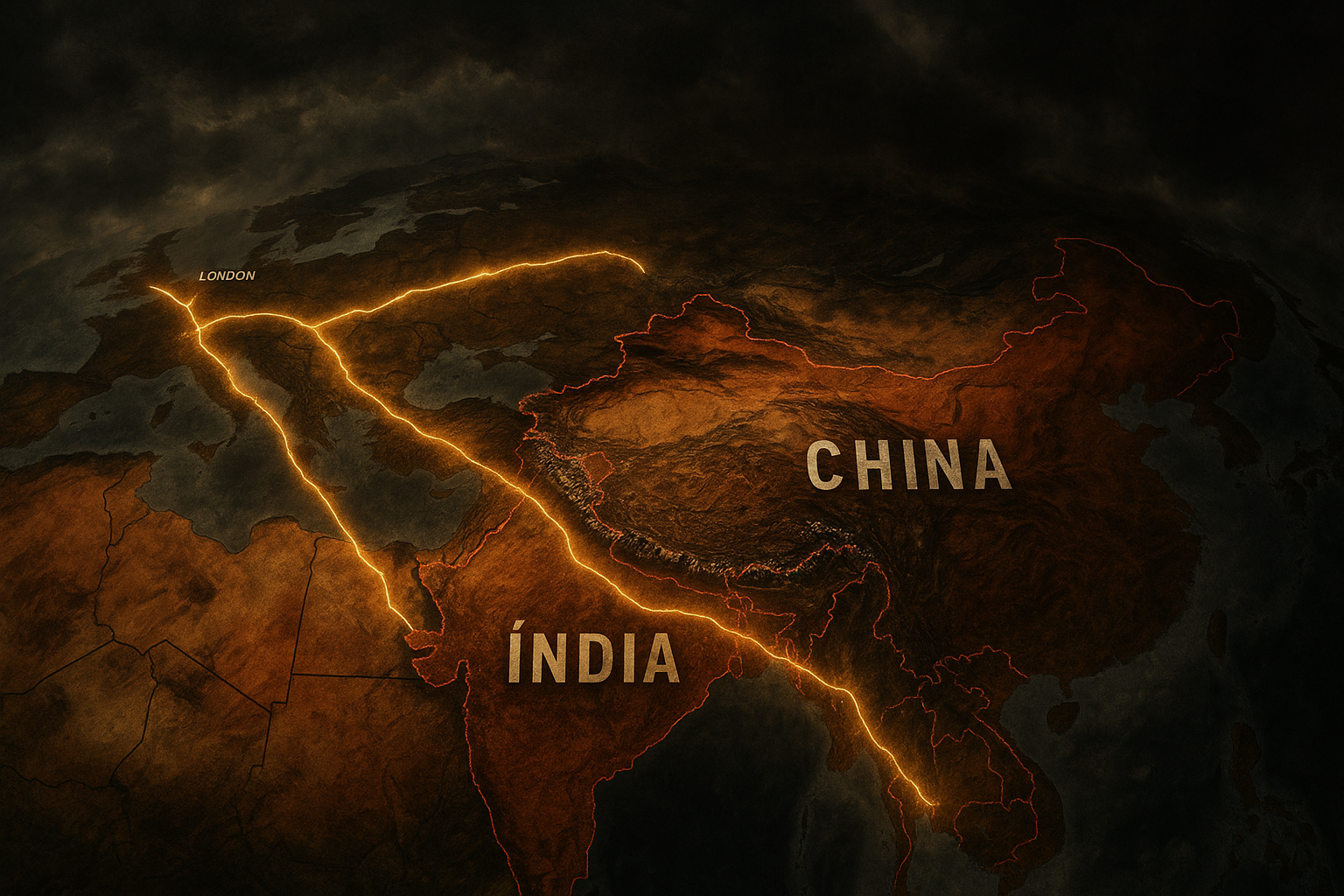
In recent years, China has intensified its strategy to expand its regional influence. With its Belt and Road Initiative, Beijing has been financing and building highways, railways, and ports in various countries neighboring India.
Significant investments are highlighted in Sri Lanka, Myanmar, and especially in Pakistan, where the China-Pakistan Economic Corridor (CPEC) has been created, a project that concerns New Delhi as it consolidates the Chinese presence in its immediate vicinity.
Additionally, China is building a long-range railway that will connect the country to London, passing through Kazakhstan, Russia, and several European nations. This new trade route almost bypasses India.
Control Of Maritime Straits: Another Field Of Dispute
But the fight is not only happening on land. The control of major maritime routes has also come into play.
China has been heavily investing in infrastructure around strategic points such as:
- Bab-el-Mandeb Strait (connects Europe and Asia via the Red Sea);
- Hormuz Strait (an essential passage for global oil trade);
- Malacca Strait (through which more than 70% of China’s oil imports pass).
India’s fear is that Beijing will come to control these maritime corridors. To attempt to balance the situation, the Indian government launched the so-called Diamond Necklace Strategy.
Diamond Necklace: The Indian Response
India’s strategy is simple: to establish military and commercial agreements with key countries to ensure access to ports and bases that allow monitoring of Chinese movements.
Among the signed agreements are:
- Singapore, where Indian navy ships can be refueled and rearmed;
- Indonesia, granting access to the port of Sabang;
- Oman, at the port of Duqm.
With this, India can protect its own maritime trade and closely monitor Chinese routes. Another important point is strengthening relations with Mongolia and Japan, expanding its network of allies in the Asian context.
Geography And Demography Also Matter
A little-discussed aspect that helps to understand the territorial dispute is the demographic factor.
In India, most of the population is concentrated in the northern states, close to the border with China. On the Chinese side, its population density is concentrated along the eastern coast. The areas closest to India, such as Tibet, are sparsely populated.
This creates a logistical challenge for Beijing, which relies on fragile and limited infrastructures to access Aksai Chin. The main route, the G219 road, practically crosses all of Tibet. On the Indian side, the road network is more extensive, favoring military movement.
Conflicts That Still Occur
Despite the natural barrier of the Himalayas, tension between the two countries remains high. There are demilitarized areas where borders are not fully clear, leading to recurring clashes.
The most recent and serious episode occurred in June 2020, when around 300 Chinese and Indian soldiers engaged in physical confrontation in the Galwan Valley, resulting in the deaths of at least 40 military personnel. According to a report from the BBC, it was “the most violent clash between the two armies in decades”.
The Future Of The World’s Largest Territorial Dispute
The territorial dispute between China and India has no solution in sight. On the contrary, the race for influence in Asia is just accelerating.
With China’s advancement in regional infrastructure and the Indian strategic response, the tension in the region is expected to remain elevated. Any unexpected incident could serve as a catalyst for new conflicts.
According to recent analysis from the Council on Foreign Relations (CFR), “the relations between China and India are expected to remain volatile in the medium term, requiring constant vigilance and diplomacy”.
Leave Your Opinion What do you think about this territorial dispute between China and India? Do you believe there will ever be an agreement, or will the conflict continue to drag on? Share your opinion in the comments, and if you found the article interesting, don’t forget to send it to your friends!







Seja o primeiro a reagir!