






 Portuguese
  Spanish


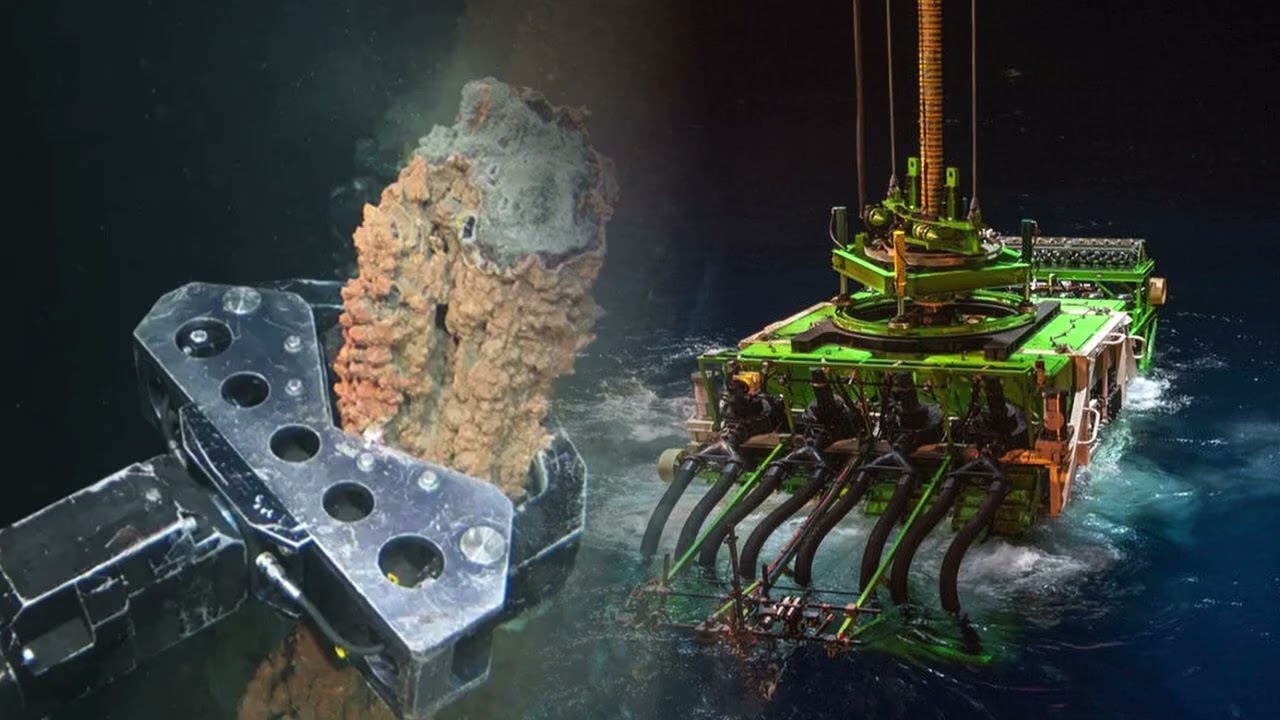


With Tests Over 4,000 Meters, China Advances in The Mining of Polymetallic Nodules and Transforms The Ocean Floor into A New Strategic Frontier for Critical Metals.
For decades, the ocean floor has been treated as a practically unreachable territory, more associated with scientific research than economic exploration. This has begun to change rapidly in recent years, and few countries have advanced as much as China. Real tests conducted at depths exceeding 4,000 meters show that Beijing is no longer just studying deep-sea mining, but developing, testing, and refining technologies capable of transforming the ocean bed into a new strategic frontier for mineral resources.
The focus of this offensive is the so-called polymetallic nodules, round rock structures, the size of potatoes or oranges, spread across the ocean floor. These nodules form over millions of years and concentrate metals considered critical to the modern economy, such as nickel, cobalt, manganese, and trace amounts of copper. These are exactly the elements that sustain electric vehicle batteries, wind turbines, solar panels, special alloys for the aerospace industry, and advanced military systems.
The strategic relevance of this movement is not only in geology but in the combination of technology, geopolitics, and global supply chains. In an increasingly mineral-dependent world, mastering the ocean floor could mean reducing economic vulnerabilities and enhancing global influence.
-
Mexico’s Giant Crystal Cave: A Deadly 58°C Underground Palace with 11-Meter Crystals Formed Over Nearly a Million Years

-
China Dominates Over 90% of Rare Earth Refining, Prompting Global Concerns: Canada and Japan Launch Billion-Dollar Plan to Reduce Dependency and Safeguard Batteries, Semiconductors, and Defense

-
Ancient Mines in Spain Reveal Tools and Metals That May Explain Bronze Age Trade with Scandinavia
-
XCMG Launches 240-Ton Mining Truck in Brazil, Promising Increased Productivity with Lower Fuel Consumption


What Are Polymetallic Nodules and Why Do They Matter So Much?
Polymetallic nodules mainly accumulate in large abyssal plains, at depths ranging from 3,500 to 6,000 meters. The most well-known region on the planet is the Clarion-Clipperton Zone, in the Pacific, between Hawaii and Mexico, where trillions of these nodules cover thousands of square kilometers.


Each nodule is, in practice, a natural concentrate of strategic metals. Studies by the International Seabed Authority indicate that a single nodule can contain up to 30% manganese, along with smaller but economically relevant percentages of nickel and cobalt.
The latter two are especially sensitive from a geopolitical standpoint, as they currently rely heavily on land mines concentrated in a few countries.
The global energy transition has exponentially increased the demand for these metals. An electric car can require several times more nickel and cobalt than a conventional vehicle. At the same time, environmental restrictions, political instability, and trade disputes make access to these resources increasingly complex. It is in this context that deep-sea mining is shifting from scientific curiosity to strategic priority.
How China Entered The Deep-Sea Race
China’s involvement in deep-sea mining did not arise spontaneously. Since the early 2000s, the country has been continuously investing in oceanographic research, underwater engineering, and international maritime law.
One of the pillars of this strategy is COMRA, the Chinese state entity responsible for coordinating research and exploration contracts in international ocean areas.
China holds multiple exploration contracts granted by the International Seabed Authority, an agency linked to the United Nations that regulates activities in areas beyond national jurisdictions.
These contracts allow for detailed studies of the ocean floor, collection of samples, and technological testing, although large-scale commercial exploration still depends on definitive regulations.

In recent years, China has taken a step beyond theory. Prototypes of underwater mining robots have been tested under real conditions, operating at depths exceeding 4,000 meters. These vehicles can move across the seabed, identify nodules, mechanically collect them, and send them to the surface via lifting systems.
These tests are not laboratory simulations. They involve real descents, extreme pressure, near-freezing temperatures, and limited communication—challenges that only a small group of countries can tackle.
The Engineering Behind Chinese Mining Robots
Operating at over 4,000 meters of depth means dealing with pressures exceeding 400 atmospheres, equivalent to dozens of tons compressing each square meter of equipment. To function in this environment, Chinese robots use special metal alloys, sealed hydraulic systems, and electronics protected against infiltration and corrosion.
These vehicles are designed to operate semi-autonomously, as the communication delay between the surface and the ocean floor makes real-time control unfeasible. Sensors, high-resistance cameras, and navigation systems allow the robot to follow pre-programmed routes, avoid obstacles, and maximize nodule collection.
Another critical challenge is the environmental impact. During the tests, Chinese engineers study sediment suspension, particle dispersion, and the effect on little-known benthic ecosystems.
This data is essential for both improving technology and supporting international negotiations on the limits and rules of deep-sea mining.
The Role of The International Seabed Authority
Mining in international ocean areas cannot be done unilaterally. The International Seabed Authority is responsible for regulating contracts, overseeing research, and, in the future, authorizing or not commercial exploration.

China, like other countries, uses its tests to demonstrate technical capability and gain influence within this agency. The more data, equipment, and experience a country accumulates, the greater its weight tends to be in discussions about rules, royalties, and benefit-sharing.
This point is crucial. Deep-sea mining is not just a technological competition but also a legal and political one. The first to arrive with viable solutions tends to shape the global regulatory framework.
Why The Chinese Movement Worries and Inspires Other Countries at The Same Time
China’s actions on the ocean floor do not go unnoticed. Countries like Japan, South Korea, France, and Germany also maintain active research programs in deep-sea mining. However, few have advanced as quickly from the experimental phase to integrated tests at great depth.
For some analysts, this represents a risk of excessive concentration of power over critical minerals. For others, it is a sign that deep-sea mining could become inevitable in the face of the global surge in demand for metals and the limitations of land mining.
There is also the environmental debate. Scientists warn that the ecosystems of the abyssal plains are extremely slow to regenerate. A disturbed area today could take centuries or millennia to recover. Therefore, each technological test is closely monitored by international scientific communities.
A New Strategic Frontier in Formation
What is at stake goes far beyond collecting nodules from the ocean floor. This is about opening a new economic frontier, comparable to the race for oil in deep waters in the 20th century.
Countries that master this technology will have access to virtually untouched mineral reserves capable of sustaining entire industries for decades.
In the case of China, this strategy fits into a broader plan to reduce external dependence, strengthen its high-tech industry, and project power in areas traditionally dominated by a few nations.
By testing mining robots at over 4,000 meters depth, Beijing sends a clear message: the ocean floor is no longer just a scientific study object and has become part of the global geopolitical board. The race for deep-sea mining has already begun, and its effects could redefine production chains, international agreements, and the very concept of sovereignty over the planet’s resources.









You forgot to mention this is a huge environmental concern for marine life because these nodules produce dark oxygen which is the deep marine life’s main source of oxygen.