





 Portuguese
  English
  Spanish
  4 min of reading
  0 comments


Discover How Wooden Piling Engineering Has Supported Venice for Over 1,600 Years, Preventing the City from Sinking.
Venice, the stunning floating city of Italy, is one of the most fascinating and unique destinations in the world. Known for its romantic canals, iconic bridges, and historic palaces, the city has impressively resisted the test of time and natural forces. However, what few know is that the reason why Venice remains upright, without sinking into the waters of the Adriatic Sea, is deeply linked to an ancient and ingenious construction technique.
This system, based on the use of wooden piles driven into the riverbed, is key to understanding how the city, which recently celebrated 1,604 years of history, has managed to survive for centuries, defying the laws of physics and nature.
Foundations of Venice: The Engineering That Supports the Floating City
The great engineering feat that allowed the construction of Venice dates back to ancient times when the first inhabitants decided to build the city on a group of islands in the middle of a lagoon.
-
The Brazilian colonial city that stopped in time and shares territory with a rocket launch base.

-
79-year-old woman challenges limits, visits 193 countries in the world after 56 years of planning and reveals the behind-the-scenes of a global journey that few have managed to accomplish.

-
These are the drivers who may stop paying tolls on highways in a project that promises to reduce costs for those who live from transportation in Brazil.

-
(Video): Italian pilot lands plane on moving train at 120 km/h and achieves unprecedented feat in aviation, even with a narrow runway and without direct visual contact.


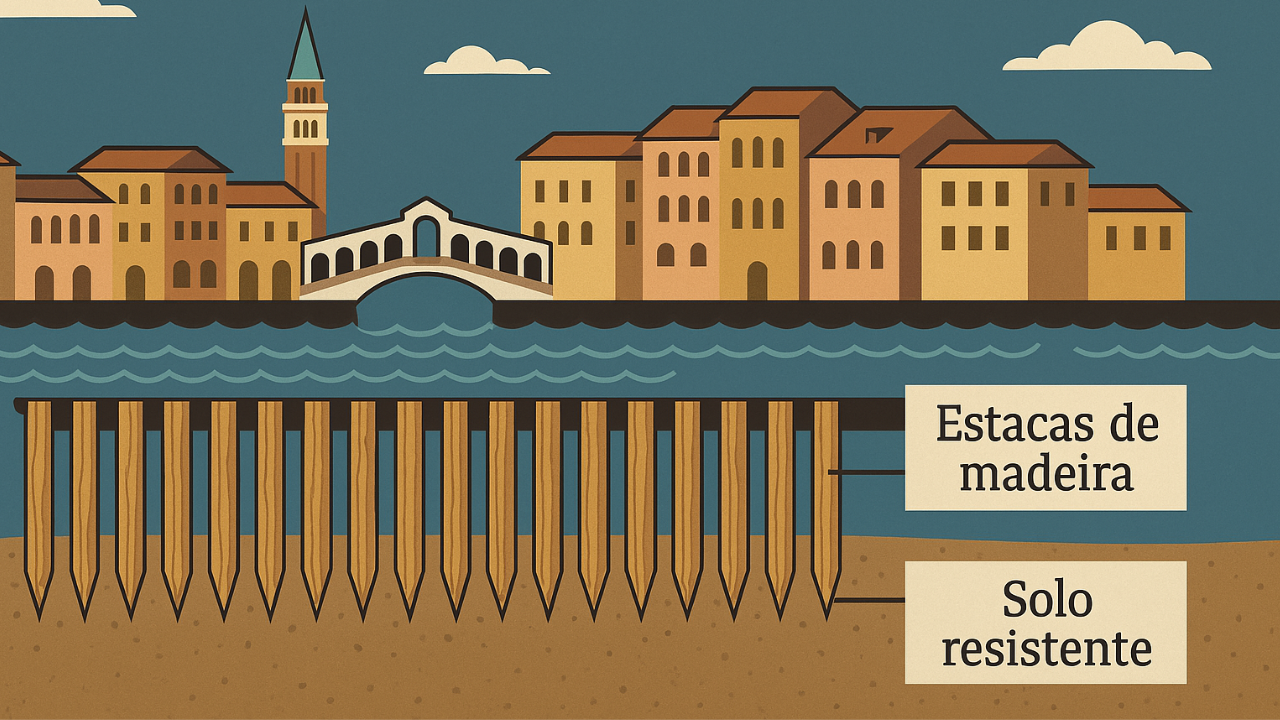
To ensure that the foundations of their buildings remained firm and stable, ancient engineers created an innovative system based on the use of wooden piles.
These posts, sourced from trees such as larches, oaks, and alders, were driven into the riverbed until they reached more resistant soil layers.
The technique involves inserting wooden piles with the tip facing downward, a kind of “inverted forest” that supports the heavier constructions of the city.
Although concrete and steel are widely used in modern projects to ensure the stability of large structures, Venice’s wooden piles still play the primary role in the city’s foundations.
With impressive strength, these piles have supported the weight of the palaces, bell towers, and churches of Venice for over a thousand years.
While concrete or steel piles in modern constructions have an average lifespan of 50 years, the wooden piles of Venice have proven to be more durable, even in a submerged environment, where water and mud play essential roles in preserving the system.
The Tradition and Sustainability of Wooden Piles
The secret to the durability of Venice’s foundations lies in the interaction between wood, soil, and water. The piles are inserted into a layer of watery soil, where the lack of oxygen helps preserve the wood, protecting it from the attack of fungi and insects.
Additionally, water fills the cells of the wood, maintaining its integrity and shape over the centuries. The friction generated by the interaction between the piles and the soil also contributes to the resistance of the foundations.
However, the construction of Venice did not merely involve the simple insertion of piles. To ensure the stability of the structures, the foundations were reinforced with transverse wooden planks, such as the zatteroni, which supported the stones used in building the walls and bell towers.
Over time, Venice developed forestry techniques to ensure a continuous supply of quality wood without depleting its natural resources.
The Italian city invented forestry, creating laws to regulate wood extraction and preserve its forests for future generations.
Challenges and the Preservation of Venetian Foundations
Despite their impressive resistance, the foundations of Venice are not immune to wear and tear. In recent years, geotechnical engineering studies have revealed that the wooden piles are suffering damage caused by bacteria and water pressure.
A study conducted by the University of Venice, in partnership with other institutions, showed that the wood, although largely preserved, shows signs of deterioration, especially in the deeper areas of the foundations.
The city still faces the challenge of monitoring the condition of its foundations and ensuring that the integrity of the system is maintained for centuries to come.
Despite preservation efforts, such as investigating the conditions of the bell tower and church foundations, uncertainty about the longevity of the system persists.
Experts assert that the preservation of the foundations depends on maintaining the balance between the three essential elements for the system: wood, soil, and water.
The Engineering of Venice as an Immortal Legacy
Venice continues to be a remarkable example of human ingenuity and adaptation to the environment.
The city not only defies time but also illustrates how ancient engineering practices, based on the smart use of natural resources, can be more sustainable and durable than modern solutions.
The wooden piles that support Venice’s buildings are not only a testament to a distant past but also a reminder of the value of innovation and the wisdom of ancient engineers.
As the city remains an icon of global tourism, the submerged foundations of Venice, with their wooden piles immersed in the river, serve as a reminder that when nature and engineering meet, solutions can arise that endure for centuries.
In times of growing interest in sustainable and eco-friendly construction, the ancestral techniques of Venice can offer valuable lessons on how to respect and work in harmony with the environment, ensuring the preservation and stability of cities for future generations.








-

Uma pessoa reagiu a isso.