





 Portuguese
  English
  Spanish
  4 min of reading
  26 comments


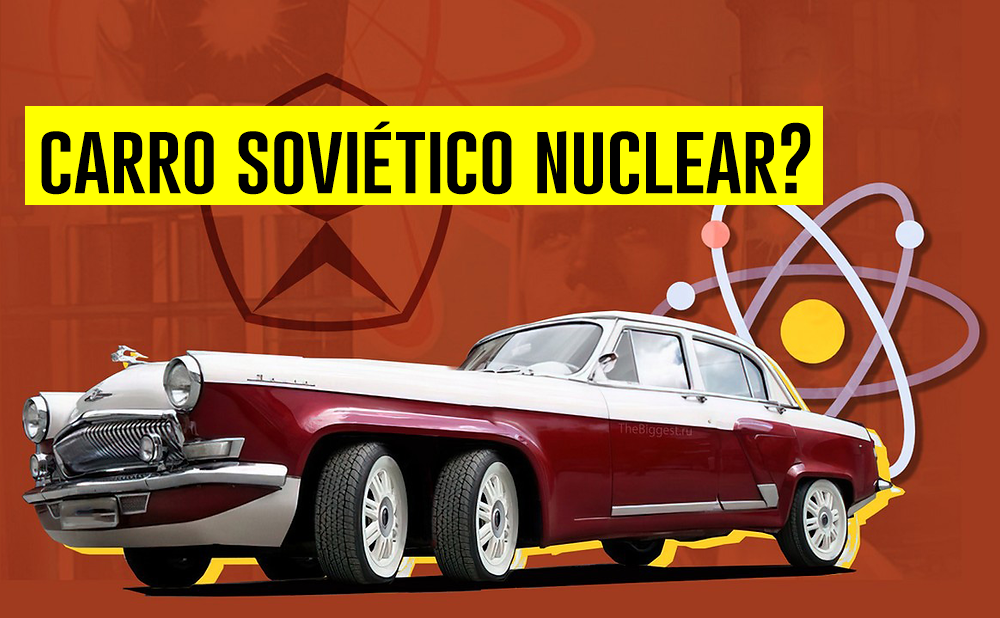


It Is Said That The Soviet Union Developed A Nuclear-Powered Car Capable Of Traveling 200 Thousand Kilometers With A Minimal Amount Of Nuclear Fuel
Nuclear-powered cars have always seemed like something out of science fiction, but some say that in the 1960s, the Soviet Union came close to making this concept a reality.
Amid rumors and supposed evidence, the Volga Atom remains one of the most intriguing stories of Soviet engineering. Let’s analyze all the available information available.
The Historical Context Of The Nuclear-Powered Car
In the 1950s, the technological race between the United States and the Soviet Union was intense. Nuclear energy, seen as the solution for everything — from electricity to space exploration — also became a target for experiments in the automotive sector.
-
Less than a Tera TSI, up to 710 km of range and charging in 9 minutes: the new BYD Song Ultra expands the Chinese brand’s bet on increasingly faster, more technological, and competitively priced electric SUVs.

-
With a 1.0 engine producing 75 hp and costing less than R$ 70,000, Fiat’s car returns to the podium as the cheapest in the country; a temporary promotion for the 2026 Like version reduces the price of the Fiat Mobi.
-
With a mild hybrid system of 48 V, 176 hp and a price of R$ 175,990 in the Sahara version, the new Jeep Renegade changes mostly on the inside, improves slightly in fuel consumption, and remains almost the same car.
-
With a 293.5 cm³ engine and a range of up to 400 km with a 14.1-liter tank, the Honda CB 300F Twister 2026 has up to 24.7 hp, an initial price of R$ 25,150, and already exceeds R$ 29,000 in the Fipe Table.

A famous example is the Ford Nucleon, a concept car presented by the Americans in 1958.
At the time, the Nucleon promised to run on a small nuclear reactor instead of a conventional engine. We will talk about the Nucleon at the end of the text.
Despite the innovation, technical challenges and safety risks buried the idea quickly. However, according to rumors, the Soviets drew inspiration from this concept to develop the Volga Atom, a nuclear vehicle with impressive features, but whose existence has never been confirmed.

The Legend Of The Soviet Union, The Volga Atom
The story of the Volga Atom supposedly began in 1958, when a Soviet official reportedly saw the Ford Nucleon at an international exhibition.
Enchanted, he took the idea to Premier Nikita Khrushchev, who reportedly ordered Soviet engineers to create something similar.
The project is said to have taken shape in 1965, based on the popular GAZ-21 Volga, a car known for its robustness and iconic design at the time.
According to unverified reports, the Volga Atom would be equipped with an engine powered by uranium-235, the same material used in nuclear reactors and atomic bombs.
The supposed vehicle had an engine capable of producing 320 horsepower, but faced serious overheating issues, limiting its functionality and making mass production unfeasible.
What We Know
Although there are no official documents confirming the existence of the Volga Atom, rumors have persisted for decades.
The story gained traction with the display of a car nicknamed “Volga Atom” in a museum in Nizhny Novgorod, Russia. However, experts believe that the displayed model is just a mock-up, without functional technology.

Just like the Ford Nucleon, many nuclear concepts of the time were little more than design experiments or propaganda.
The very technology available in the 1960s made the development of a functional nuclear car extremely difficult.
Even with the advancement of compact nuclear reactors, like the Soviet EGP-6 — one of the smallest commercial reactors in the world — a vehicle of this kind would face challenges of weight, cost, and safety.
The Myths And The Reality
Theoretically, a nuclear-powered car could travel thousands of kilometers with a minimal amount of uranium-235. It is estimated that the Volga Atom, if real, could cover about 200 thousand kilometers with just 12 grams of nuclear fuel.
However, the total weight of the vehicle would be a major issue. At that time, nuclear reactors were heavy and bulky, making mobility unfeasible.
Additionally, the Soviet automotive industry at the time was known for copying Western designs, but not for incorporating cutting-edge military technologies into civilian projects.
Even with advancements in reactor miniaturization for submarines and spacecraft, creating something safe and practical for road use would be almost impossible.
Ford Nucleon: The Most Famous Nuclear Car

In 1958, Ford presented the world with a revolutionary concept: the Ford Nucleon, a car powered by nuclear energy. The idea was to replace the gasoline engine with a small nuclear power plant. Through uranium fission, the system would generate heat to turn water into steam.
This steam would drive turbines, producing electrical energy or mechanical energy to propel the vehicle. Its operation was similar to that of nuclear submarines and ships, already in operation at the time.
The project was ambitious. Ford estimated a range of 8,000 km with just a small pellet of uranium. Refueling would be simple: it would just require replacing the material at specific stations, substituting traditional gas stations.
The automaker even imagined customizing the reactors. Customers could choose models that prioritized performance or greater range. All this seemed a glimpse of a utopian future where nuclear energy would also dominate the roads.
Why Did The Nucleon Never Happen? Despite the promises, the Ford Nucleon never got beyond the drawing board. The company did not even build a functional full-size prototype.
The display of the scaled model, currently at the Henry Ford Museum in Dearborn, Michigan, is the most concrete reminder of this project.
The Legacy Of Nuclear Cars
The Volga Atom, like other nuclear cars of the 1960s, continues to serve as an example of how technological imagination sometimes surpasses the limits of reality.
Although it may not have come to fruition — or perhaps never existed — the idea of vehicles powered by nuclear energy still sparks curiosity and inspires debates about the future of mobility.
While it seems unlikely that a car like the Volga Atom was functional, its story persists as an interesting piece of the technological narrative of the Cold War. If it wasn’t real, it certainly was a powerful idea to illustrate what the future could have been… had technology allowed it.








Um projeto que hoje seria ótimo para economia de combustível e energia pois em pouco tempo teríamos carros voadores.
O carro nuclear só não deu certo porque se a bateria dele tivesse um vazamento, matava uma cidade inteira. Kkkkkkk
Ainda prefiro a gasolina , motor v6 pra cima, essas bostas elétricas estão com duas contados, polui muito mais pra produzir um elétrico do que um a combustão , sem contar o resquício pós uso!