





 Portuguese
  English
  Spanish
  4 min of reading
  0 comments


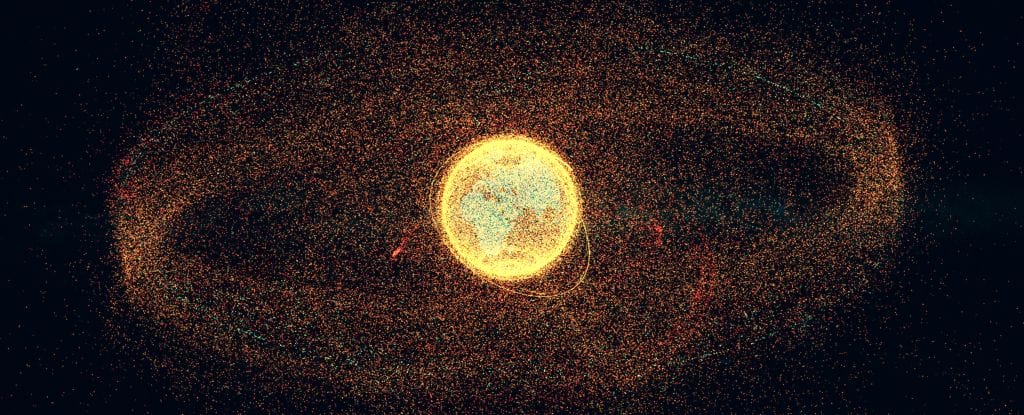
A New Report From ESA Highlights That The Trunk Of The Earth Orbit Is Accumulating A Worrying Amount Of Debris, Which May Result In Dangerous Collisions. The Discovery Reinforces The Urgency Of Developing Technologies And Policies For The Removal And Control Of Space Junk, Protecting Satellites And Future Missions
The amount of space junk in Earth’s orbit is growing rapidly. This is shown in the Annual Space Environment Report from the European Space Agency (ESA). The document points out that we are launching satellites at a much higher rate than they can deorbit. The result is a buildup of objects that threatens the safety of the space around the planet.
Currently, there are about 40,000 objects being tracked in Earth’s orbit. Of these, only 11,000 are active and operational. The rest is made up of broken satellites and pieces of spacecraft. In other words: we have much more junk than functioning equipment.
The Threat Of The Kessler Syndrome
According to ESA, this scenario can lead to a phenomenon known as the Kessler cascade. It is a chain reaction: collisions between debris generate more debris, which in turn cause new collisions. Over time, some orbits may become so dangerous that they will no longer be usable.
-
They were brilliant! Scientists discover that our ancestors in China were already making super advanced tools 160,000 years ago, changing everything we knew.

-
Scientists unveil 3 million years of climate secrets hidden in the ice of Antarctica.

-
Ancient farmers created “aggressive plants” that changed nature forever.

-
Astronomers find a “backward” solar system that ignores all the rules of space and leaves scientists scratching their heads!


The agency explains that even if no new satellite is launched, the number of debris will still continue to grow. This is because fragmentation events — caused by collisions, explosions, or wear — happen much faster than the natural reentry of these objects into the atmosphere.
The Numbers Of Space Junk
ESA’s 2025 report provides impressive estimates. There are about 54,000 objects larger than 10 centimeters orbiting Earth. Between 1 and 10 centimeters, the number rises to 1.2 million. And there are approximately 130 million pieces between 1 millimeter and 1 centimeter.
Even smaller fragments can pose a danger. Tiny particles at high speeds can damage important satellites, such as the Hubble Space Telescope and the International Space Station.
These fragments do not only come from collisions. Many are the result of explosive failures or aging equipment in orbit.
In 2024, for example, non-collision fragmentation events were the main source of new space debris. ESA recorded 11 of these episodes, which generated at least 2,633 pieces of junk.
Controlled Reentries Increased
Despite the worrying situation, there are some positive signs. The number of controlled reentries to the atmosphere — that is, objects that return to Earth as planned — increased in 2024. This indicates that some disposal strategies are working.
There were also fewer uncontrolled reentries compared to previous years. According to ESA, about 90% of rocket bodies in low orbits are now leaving space according to established reentry standards.
This process should occur within a maximum of 25 years after the end of the mission. More than half of these objects are already returning in a controlled manner.
Furthermore, ESA has adopted an even stricter standard for its own missions. Since 2023, it will ensure that objects leave orbit within five years. About 80% of the agency’s activities are already following this new guideline.
Active Cleaning Will Be Essential
Despite the advancements, the report makes it clear: maintaining the trend of controlled reentry is only part of the solution. It will be necessary to actively clean Earth’s orbit. This will require new technologies, large investments, and, above all, international cooperation.
Without concrete actions, the risk of collisions will continue to grow. And even stringent disposal measures will not be enough if fragmentation events persist.
The space environment needs to be urgently protected. For ESA, the future of orbital activities depends on our ability to act now. If humanity wants to continue exploring and utilizing space, it will be necessary to make it safer.
Fragmentation Is The Main Challenge Today
The majority of recent space junk did not come from uncontrolled launches, but from unexpected fragmentations. This shows that, in addition to planning for the end-of-life of satellites, it is essential to prevent failures that cause explosions or breaks in orbit.
These fragments are difficult to track, especially the smaller ones. However, the impact of a collision can be significant, even with a tiny piece. This poses a constant risk to equipment still in operation.
ESA emphasizes: it is not enough to stop launching satellites. It is necessary to take care of what is already up there. Until there is real cleaning, the number of debris will continue to rise.
The report highlights that cleaning space is urgent and inevitable. The good news is that cooperation among major agencies and countries has already begun to yield results. But much more joint effort will be needed to ensure that Earth’s orbit remains functional and safe in the coming years.
With information from Science Alert.







Seja o primeiro a reagir!