





 Portuguese
  English
  Spanish
  4 min of reading
  0 comments


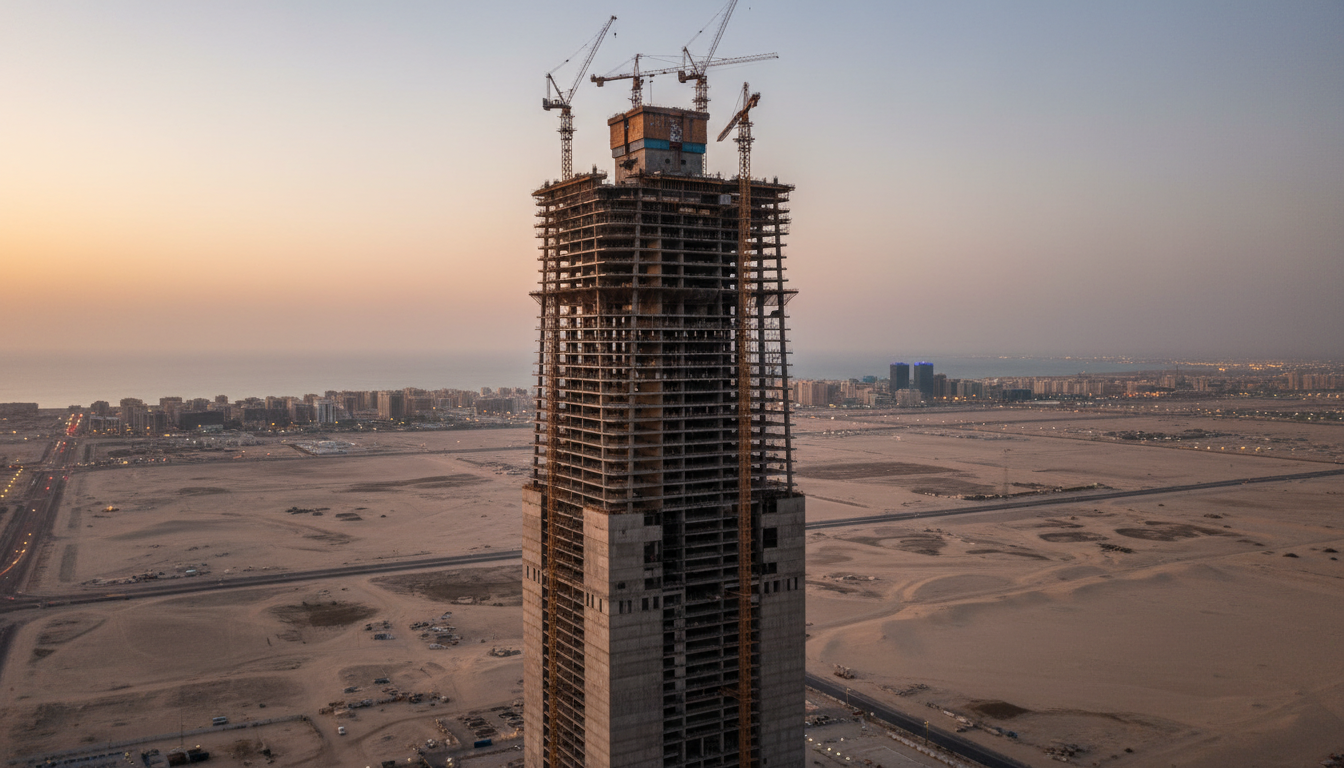
The Jeddah Tower has already surpassed the 97th floor in April 2026 after a remarkable resumption, with the tower rising one floor every three days towards the height of 1,000 meters and promising to dethrone the Burj Khalifa by 2028
Published in April 2026, the resumption of the Jeddah Tower surprised the global engineering sector. According to New Atlas magazine, the 1 km skyscraper under construction in Saudi Arabia resumed growth at a record pace after seven years completely halted in the desert. According to Construction Digital, the tower surpassed 80 floors in January 2026 and has already surpassed the 97th floor in April. The tower is part of a complex valued at $20 billion.
Seven years abandoned in the Saudi desert
The construction of the Jeddah Tower began in 2013, led by the Jeddah Economic Company (JEC), as a centerpiece of Saudi Arabia’s Vision 2030 to diversify the economy beyond oil. However, in 2018, the work stopped abruptly.
The bankruptcy of the main contractor, the Binladin Group, combined with financial problems and logistical challenges such as concrete pumping at extreme heights, left the site abandoned for seven years in the desert. At that time, the structure had only reached 157 meters in height — about 40 to 50 floors.
-
Untouched for 2,200 years, the tomb of China’s first emperor hides up to 100 tons of mercury, lethal traps designed to kill invaders, and a mystery so dangerous that archaeology still refuses to uncover it.
-
With 220 meters, 721 feet, and 25 thousand gross tons, the world’s largest sailing cruise ship sets a record before its debut and promises to reinvent luxury at sea with giant sails and futuristic engineering.

-
A Brazilian city is being invaded by the sea, buildings are leaning, and the solution could cost R$ 200 million with support from BNDES to prevent flooding, modernize drainage, and protect more than 200,000 residents within 5 years.

-
Lula’s government puts R$ 1 billion on the table to revitalize watersheds with 60 projects, including the São Francisco and Parnaíba rivers, sanitation, navigation, urban drainage, pollution control, and actions in strategic areas of Furnas.
Thus, the project that promised to be the world’s first 1 km skyscraper was frozen while other megaprojects advanced around the globe. Furthermore, critics questioned whether the tower would ever be completed.
By the end of 2024, however, the project was officially relaunched with a new contract and reinforced financial support. Inspections confirmed that the existing structure remained safe, and work resumed in early 2025. Like other projects using deep piles and unprecedented foundation technology, the Jeddah Tower employs a system that distributes the load across the sandy terrain to support 1 km of concrete and steel.
One floor every three days: the record pace of the 1 km skyscraper
Since the resumption, the construction pace has been impressive. As reported by Newsweek, by January 2026, the Jeddah Tower had already reached over 80 floors. In April 2026, the tower had surpassed the 97th floor, with more than half of the concrete work — hundreds of thousands of cubic meters — completed.
The most impressive figure is the current pace: a new floor emerges every three days of operation, according to engineers from Thornton Tomasetti, responsible for the structural design. If this speed is maintained, the 1 km skyscraper could be completed by 2028.

For comparison, the Burj Khalifa is 828 meters tall. Therefore, the Jeddah Tower will surpass it by 172 meters — meaning it will be 21% taller than the current world record holder. Still, the difference between the current 97th floor and the more than 150 final floors shows that the most challenging part is yet to come.
Extreme engineering to raise the 1 km skyscraper
Building a structure 1,000 meters tall is not just about stacking floors. Consequently, engineers face unprecedented technical challenges at every phase of the work.
Pumping concrete to extreme heights requires pressures at the base that few systems can withstand. Additionally, tens of thousands of tons of steel are needed for the structure, and the top of the tower will need to sway “a few meters” under strong winds — a noticeable movement, but controlled by extensive simulations in wind tunnels.
Daily logistics require perfect synchronization between teams, materials, and tests, with real-time monitoring through 3D models to avoid bottlenecks that could compromise the pace of one floor every three days.
However, the biggest challenge may lie in the upper floors. Technical analyses indicate that the phase above the 130th floor may present additional structural obstacles that have not yet been tested in practice.
Vertical city with a five-star hotel and hundreds of apartments

The Jeddah Tower will not just be a tall building. The project envisions a true vertical city, with hundreds of luxury apartments, a five-star hotel, restaurants, a spa, swimming pools, and leisure areas distributed along the 1,000 meters.
The elevator system has been designed in zones — express elevators take passengers to intermediate lobbies, avoiding direct trips from the ground floor to the top. Thus, dozens of elevators operate simultaneously, including two-story models. Other megaprojects of vertical transportation around the world are also redefining how people move within giant structures.
On the other hand, the 1 km skyscraper is just the center of an even larger complex. The Jeddah Economic City, on the coast of the Red Sea, brings together commercial, residential neighborhoods, and tourist attractions in a total investment of $20 billion, as reported by Olhar Digital.
1 km skyscraper still faces challenges to reach the top
Despite the optimism surrounding the resumption, experts urge caution. The seven-year history of stoppage raises doubts about the long-term sustainability of the project. Additionally, the pace of one floor every three days requires perfect synchronization — any failure in teams, materials, or tests can lead to significant delays.
The question that international analysts are asking is straightforward: are we witnessing a historic comeback or preparing for another slow-motion collapse? The answer will only come with the progress of construction over the next two years.
Still, with more than 97 floors completed and the fastest pace ever recorded, the Jeddah Tower remains the most ambitious bet in global engineering in 2026. If everything goes as planned, the world will have its first 1 km skyscraper by 2028 — and the Burj Khalifa will lose the throne it has held since 2010.






Seja o primeiro a reagir!