





 Portuguese
  English
  Spanish
  3 min of reading


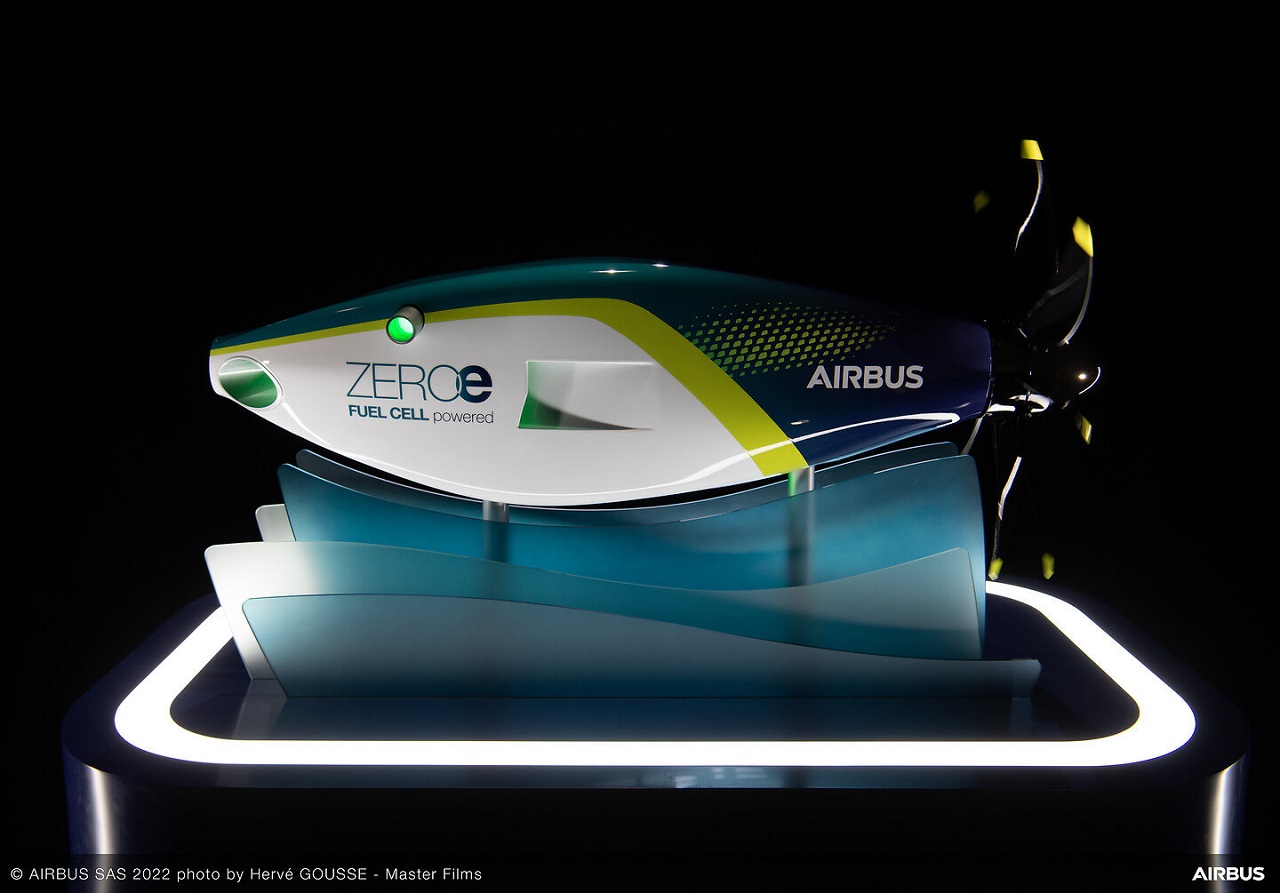
Airbus, Aiming to Bring Sustainability to the Aviation Sector, Announced a New Hydrogen-Powered Engine That Can Offer a Range of 1,850 km.
Airbus recently unveiled its new hydrogen fuel cell engine. The initiative is part of the manufacturer’s plan to produce zero-carbon emission aircraft, expected by 2035. The propulsion system generates energy through an electrochemical reaction rather than combustion and will begin testing on the ground and in flight in the company’s A380 MSN1 test aircraft, which is being modified to accommodate the new hydrogen engine.
Hydrogen-Powered Engine Can Offer a Range of 1,850 km


According to Airbus, the fuel can be utilized in two ways to generate energy for aircraft propulsion, either through the combustion of the element in a gas turbine or with fuel cells to convert hydrogen into electricity. A hybrid-electric setup can combine a hydrogen gas turbine with fuel cells. In addition to not emitting polluting gases, the new technology produces only heat and water as byproducts.
The hydrogen fuel cells also allow for scalability by stacking them together to boost the aircraft’s power. The stacks are combined in several channels to achieve the necessary megawatt levels for an aircraft.
-
The Himalayas continue to grow to this day, with tectonic plates advancing 5 cm per year, mountains rising up to 10 mm annually, and the 2015 earthquake that killed 9,000 people may have increased the risk of an even larger seismic mega-event.

-
At an altitude of 400 km by astronauts from the International Space Station, Paris transforms at night into a golden mesh so precise that it reveals the outline of the Seine River, avenues, and entire neighborhoods like a luminous map drawn over the Earth.

-
iPhone 17 reaches historic low price with 256 GB, 120 Hz display, and drops to R$ 5,703 on Shopee, featuring A19 chip, dual 48 MP cameras, battery life of up to 30 hours, and advanced AI features.

-
Trip to Mars getting closer: Pulsar Fusion, from the UK, advances with plasma ignition in fusion engine and could drastically reduce space travel time, making crewed missions faster, safer, and economically viable.

The hydrogen engine from Airbus can potentially power a 100-passenger aircraft with a range of approximately 1,850 km, according to Airbus. The estimate is that the ZERO aircraft will be launched between 2027 and 2028.
It is important to highlight that a few days ago, the company Rolls-Royce tested a hydrogen-powered aircraft engine and obtained promising results. The concept has also reached ground vehicles, with Hyundai already presenting a concept car that uses the same principle of technology.
Airbus and CERN to Partner Focused on Clean Aviation Technologies
In addition to the announcement of the hydrogen engine, Airbus UpNext, a wholly-owned subsidiary of Airbus, and the European Organization for Nuclear Research (CERN) are launching a project aimed at assessing how superconductivity can assist in the decarbonization of future aircraft systems.
The Low Emission Aviation Superconductor Demonstrator (SCALE) aims to promote the adaptation and use of superconducting technologies in airborne electrical distribution systems. According to CERN’s Chief Financial and Human Resources Officer, Raphael Bello, in its research, CERN expands the boundaries of science and engineering and establishes partnerships with industry to make possible innovations that positively impact the environment.
The laboratory’s strategies have the potential to be adapted to the demands of future clean transport and mobility solutions, as demonstrated by the agreement with Airbus.
Airbus UpNext Responds on Partnership
For Airbus UpNext CEO, Sandra Bour-Schaeffer, her role in the company is to explore the full potential of technologies applied to future aircraft and partner with global leaders to prepare for this future.
The partnership with a leading research institute like CERN, which has brought significant discoveries in fundamental physics to the world, contributes to pushing the boundaries of clean aerospace research while working to make sustainable aviation a reality.
A superconductor demonstrator called the Advanced Superconducting and Cryogenic Experimental PowertraiN Demonstrator (ASCEND) is already being developed to study the viability of this technology for hybrid and electric aircraft. Combining the knowledge gained from its demonstrator and CERN’s unique capabilities in the field of superconductors creates a natural partnership.










Seja o primeiro a reagir!