





Brazilian project developed airless bicycle tires with 3D printing, TPU filament, and four geometries, subjecting the prototypes to stones, water, sand, nails, knife, braking, and falls; after two months of adjustments, the arrow model showed the best balance between comfort, resistance, and response during the final tests.
A Brazilian team developed airless bicycle tires produced by 3D printing and installed four prototypes on bicycles to evaluate fit, resistance, and cushioning. The project used flexible TPU filament and took over two months between modeling, printing, corrections, and tests conducted on different surfaces.
The information is contained in the transcript of the video provided as a source, which does not include the channel name or publication date in the material sent. The record accompanies all stages of the experiment, from the first rim measurements to the final comparison between honeycomb, circles, cylinders, arrow, and solid structure models.
Rim measurements initiated the project
The work began with the choice of the wheel and the taking of various measurements. The data was recorded and sent for digital modeling, necessary for the inner part of the tire to fit correctly on the rim.
-
Invasive plant with turpentine smell takes over Arizona yards, suffocates native flowers, spreads thousands of viable seeds for up to five years, and when dry, increases fire risk and can cause skin irritations and respiratory problems, prompting authorities to request protected removal and reporting of outbreaks.

-
Instead of demolishing the historic 2,750-ton theater to make room for a new stadium, engineers placed the entire building on 72 wheeled platforms, moved the structure 563 meters through the streets of Detroit, and preserved the halls, stage, and facades without dismantling the building.

-
She left her job to start her own brand: Former HR director invests R$ 900,000 to create an educational games brand, projects revenue of R$ 1.3 million, and will take the project to 21 public schools.
-
Restorers remove accumulated layers during works at the Palace of Monaco and find 600 square meters of Renaissance paintings hidden for centuries, featuring gods, heroes, and the Twelve Labors of Hercules over the corridors of the royal family.


Before printing a complete structure, the team manufactured a thin piece used as a template. The first fits showed differences of a few millimeters, enough to prevent the segments from closing correctly around the wheel.
Small errors altered the entire diameter
After the first attempts, new pieces were produced with smaller dimensions. One of the tests still left a gap, while the following version managed to fit the rim with greater precision.
The problem reappeared when several modules were joined. Since the tire was composed of ten parts, a difference of about one millimeter in each segment accumulated about ten millimeters in the assembly, requiring the manufacture of a larger piece to complete the circumference.
TPU was chosen to replace rubber and air
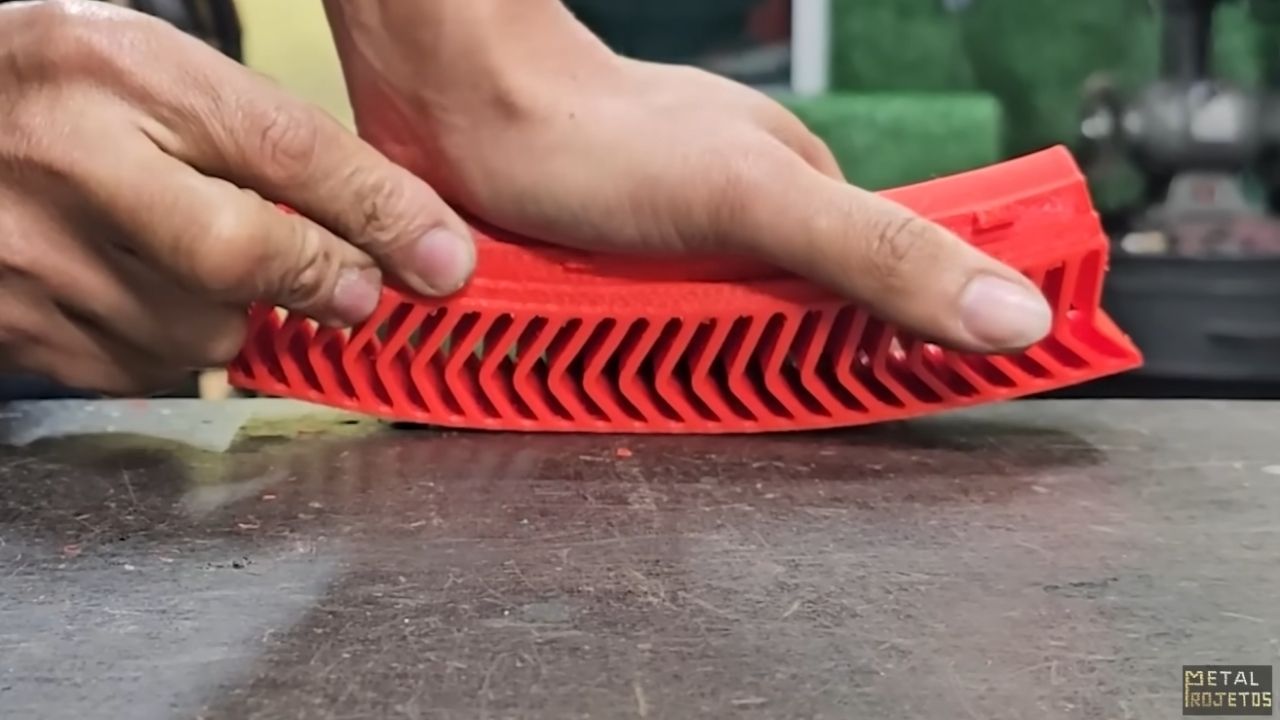
The prototypes were printed with TPU, a flexible and rubbery filament. The material allows the structure to deform under the weight of the bicycle and partially return to its original shape, simulating the behavior of a conventional tire.
Unlike an inflatable tube, however, airless bicycle tires rely solely on the geometry and elasticity of the material to absorb impacts. Therefore, walls, filling, and internal designs needed to be adjusted repeatedly.
Printing temperature caused the first defects
During the initial manufacturing, the TPU left thin strings between different areas of the parts, a problem known in 3D printing as stringing. The supports also became difficult to remove and affected the finish.
The standard configuration used the nozzle at 230 °C. After tests with filament drying and other unsuccessful attempts, reducing to 210 °C eliminated most of the strings and left the surface cleaner, according to the project’s report.
First honeycomb format was too rigid
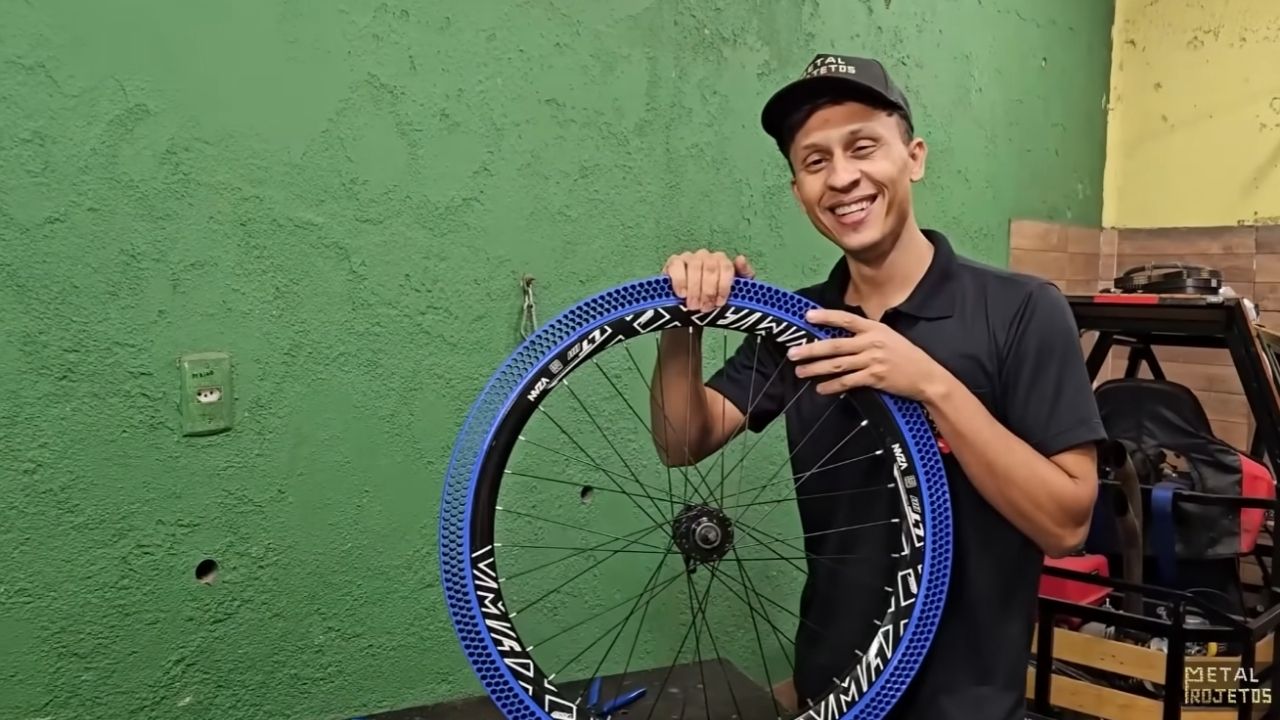
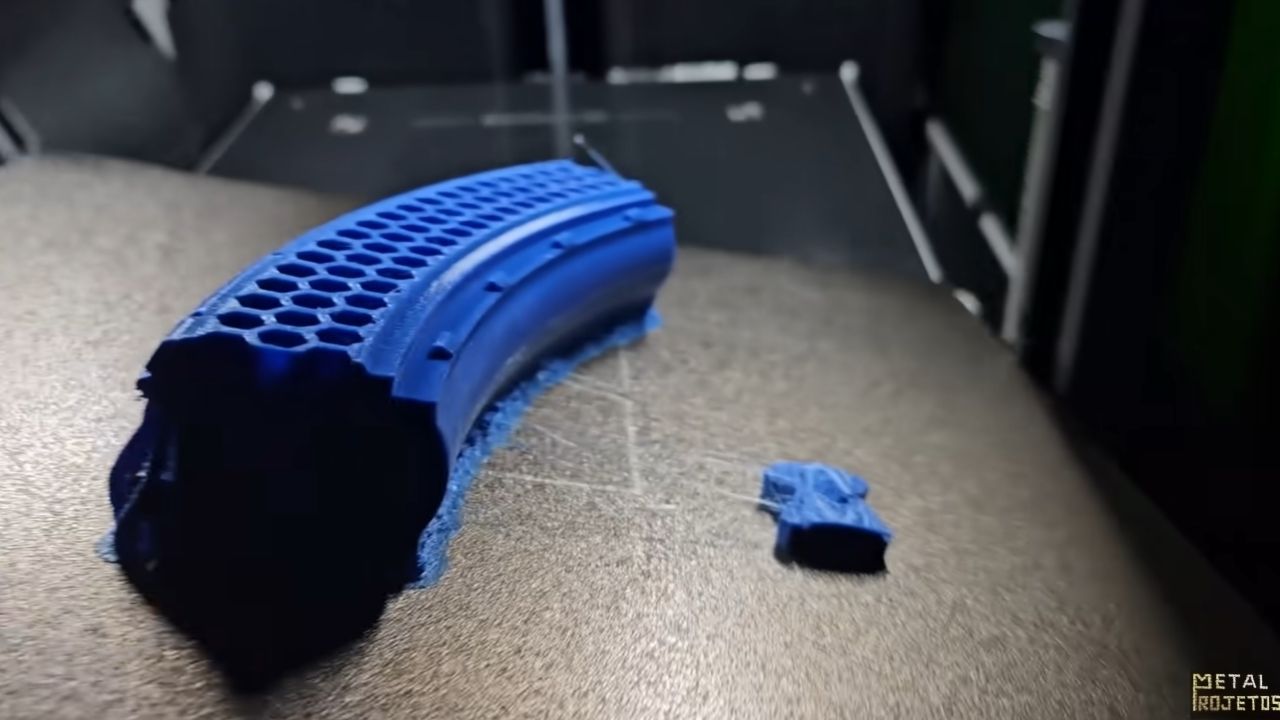
The first complete geometry had cavities similar to a honeycomb. Although the design seemed suitable for distributing efforts, the initial version had thick walls and showed little deformation.
The team compared the prototype with a kart tire and noticed that the printed piece was much more rigid. The model practically did not yield when pressed, which would reduce comfort and directly transfer the terrain’s irregularities to the bicycle.
Thinner walls improved cushioning
The structure was redesigned with a reduction in the external thickness and internal dividers. A new sample demonstrated greater flexibility and was placed under a bicycle wheel to simulate the cyclist’s weight.
The test indicated that the revised version approached the cushioning of a regular tire. Nevertheless, the outer layer continued to transmit a rigid sensation when passing over stones, despite the internal part deforming.
Four designs sought different responses
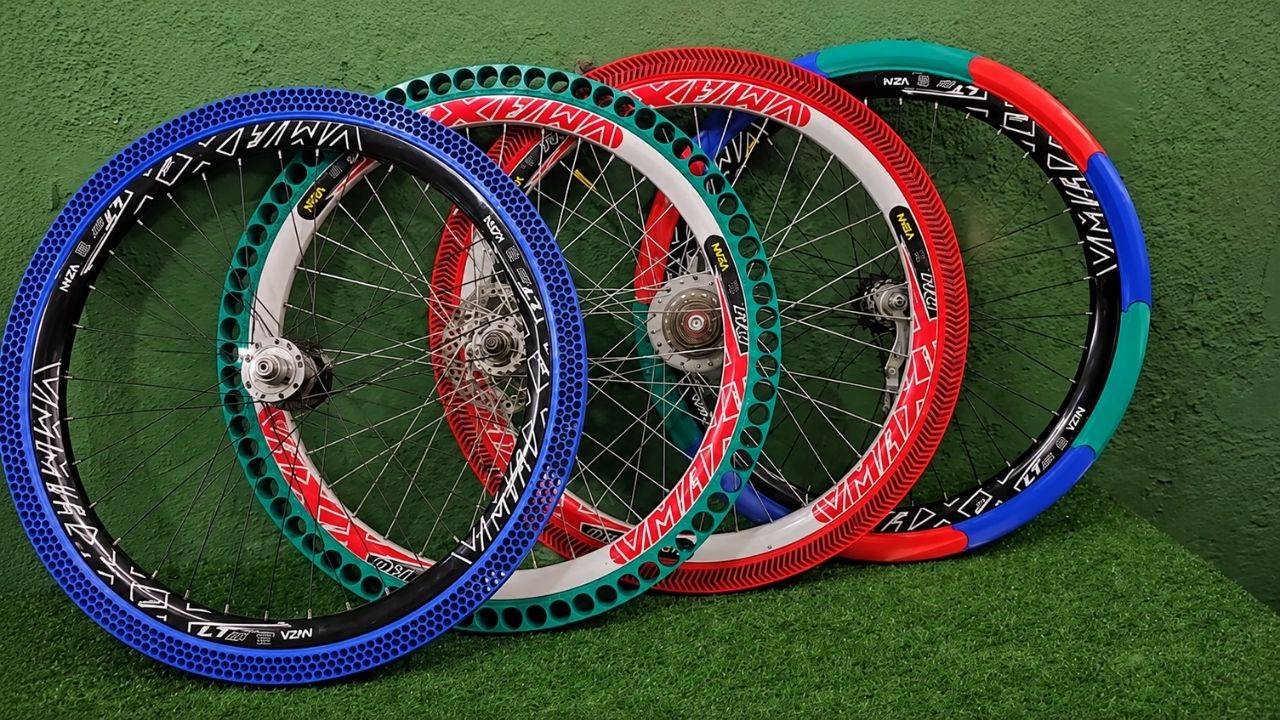
In addition to the honeycomb, models with circular cavities, cylindrical structures, arrow design, and solid body with internal filling were created. Each format modified weight, flexibility, and force distribution.
The pieces had to be printed in segments because they did not fit entirely in the machine’s work area. The modules received fittings and, in some cases, glue to prevent separations and misalignments during rotation.
Solid model required four internal adjustments
In the solid tire, flexibility did not come from visible cavities, but from the filling percentage created by the printer. The first test combined four external walls with 20% filling and was excessively hard.
The density was reduced to 10% and then increased to 15%, but both versions were too soft. The configuration considered ideal used 20% filling with three external layers, balancing support and deformation.
Prototypes presented different weights
After assembly, the tires were weighed individually. The cylindrical model registered approximately 1.111 kg, while the honeycomb structure was around 1.363 kg.
The arrow design was the heaviest, at about 1.537 kg, and the solid one weighed approximately 1.182 kg. Although the cylinder started the comparison with an advantage in weight, the tests showed that reduced mass did not necessarily mean better performance.
Bicycles faced stones, water, and sand
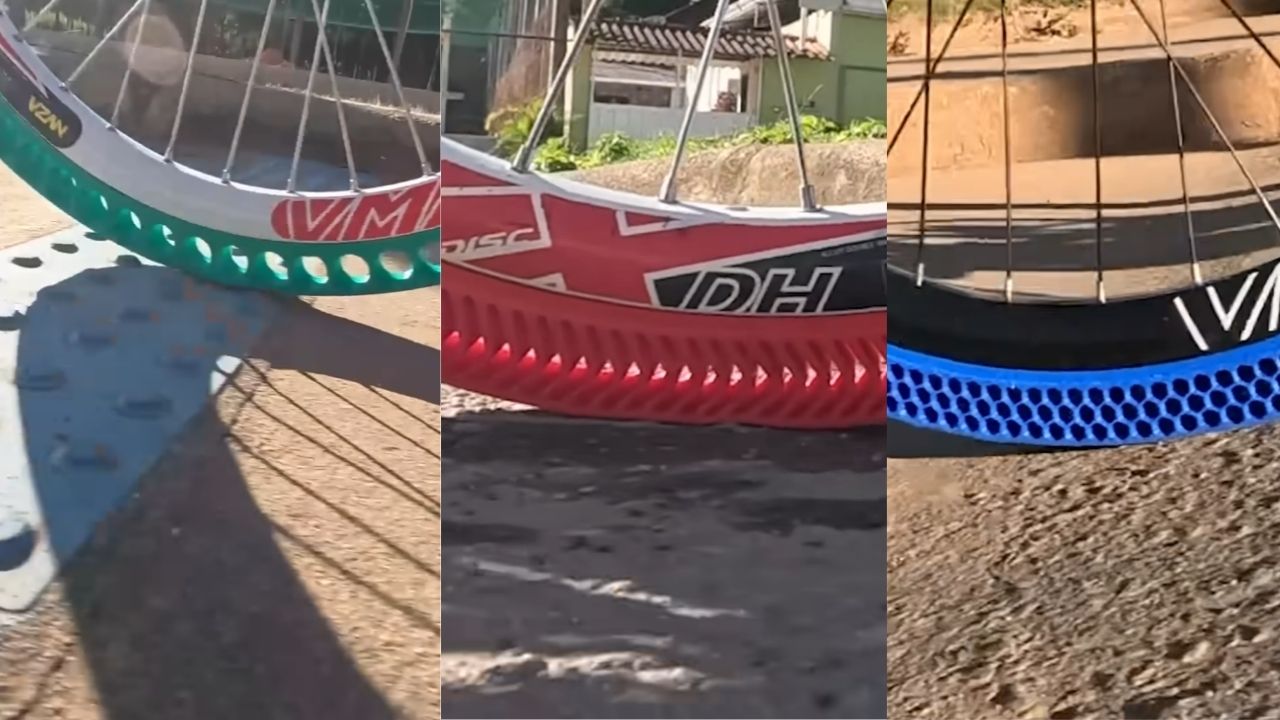
The wheels were installed on two bicycles adapted for the tests. Participants rode on cobblestone streets and observed how each geometry reacted to the small elevations of the terrain.
The prototypes also crossed water, sand, gravel, and muddy sections. The open structures carried water and particles between the cavities but continued to rotate. Even without air, the tires maintained rolling capability and absorbed some of the irregularities.
Knife and nails couldn’t deflate the tires
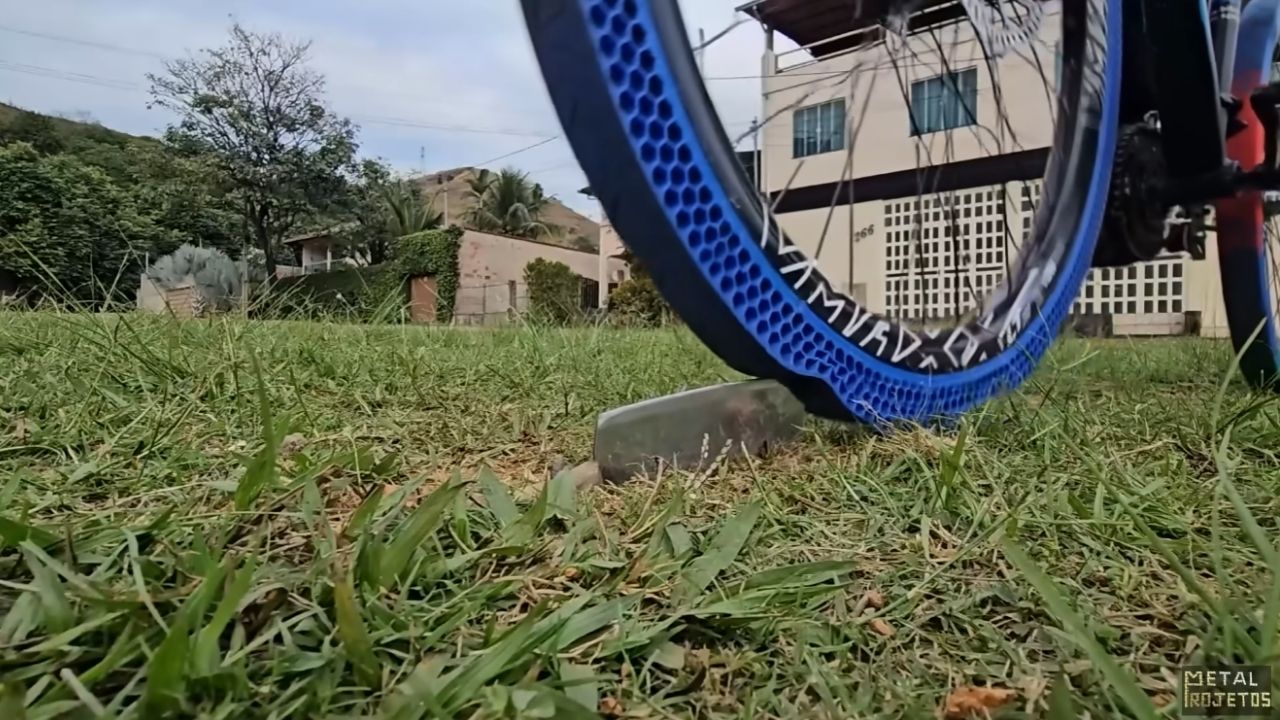
In one of the evaluations, the bicycles passed over a knife positioned against the surface. The blade left only small marks on the printed pieces, while it caused a significant tear in a conventional tire with a tube.
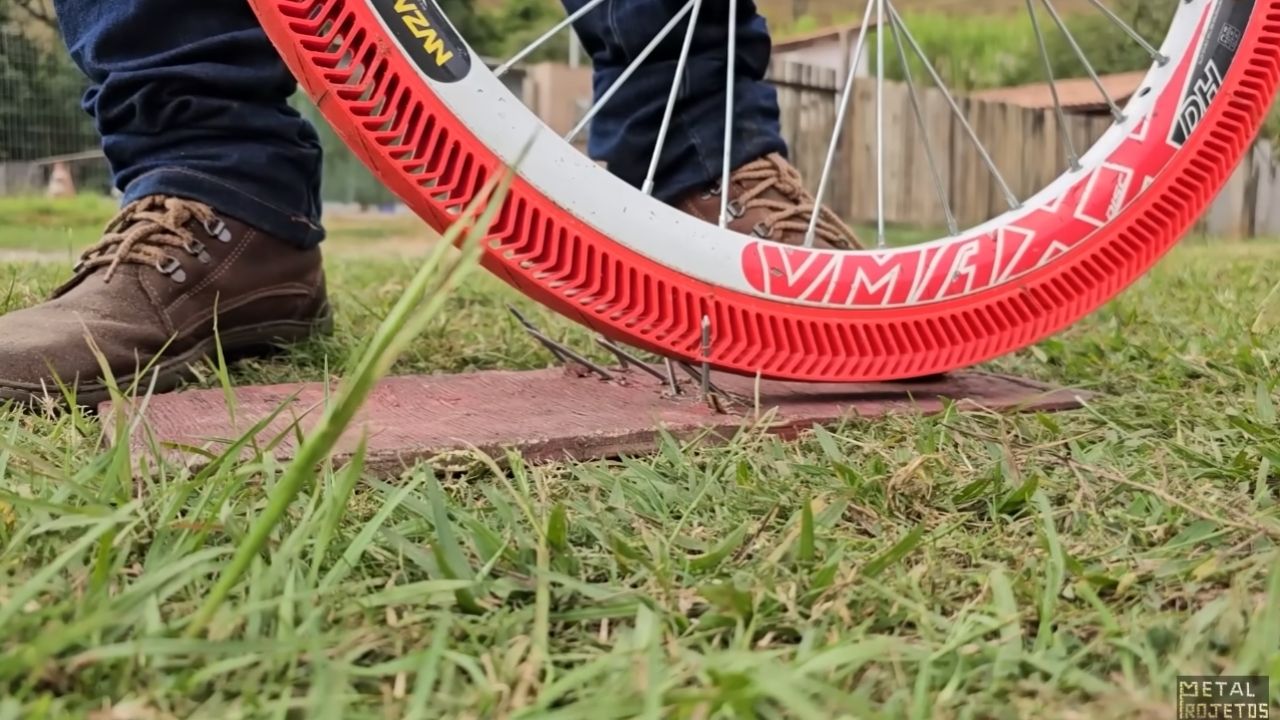
Nails of different sizes were also spread over boards. Some bent or were pressed against the wood. Since airless bicycle tires have no tube or internal pressure, superficial punctures did not cause immediate loss of function.
Braking caused little visible wear
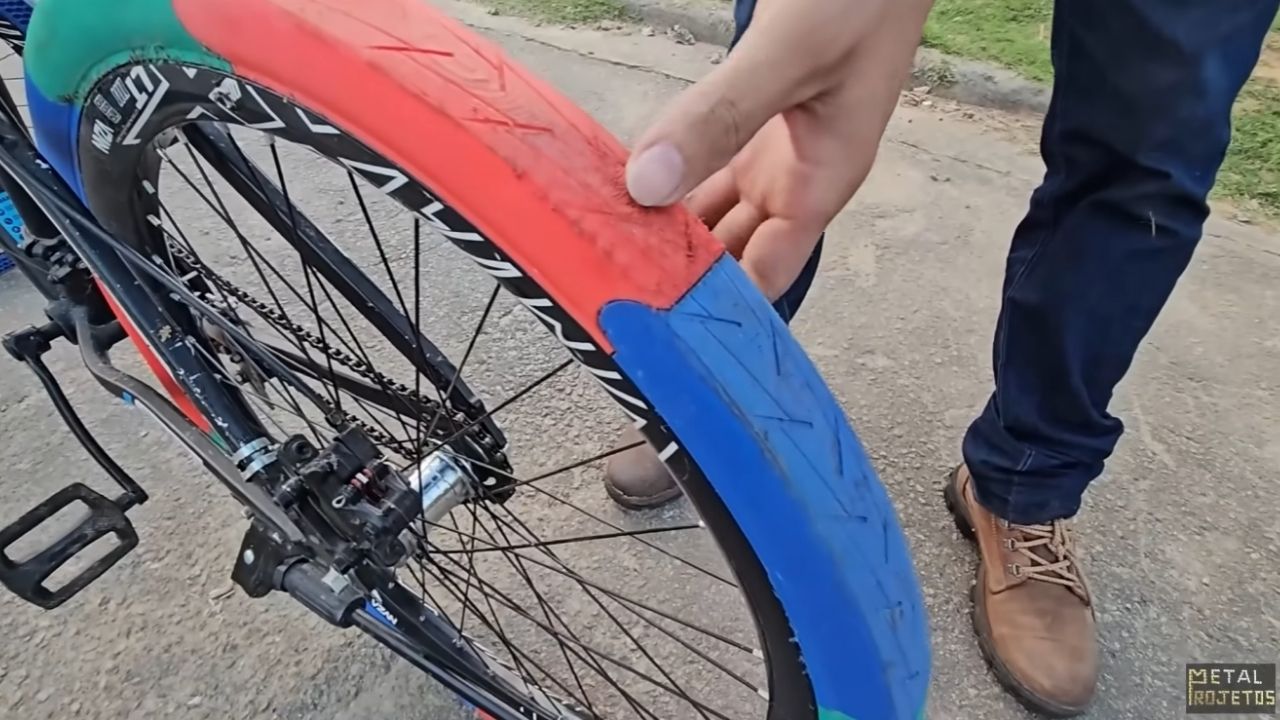
The team performed hard braking to check if the TPU would be torn off or leave colored fragments on the asphalt. The tires showed small marks and a slight odor of heated material.
Despite the friction, few parts were removed. The ground left marks on the TPU, but the material hardly transferred its colors to the pavement, contrary to the expectation of rapid wear during skidding.
Cylindrical model showed the main rupture
After approximately a day and a half of running, the cylindrical prototype began to fail. A joint came loose and nearby parts started to suffer repeated impacts during rotation.
The team considered two possibilities: initial failure in the joint or fragility caused by the temperature used in its printing. The tire was patched and managed to participate in the remaining stages, but ended up as the least reliable structure of the set.
Drop test measured the bouncing ability
The models were dropped from a height of 70 centimeters to compare elastic recovery. The tire with circles and the honeycomb model reached approximately 14 centimeters after impact.
The solid one reached 19 centimeters, and the arrow design reached 23 centimeters. A conventional inflated tire reached 51 centimeters. The result confirmed that the prototypes absorbed energy but still returned less bounce than a pneumatic structure.
Arrow design offered the best balance
During modeling, the arrow shape initially showed uneven thicknesses, causing the piece to move back and forth when compressed. The pillars were standardized so that both sides deformed at the same time.
In the final evaluation, this model was considered the most comfortable and efficient. The diagonal geometry functioned similarly to a spring, allowing for progressive deformation and better cushioning than designs with many straight walls.
Honeycomb structure also showed potential
The honeycomb tire absorbed impacts, but its straight partitions limited some of the deformation. According to the analysis conducted during the project, only the diagonal regions worked intensively when weight was applied.
The outer layer also became thicker than necessary. The prototype worked, but it gave the cyclist the sensation of a rigid cover touching the ground, even with the interior flexing.
Softer material could change the outcome
The tires were made with 95 hardness TPU. The team assessed that a more flexible filament could especially improve the solid model, bringing its response closer to that observed in conventional tires.
Changing the hardness, however, would also alter stability, wear, and weight-bearing capacity. Each geometry would need to be recalibrated, because an efficient design with a certain material might become excessively soft with another.
Project took more than two months
Each segment required between 14 and 19 hours of printing, as reported in the video. Since several tests needed to be redone, many stages consumed an entire day before the team could evaluate the result.
Adding up modeling, manufacturing, assembly, and corrections, the development exceeded two months. The timeline shows that printing a piece does not end the work: achieving fit, comfort, and resistance requires successive revisions.
Prototypes withstand but still require evolution


The airless bicycle tires demonstrated resistance against sharp objects and continued functioning after tests on different surfaces. The experiment showed that 3D printing allows exploring geometries difficult to manufacture by conventional methods.
The results, however, do not prove durability for prolonged use, varied loads, or commercial circulation. Standardized tests for fatigue, grip, wear, temperature, and safety would still be necessary before replacing traditional tires.
Arrow model ended the race in front
Among the four main solutions, the arrow design presented the most convincing combination of flexibility, cushioning, and resistance. The geometry better distributed the deformation and remained functional after the tests aimed at damaging the prototypes.
The project turns a simple question — why do tires still get punctured? — into a practical experiment in engineering and digital manufacturing. Would you use 3D printed tires that don’t deflate or would you still trust conventional rubber with an inner tube more? Leave your opinion in the comments.


